
Where the time goes
Buyers often think of production as a single block of days. In practice a first order spends most of its calendar in the stages before the line starts: tooling, parts qualification and certification. Once parts are approved and flowing, final assembly is quick. The reference lead times the desk uses are 30-45 days for a stock model batch, 35-50 days for private label and 60-120 days for a first ODM order including certification, each confirmed in writing for each program; see MOQ and lead time.
The stages below describe a typical cordless or corded household line at a partner plant. Commercial and industrial machines follow the same logic with heavier fabrication, and a robot adds sensor and firmware loading.
The eight stages
- Tooling. For an ODM housing, steel moulds are designed, cut and tried out. This is the longest single item and the reason ODM carries a tooling cost. Stock models use existing moulds.
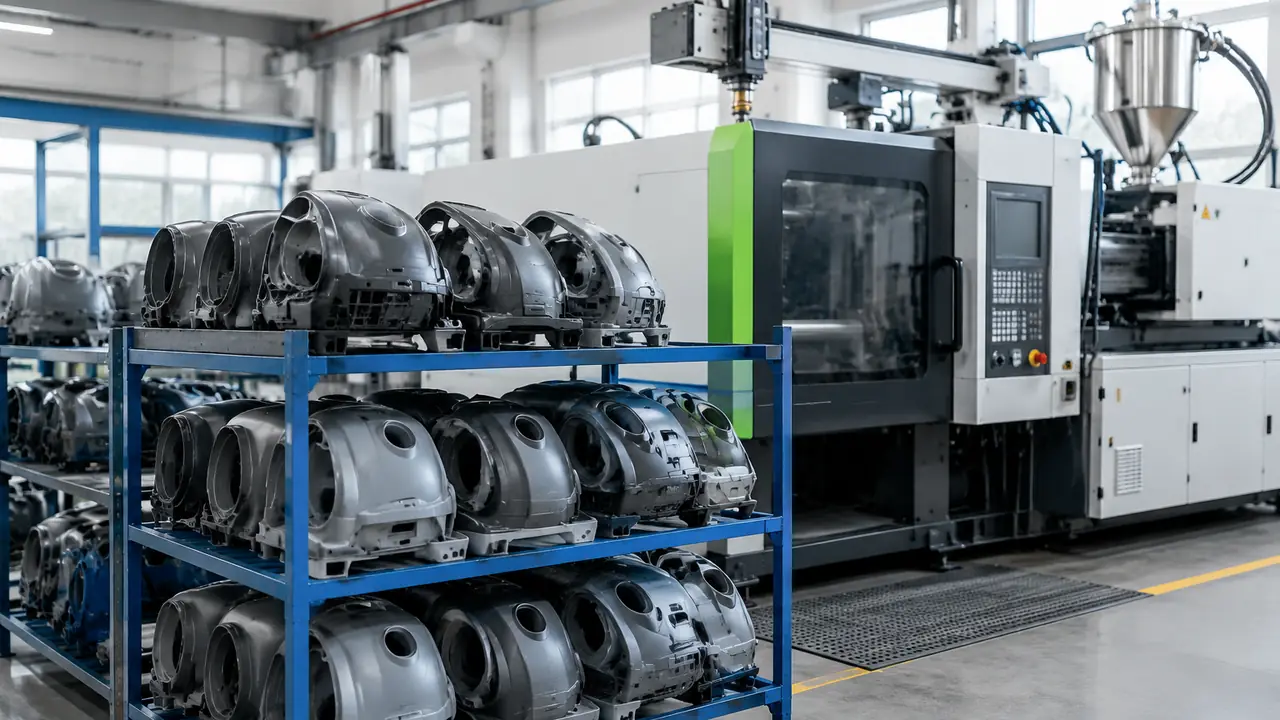
- Moulding. Housings, bins, wands and brush heads are injection-moulded in ABS, PP or PC blends, then trimmed, sprayed or pad-printed.
- Motor and PCB sourcing. Motors, controllers and boards arrive from specialist suppliers or the plant's own motor shop. Incoming inspection samples each lot.
- Battery pack assembly. Cells are matched, welded to nickel strips, fitted with a BMS and a fuse and sealed in the casing. Packs are charged and discharged before they reach the line.
- Sub-assembly. Motor head, cyclone, brush head and dock are built as modules and tested alone where possible.
- Final assembly. Modules, filters, cords or packs and labels are joined on the line using torque-controlled tools, with lot labels applied.
- Routine tests and run-in. Every unit goes through a hi-pot test, ground-continuity check and a function run, as the plant's safety routine requires. Many plants add a short aging run to catch early motor or switch faults.
- Packing. Accessories, manual and unit are placed in the colour box and outer carton, labelled and palletised; see packaging.
Stage checkpoints
| Stage | Typical checkpoint | Record kept |
|---|---|---|
| Tooling | First-shot sample against drawing; fit and seal check | Tooling sign-off sheet |
| Moulding | Dimension, flash, colour match, drop check on sampled parts | First-article report |
| Motor and PCB | Incoming speed, current and insulation sampling | Incoming inspection log |
| Battery pack | Cell matching, weld pull, BMS function, capacity | Pack batch record |
| Sub-assembly | Module function and airflow path leak check | Station sheet |
| Final assembly | Torque, label, filter seating, brush spin | Lot label and line log |
| Routine tests | Hi-pot, ground continuity, function run on every unit | Test log by serial or lot |
| Packing | Contents, manual, label, carton drop on sample | Packing list and photos |
The routine safety tests
Safety routine tests are different from type tests. A type test is run once on a sample in a laboratory to show a design meets the standard, for example IEC/EN 60335-2-2. A routine test is run on every unit on the line to show that this unit was built like the tested one. The hi-pot test applies a high voltage between live parts and accessible metal to confirm the insulation holds; the ground-continuity test confirms that protective earth is intact on class I mains products; the function test confirms the motor, switch and, for cordless lines, charging work. Test voltages and times come from the standard and the plant's procedure, and are listed on the quality plan. More on the methods is on the testing and inspection page.
Where the buyer can intervene
The earliest and least costly moment to change anything is at tooling and sample approval. Colour, logo position, filter seat and accessory set are all fixed there, along with the packing method and the label content for the target market. A buyer who wants a second colour, a different charger or a changed manual should say so before the golden sample is signed, because each of these touches a different supplier and a different lead time. After mass production starts, changes mean a new approval round and often new parts. The desk therefore asks buyers to sign a golden sample and a specification sheet before the batch order, and keeps the sample as the reference for inspection. The plant side of this is checked in the factory audit.
For a program estimate, send the line, the volume and the target market through the quote form.