
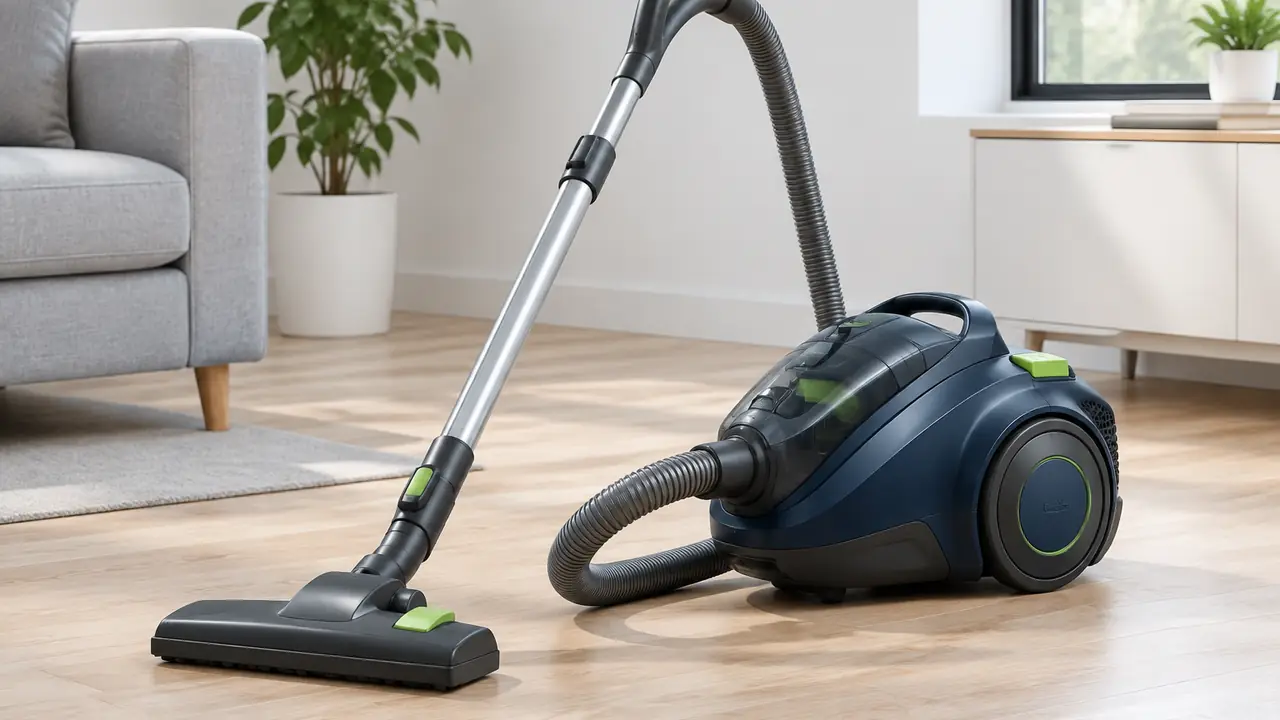
What a canister vacuum is
A canister vacuum separates the cleaning head from the motor body. The user pulls a wheeled body behind a hose and wand, and swaps floor heads for hard floor, carpet or upholstery. Because the heavy parts are on the floor, the part in the hand is light, which suits stairs, ceilings and furniture, and the body can hold a larger motor and dust bag than a stick. The design is the mainstream choice in Europe and in markets where hard floors dominate, and it sits at the quieter end of the household range when it is well made.
Corded canisters come mostly from Zhejiang and Guangdong plants that already build motors and moulded parts for the mains category; see the clusters. For brands, the design leaves a lot of room for differentiation: floor heads, a bag system with a premium filter, a quiet-motor package or a compact body for small apartments.
The six parts on the card
| Part | What decides performance | Typical options |
|---|---|---|
| 1 Body shell | Stability, wheel design, cord rewind, storage | ABS or PP; rotating front wheels; cord rewind button; parking slot |
| 2 Motor | Efficiency, noise, thermal protection, lifetime | Mains motor; EU models under 900 W; variable speed on the body or handle |
| 3 Dust bag | Layers, filtration, volume, fit | Multi-layer non-woven bag in the 2-4 L range, or a bagless cyclone canister |
| 4 Hose | Flexibility, kink resistance, cuff connection | EVA or PVC; swivel handle; telescopic aluminium or steel wand |
| 5 Filter | Motor protection and exhaust grade | Foam or paper motor filter; exhaust filter, HEPA H12-H13 optional |
| 6 Floor head | Seal, glide, brush type | Parquet head with soft bristles, carpet head, switchable combo head |
Figures are typical across the category, per model datasheet. The hose and attachments page lists the tool options in more detail, and the dust bag and bin page covers bag collars and materials.
Bagged or bagless
Bagged canisters remain popular in Europe because the bag holds the dust in a closed unit and the filtration is easy to specify: a multi-layer bag, a motor filter and an exhaust filter. Bagless canisters use a cyclone or a bin with filters; they remove the running cost of bags but need washing. The right answer follows the market: retailers should check which bag and filter replacement SKUs they will carry before choosing. The cost and hygiene trade-offs are in bagged vs bagless vacuums.
Ecodesign and noise for the EU
A mains-operated canister on the EU market falls under ecodesign Regulation (EU) 666/2013: rated power below 900 W, annual energy below 43 kWh, motor life of at least 500 hours, plus dust pick-up and emission limits. The 665/2013 label regulation was annulled in 2018, so there is no mandatory energy label, but some brands print a noise figure measured to IEC 60704-2-1. Canister buyers tend to ask about noise more than any other mains line, so request the dB(A) figure from the model's test report and check how it was measured. See noise levels guide and EU ecodesign 666/2013.
Where the canister fits in a range
In a retail range the canister is usually the quiet, hard-floor and stairs option, positioned beside an upright or a cordless stick rather than against them. It suits buyers who want a larger dust capacity than a stick offers without a heavy head to push, and homes with a mix of parquet, tile and rugs. Because the body is separate from the head, a brand can sell the same body with two or three floor head kits and use that to build good, better and best tiers without tooling three bodies. Send the target market and tier plan through the quote form so the desk can match a platform. The other lines are collected on the household vacuum hub.
Options worth specifying
- Floor heads. A hard-floor head with soft bristles is the minimum; a powered head adds a motor and a connector to qualify.
- Accessory storage. On-board clips for the crevice tool and dusting brush.
- Bag system. Proprietary bag with a collar, or a universal bag; this sets the spare-part strategy.
- Appearance. Colour and finish, label design and carton; see OEM and private label.
Inspection before shipment
- Input power and airflow against the model's own test report on sampled units.
- Hi-pot and earth-continuity on every unit, as the plant's safety routine requires.
- Noise at one metre against the approved sample.
- Hose pull and kink test, wand release, floor-head swivel and bag seating.
- Cord rewind cycles, label and manual check, and carton drop test.
The plan is agreed per program; see quality control, MOQ and lead time and the quote form.