
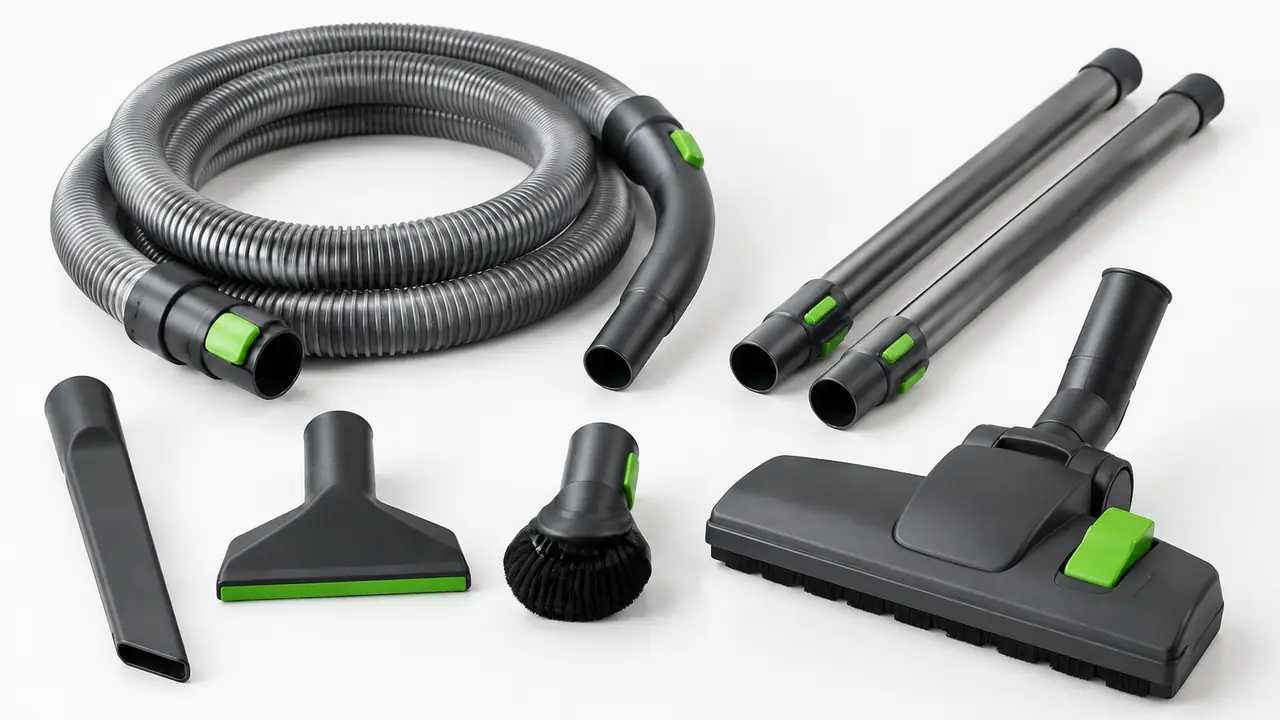
What these parts do
A hose carries air from the tool to the machine; a wand lengthens the reach; the attachments shape the airflow for the surface. They contain no motor and are simple to describe, which is also why many problems with them go unnoticed until returns arrive. A hose that kinks, a cuff that slips, a crevice tool that is a few millimetres too wide or a wand that will not click into the head each produce a one-star review. The principles are in hoses and wands, and the right kit depends on the machine: a canister with a floor head, a handheld with a crevice tool, a car vacuum with a long hose.
Hose materials
| Material | Properties | Typical use |
|---|---|---|
| EVA | Flexible, light, good kink recovery, soft feel; usually lower odour | Household canister and premium machines |
| PVC | Durable, low cost, a little stiffer; plasticiser content needs RoHS and REACH control | Value canister, wet-dry and commercial machines |
| Reinforced or anti-static | Wire or spiral reinforcement; conductive path where required | Workshop and dust-extractor use |
Bore, wall thickness and corrugation pitch decide flexibility and airflow loss. A narrower bore concentrates the airflow at the tool but costs more resistance over distance, and the usual household range is a 32-38 mm bore. Ask the plant for bend, pull and crush tests on a sample.
The six parts on the card
- Hose. Length, bore and wall; EVA for feel, PVC for cost and toughness.
- Cuff. The moulded end fitting. It is the usual weak point; check the push-fit force and the lock.
- Wand. Aluminium is light and common; steel is stiffer; plastic is the lowest-cost option. Telescopic wands add a joint that needs a cycle test.
- Crevice tool. Flat nozzle for gaps and edges; the shorter and narrower the nozzle, the higher the air speed at the tip.
- Upholstery tool. Wide nozzle with a fabric strip or brush; a mini motorised tool is a premium option.
- Floor nozzle. Carpet and hard-floor positions, wheels, bristle strip; the part that drives most noise and wear.
Fit standards and compatibility
There is no single worldwide fit. Machines use push-fit, bayonet or snap cuffs in several diameters, and a tool made for one platform may be a loose fit on another. A reliable specification gives the outer and inner diameters at the cuff with tolerances, the taper angle, the locking feature and the pull-off force. For a brand that sells accessories as an add-on, the usual solution is a model list printed on the pack and a drawing signed with the plant. Where a motorised tool is included, the electrical connector and the supply voltage must be documented too, and the tool follows the machine's safety standard.
Kits and merchandising
Accessory kits help sell machines because they are visible in a listing. A two-tool kit (crevice and upholstery) is the entry level; four to six tools with a hose and a storage bag suit car and handheld lines; pet kits add a motorised tool or a groom brush. Matching colours and printed logos are tooled per program. The bundle ideas article lists kits that sell in retail. Packaging should hold the tools in place and show each name, since customers search for a tool by name.
Quality points that cause returns
Most complaints about this line trace back to four points. Odour: new PVC and some EVA grades smell when opened, so ask for an odour check on the sample and a ventilated packing method. Colour: tools moulded in different batches can differ in shade, which shows on a shelf, so agree a master colour sample and tolerance. Burrs and flash on the nozzle edge scratch furniture and floors, and a final trim or deburr step should be in the plant routine. Finally, strength at the cuff: a pull-off test at the stated force on sampled hoses prevents the typical failure where the cuff separates from the hose in the first months of use. These checks go in the written inspection plan before the first batch, and the same plan is used for later spare-part runs.
Sourcing flow
- Send the machine model, the existing hose and tools or a drawing, and the kit list.
- The desk asks partner plants for samples and checks for bend, pull and crush behaviour.
- Fit-check every item on the real machine and sign the drawing.
- Agree material declarations for RoHS and REACH and the odour level of the hose.
- Confirm packaging, labels and batch codes, then release the order.
Hoses and tools are counted in thousands per variant; see MOQ and lead time. Send your list through the quote form. The parts are used across the canister, wet and dry and car vacuum lines.