
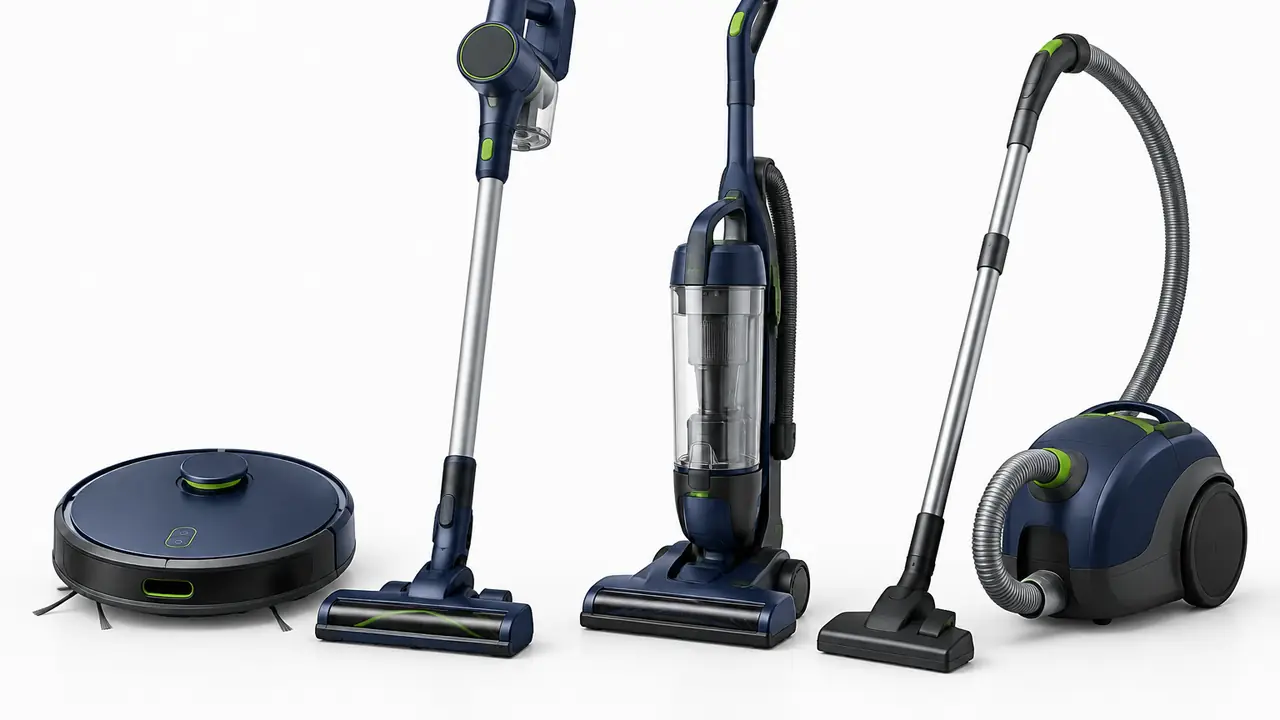
Where canisters sell
The canister is the default corded household machine across much of Europe, and it holds a niche in North America for hard floors, stairs and cars. Its attraction is practical: the heavy parts stay on the floor, the hose and wand are light in the hand, and the body can hold a large bag and a generous filter stack without making the cleaning tool heavy. The same layout makes it quiet, because the motor sits in a housing that can be insulated. The corded lines come largely from Zhejiang, with plants around Cixi supplying bodies, bag systems and cords. For market context, read upright vs canister vacuums.
Bagged or bagless: decide by market and by spare parts
Bagged canisters pass dust into a replaceable bag that forms a first filter, which keeps the motor clean and makes emptying a closed action. Bagless canisters separate dust with a cyclone or filter bin and are emptied by the user, which saves on consumables but exposes the user to dust at emptying time and needs a washable filter to be maintained. Many European buyers still prefer bagged for hygiene reasons and for lower long-term maintenance; North American buyers often prefer bagless for the absence of a recurring cost. In both cases, the part is a product in itself: dust bags and bins sets out materials such as non-woven and paper, and bagged vs bagless compares cost and filtration.
If you choose bagged, make the bag a registered part number. A universal-fit bag is convenient for the user, but a bag that fits only your body gives you a repeat-sales line. Write the bag format, the collar design and the minimum order for bags into the purchase agreement.
The parts to specify
| Part | Typical options | Points to settle |
|---|---|---|
| Body shell | ABS or PP, wheel set, bumper, cord reel | Stability on stairs, wheel noise, parking position |
| Motor | Universal brushed motor, power set by the market | Rated input, noise, rated life |
| Bag or bin | Non-woven bag, paper bag or cyclone bin | Capacity, fill indicator, bag part number |
| Hose | EVA or PVC, with swivel and handle controls | Flex life, length, suction control |
| Filters | Motor protection filter, exhaust filter, HEPA H11-H13 option | Seals, washable parts, EN 1822 grade |
| Floor head | Combination head, parquet head, powered turbo head | Surface fit, brush wear, headroom |
Hose and wand material is a durability item: the hose connection at the handle and at the body flexes thousands of times in a product life, and plants differ in how they reinforce it. Options are listed under hoses and attachments. A telescopic aluminium wand feels premium but adds weight and cost compared with a plastic wand; specify it by the retail price band.
Noise and power: the numbers that sell in Europe
Noise declarations and rated power are often on the front of the carton in the EU. Noise is measured to IEC 60704-2-1 and quoted in dB(A) per model datasheet, with household canisters falling in a range of about 65-80 dB(A) across the category, and quieter models at the lower end through insulation and a motor and fan designed for lower speed. Rated input power matters to the law as well as to the buyer. Under ecodesign regulation 666/2013, a mains-operated household vacuum must stay below 900 W rated input, below 43 kWh annual energy use under the test method and carry a motor rated for at least 500 hours. A brand that has a 1,200 W body in its catalogue cannot sell it as a household vacuum in the EU. The 665/2013 energy label was annulled in 2018. See noise levels guide and energy efficiency and ErP rules.
Floor heads and the accessory set
A canister is judged by its floor head as much as its body, because the head is the part the user watches. A combination head with a slide or a pedal switch between carpet and hard floor is the baseline; a parquet head with soft bristles protects delicate surfaces; a powered turbo head with its own small motor or an air-driven turbine gives carpet agitation that a passive head lacks. Each added head raises the cost, the carton size and the number of spare parts to hold. Decide the set by price band: a basic range may ship with a combination head, a crevice tool and a brush, while an upper range adds the parquet head, a mattress tool and a telescopic wand.
Storage on the body is a small detail that shapes user opinion. Clips for the tools, a park position for the wand during a pause and a handle that is comfortable when the body is carried on stairs all appear in reviews. Ask the plant for photographs of these features on the actual sample, since a drawing often shows a better arrangement than the shipped part provides. Because each tool is also a spare part, agree with the plant a spares list that covers the floor heads, the hose and the bag, and keep the part numbers in your catalogue.
Certification and customs
The safety route is IEC/EN 60335-2-2 with IEC 60335-1, with CE covering LVD, EMC and RoHS and REACH for substances; North America uses UL 1017 or an ETL listing. Third-party CE reporting typically takes about 2-4 weeks and UL or ETL about 4-8 weeks, confirmed per program. Customs classification is commonly 8508.11 for machines up to 1,500 W with a bag or container up to 20 L and 8508.19 for other household machines; your broker confirms the code. See certifications guide.
MOQ and what to ask a plant
As a reference range, existing-mould canisters start at about 200-500 pieces per model, branded versions at about 500-1,000 and new tooling at about 1,000-3,000 plus tooling, confirmed in writing for each program. Stock samples take 7-15 working days and branded samples 15-25 days. Bulk lead times are 30-45 days for stock and 35-50 for branded bodies, per MOQ and lead time.
- Ask for the rated input power, the rated motor life and the noise report, in that order.
- Ask for the bag or bin capacity and the fill indicator behaviour.
- Ask for hose flex-life test results at the handle and at the body.
- Ask which floor heads are included and which can be sold as accessories.
- Ask how the cord retracts and how many cycles the reel has been tested for.
Send quantities and market targets through the quote form so the desk can match plants that already hold the relevant EU or UL reports.