
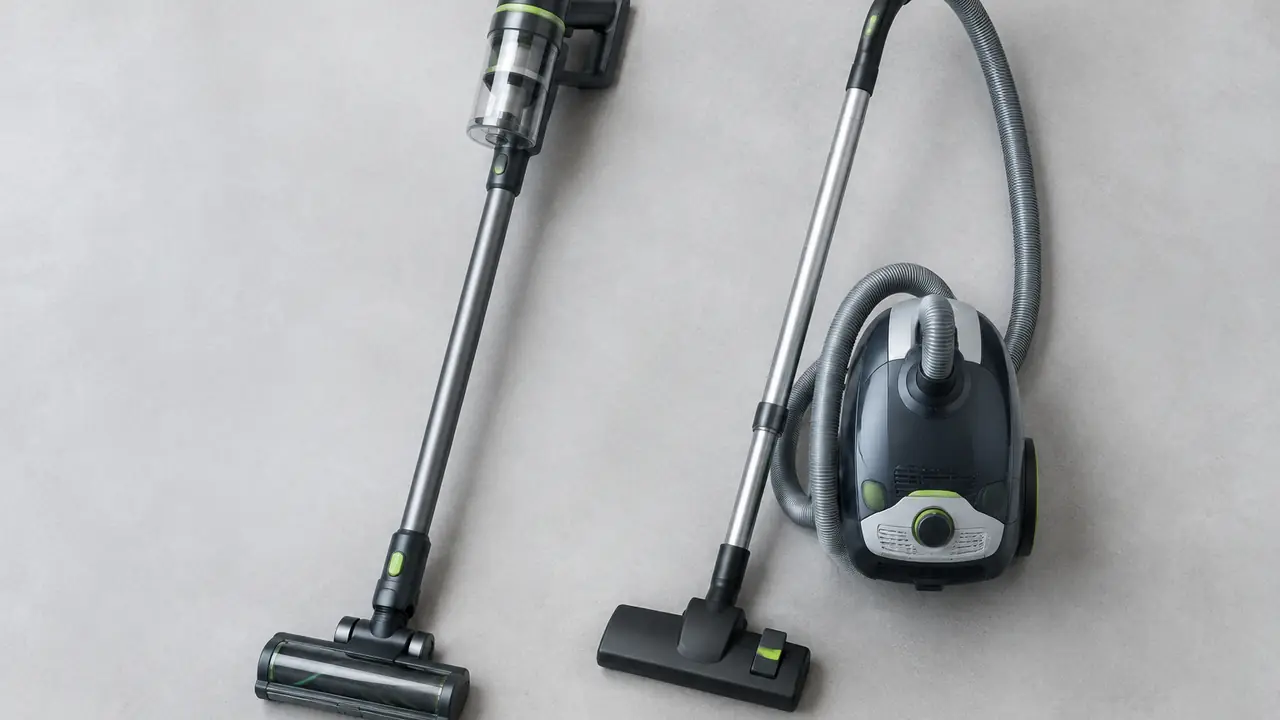
What the choice really changes
For an end user, bagged versus bagless is a question of habit. For a buyer, it changes the moulds, the consumables, the filter stack, the carton contents and the shape of the after-sales business. A bagged model needs a bag collar, a bag holder and a bag supply chain; a bagless model needs cyclone mouldings, a bin with a seal and a filter that the owner will clean. Neither is inherently cheaper or cleaner. What decides the outcome is the market, the user and the quality of the filter and sealing design around the separator.
Side by side
| Factor | Bagged | Bagless |
|---|---|---|
| Performance | Airflow falls gradually as the bag loads, but fine dust capture improves as pores fill | Airflow holds well until the bin is full or the filter clogs; cyclone design sets fine-dust separation |
| Cost drivers | Bag layers, collar, holder, bag packaging; consumable revenue for the brand | Cyclone and bin mouldings, seals, washable or replaceable filters; lower running cost for the owner |
| Hygiene at emptying | Lift out and discard the sealed bag; limited contact with dust | Tip the bin into a container; dust cloud possible; filter cleaning needed |
| Filtration route | Bag, motor filter, optional exhaust filter graded under EN 1822 | Cyclone, pre-filter, pleated or HEPA-class filter graded under EN 1822 |
| MOQ reference | Public-mould about 200-500 per model; bags bought as purchased components, often by the thousand | Public-mould about 200-500 per model; ODM about 1,000-3,000 plus tooling for new cyclone moulds |
| Fits which buyer | European retail chains, hospitality and cleaning services, buyers who value clean changeover | E-commerce sellers, brands in North America and Asia, buyers who want no consumable bag |
Ranges are typical across the category and confirmed per model datasheet. MOQ and lead-time references come from MOQ and lead time and are confirmed in writing for each program.
Cost: what moves and what does not
The unit cost difference between a bagged and a bagless model of the same format is small compared with the difference between a plain and a premium filter stack or between a basic and a brushless motor. The structural cost differences are these. A bagless model carries more injection moulding, because the cyclone, the bin, the lid and their seals are separate parts, and a premium multi-cyclone cluster adds more. A bagged model carries a purchased component, the bag, which has its own supply chain and quality control. The running cost sits with the owner: bags are repeat purchases, filters are rinsed or replaced less often. For the brand, bags and filters are the two usual repeat items, so the choice shapes the revenue after the first sale. Public-mould platforms come in both forms, so no mould cost is added for a branded run; a new cyclone design in an ODM project adds tooling and trial time.
Hygiene and filtration in practice
Hygiene is mostly about what the user touches. A sealed bag that is lifted out and thrown away lets the user avoid dust, which is why hotels and cleaning contractors lean towards bags. A bin that is tipped over a container can release fine dust, and a filter that is rinsed must dry fully before use, otherwise odour and weak suction follow. Filtration is a separate matter from the separator. A bag with a fine meltblown layer and a sealed collar can capture very fine dust; a cyclone with a well-sealed H13 filter does so too, where H13 under EN 1822 captures at least 99.95% at the most penetrating particle size. Whichever system is chosen, the whole path from the inlet to the exhaust must be sealed, since air that bypasses the filter is not filtered at all. Ask for the grade by name, never by description. The filtration grades guide sets out the grades and the vacuum filter and HEPA page lists filter options.
Where each wins
Bagged wins in markets and channels where tidy changeover and consistent suction matter: European canisters, backpack and commercial machines, central systems and any machine used by staff rather than owners. Bagless wins where the owner pays for running costs and expects to see the dirt: cordless sticks, handhelds, robots and most North American uprights. The two can also be combined, a cyclone for the bulk with a bag for the fine fraction, which some commercial machines use. The dust-capacity question is separate: a larger bin or bag means fewer interruptions but more weight, a trade-off especially visible on cordless sticks.
Spare parts and returns
Returns on both systems tend to come from the same few causes, and a buyer can plan for them. On bagged models the common complaint is a bag that does not fit or is out of stock, so the bag part number, the supply plan and a starter pack in the carton belong in the agreement. On bagless models the complaints are a clogged filter mistaken for a weak motor, a bin that does not seal after a drop, and odour from a filter put back damp. A clear manual with cleaning intervals, a washable-filter drying note and a spare filter in the box reduces these. Both systems benefit from a see-through window or indicator so the owner knows when to empty or change, which cuts the false no-suction returns that otherwise dominate the service desk.
Compliance has no preference
Standards do not favour one system. A corded model is tested to IEC/EN 60335-2-2 and in the EU falls under ecodesign regulation 666/2013 whether it has a bag or a bin; North America uses UL 1017. Cordless models add UN 38.3 and IEC 62133-2 or UL 2054. Dust pick-up and capture tests are run to the IEC 62885 series, and results should be requested in the same condition for both systems, at an empty and a loaded state, so that the comparison is fair. The certifications guide shows what applies in each market, and partner documents are verified per project.
What to specify
- Separator type, capacity in litres and fill indication.
- For bagged: bag layers, collar design, number of bags in the carton and bag supply plan.
- For bagless: cyclone type, bin sealing, hair handling and filter cleaning instructions.
- Filter stack with EN 1822 grade where HEPA-class filtration is claimed.
- Test condition for suction and capture: empty, half loaded and full.
Tell the desk the market, the user and the quantity through the quote form, and it will shortlist partner plants with the right platform. For the machine-level view, see HEPA vs standard filter vacuums.