
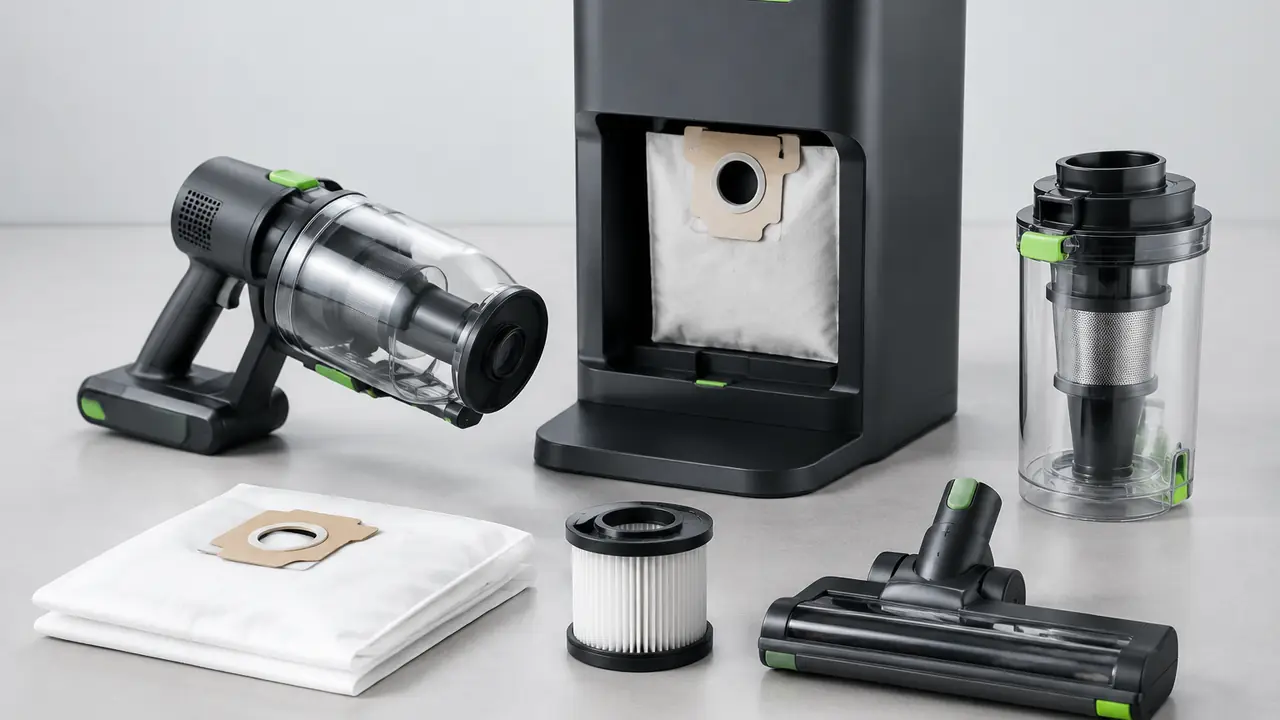
Bag, bin or dock
A vacuum can hold dust in three ways. A bag filters and stores dust in a replaceable consumable; a cyclone bin separates dust from the air by spin and stores it in a cup that the user empties; a dock bag stores what a robot or stick machine unloads at a charging station. Bagged machines are still the norm in European canisters because they keep the dust enclosed. Bagless machines dominate North American uprights and nearly all cordless sticks. See bagged versus bagless for the trade-offs, and dust capacity and emptying for how volume is read.
For a brand that sells machines, bags are the recurring part: each canister sold becomes a bag customer, so the right pack size and a stable supply matter more than margin on any single bag.
Bag materials
| Material | Properties | Typical use |
|---|---|---|
| Paper | Low cost, adequate filtration, tears when wet or when sharp debris enters | Entry canister and commercial machines |
| Nonwoven, 2-3 layers | Stronger, higher dust holding, better airflow over time | Mid-range canisters and uprights |
| Nonwoven, 4-5 layers with fine layer | Highest capture and dust capacity; stays open as it fills | Premium canisters and fine-dust use |
| Dock bag | Nonwoven with a valve flap for the station inlet | Robot and stick dock stations |
The layer count and the bag area decide how fast airflow falls as the bag fills. A bag with a self-closing collar flap keeps dust in during removal, which many buyers notice first. Where a filtration grade is stated for the bag media, the grade report must cover that media, not just the filter in the machine.
The six parts on the card
- Dust bag. Volume, layers, seams and the shape that matches the housing. Welded seams hold better than glued ones.
- Collar. The cardboard or plastic ring that fits the inlet. It must seal against the housing; check the hole position and the flap.
- Cyclone bin. Clear PC or ABS cup with a cyclone insert and mesh. Wall thickness and clarity decide drop strength and appearance.
- Lid and seal. The seal stops dust leaking at the lid; foam seals compress with age and should be tested.
- Dock bag. Bigger bag with a valve flap; fit to the dock inlet is critical.
- Latch. Spring or slide mechanism; a weak latch is the usual failure on bins and should be cycle-tested.
Fit and the compatible-bag trade
Bags for a given model are sold both by the machine brand and by compatible makers. A compatible bag must match the collar hole position and diameter, the bag volume and the inlet geometry within a small tolerance, or the bag will not seal. Brands entering the replacement bag trade should note that fit is the whole product: a loose collar causes dust leaks that the customer blames on the machine. The usual solution is a drawing signed with the plant, a sample test on the original machine and a model list on the pack. Packs of 3-5 bags with a spare filter are a common retail format, and a blank carton with a printed insert is the economical start.
Hygiene, emptying and filter life
How dust is removed shapes the user experience as much as how it is captured. A bag is removed with the dirt sealed inside, which keeps dust away from the user. A bin is emptied by hand into a waste container and sheds dust in the process unless the bottom flap is well designed. Bins also need washing and drying, and the mesh and cyclone insert should come out without tools. Dock bags suit users who want to empty rarely. A full bag or bin raises resistance and lowers airflow, so the manual should say when to change or empty; a fill-level mark on the bin and a spare pack in the carton cut service calls. Filters downstream of the bag or bin last longer when the container is changed on time, which is why many programs sell bags and filters together as one service kit.
Sourcing flow
- Send the machine model, the original bag or bin, and the target pack size.
- The desk asks partner plants for a die-cut sample, a media description and a fit test.
- Check seal, airflow with a loaded bag and tear strength on the real machine.
- For bins, test the latch cycles, the drop and the lid seal; approve the drawing.
- Agree batch checks and packaging, then release the order.
Bags and bins are counted in thousands per variant; see MOQ and lead time. Send the model list through the quote form. The parts feed the canister and upright lines and sit next to the filters in most spare-part ranges.