
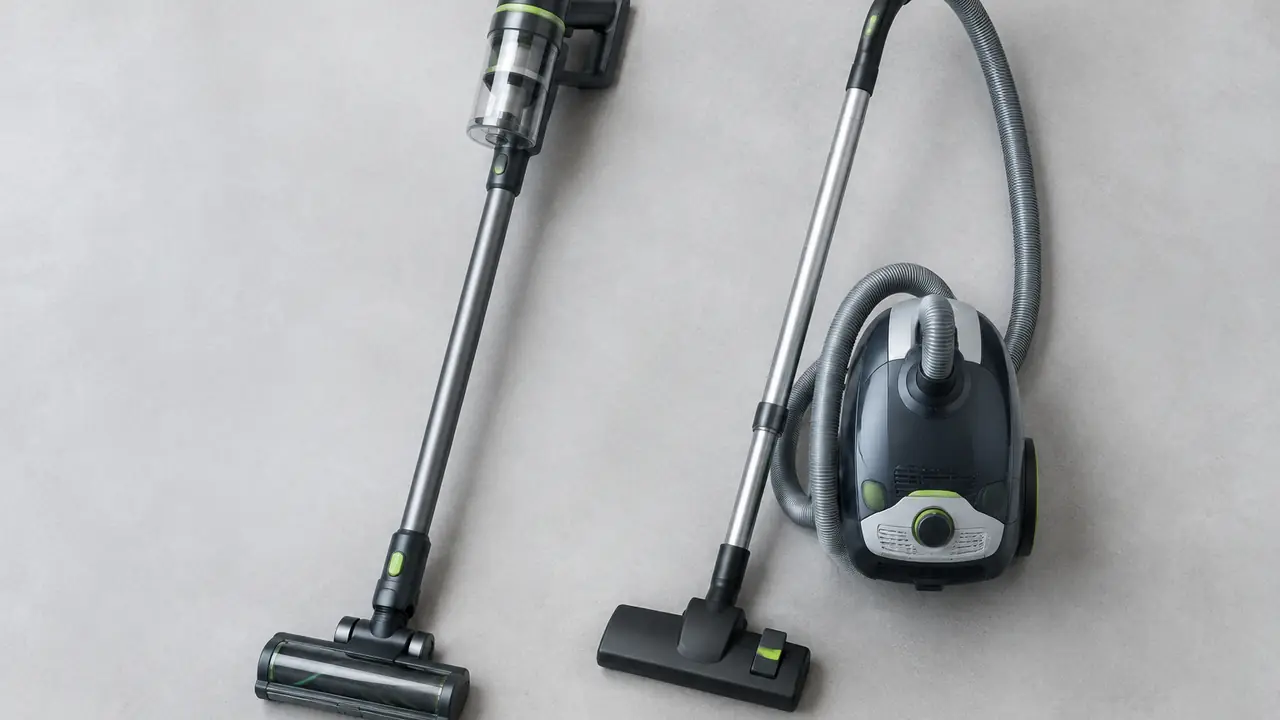
Same power source, different logic
Both formats plug into the wall, so both follow IEC/EN 60335-2-2 and, for mains household models in the EU, ecodesign regulation 666/2013. The difference is the layout. An upright puts the motor, the dust container and the handle on top of a wide brush head, so the whole machine is pushed across the floor and the brush roll is driven by its own motor or a belt. A canister keeps the motor and the dust bag in a body that rolls behind the user, connected to a floor head by a hose and a wand. The upright concentrates weight on the floor tool; the canister separates it, which makes the cleaning end lighter and the reach longer.
Side by side
| Factor | Upright | Canister |
|---|---|---|
| Performance profile | Strong on carpet thanks to the driven brush roll and wide head; airflow tuned to the head | Strong on mixed floors and stairs; hose gives reach; powered head optional |
| Cost drivers | Brush motor or belt drive, large base housing, bin and cyclone mouldings, handle assembly | Body shell and wheels, bag collar and bag, hose and wand set, floor head, filters |
| Noise | Brush head and motor close to the user's ear; per model datasheet | Motor in a body away from the user; quieter variants are common; noise method IEC 60704-2-1 |
| Certification route | IEC/EN 60335-2-2, CE LVD/EMC/RoHS, EU 666/2013, UL 1017 in North America | Same route; bag and filter details drive the technical file |
| MOQ reference | Public-mould about 200-500 per model; private label about 500-1,000; ODM about 1,000-3,000 plus tooling | Same bands |
| Fits which buyer | North American retail chains, carpet-heavy homes, value-led brands | European retail chains, hard-floor homes, buyers who want a quiet bagged range |
All figures are typical for the category and confirmed per model datasheet; timing references come from MOQ and lead time and are confirmed in writing for each program.
Where each wins by market
The two formats track regional habit more than any technical edge. North America has long favoured uprights for wall-to-wall carpet, with a bin and a cyclone rather than a bag, a driven brush roll and tools stored on board. Europe leans toward canisters on tile, laminate and wood, with a bag in the body, a quiet motor and a telescopic wand. A buyer entering a new market should look at what the main retail chains list in that region and match the format before arguing for something different. A corded range also carries a different regulatory load by region: the EU requires an EU 666/2013 technical file for mains household models, with a 900 W rated-power cap, a 43 kWh annual consumption limit and a minimum motor life of 500 hours, while North America asks for UL 1017 or an equivalent ETL listing from an accredited lab. The certifications guide lists the routes by market.
Where each wins by floor and use
An upright is the better answer for deep carpet because the brush roll agitates the pile at the point of suction, and because the whole machine is stable in the hand. A canister is the better answer for stairs, bare floors, under furniture and above-floor cleaning, because the user carries a light head and uses the hose for curtains, shelves and car interiors. A powered head on a canister closes some of the carpet gap, at the price of extra parts and a larger spare list. Many buyers cover both with two models: an upright for the carpet-heavy region and a canister for the other, using the same filter family where possible.
Bag, cyclone and filter choices
The format does not force the separator. Uprights are often bagless with a cyclone, and canisters are often bagged, but both exist the other way. Bags create a consumable business and a cleaner emptying experience; bins reduce running costs and show the fill level. Filtration is specified separately: foam pre-filter, pleated filter and, where wanted, a HEPA-class exhaust stage graded under EN 1822, where H13 captures at least 99.95% at the most penetrating particle size. See bagged vs bagless vacuums for the trade-offs and the dust bag and bin page for the options.
Sourcing notes for a corded range
Corded household machines come mostly from the Zhejiang cluster around Cixi, which reports more than 2,000 appliance makers and close to 10,000 supporting firms, with other plants in Guangdong. Public-mould platforms exist for both formats, which is why samples can arrive in about 7-15 working days and bulk in about 30-45 days. A private-label run adds branded cartons, manuals and logo, extending the sample to about 15-25 days and bulk to about 35-50 days. An ODM project with new tooling takes longer, with a first order commonly at 60-120 days including certification. The cord set is region-specific, so plugs and cord length belong in the specification. Consider also the carton: a canister carton is usually compact, while an upright carton is tall, which changes container loading and landed cost.
Spare parts and after-sales
Corded ranges live or die on spare parts. Retail chains expect bags, filters, brush rolls, belts, hoses and floor heads to stay available for several years after the model ships, and they judge a supplier by that record as much as by the first container. An upright generates belt and brush roll demand; a canister generates bag, hose and filter demand. Agree the list of serviceable parts, their packaging and a minimum stock plan with the partner plant before the first order, and record part numbers on the specification sheet so reorders match. A model with a standard bag collar or a common filter size is much easier to support than one with a one-off shape.
What to specify
- Target market and plug type, so the cord set and the standards are right.
- Rated input power and, for the EU, the data needed for the 666/2013 file.
- Bag or bin, capacity, filter stack and EN 1822 grade where relevant.
- Brush roll design for uprights; hose and wand material and length for canisters.
- Noise figure with its method and distance.
Tell the desk the market, the quantity per model and the retail price band through the quote form. For the broader format map read vacuum cleaner types explained, and for the retail angle see the retail chains page.