
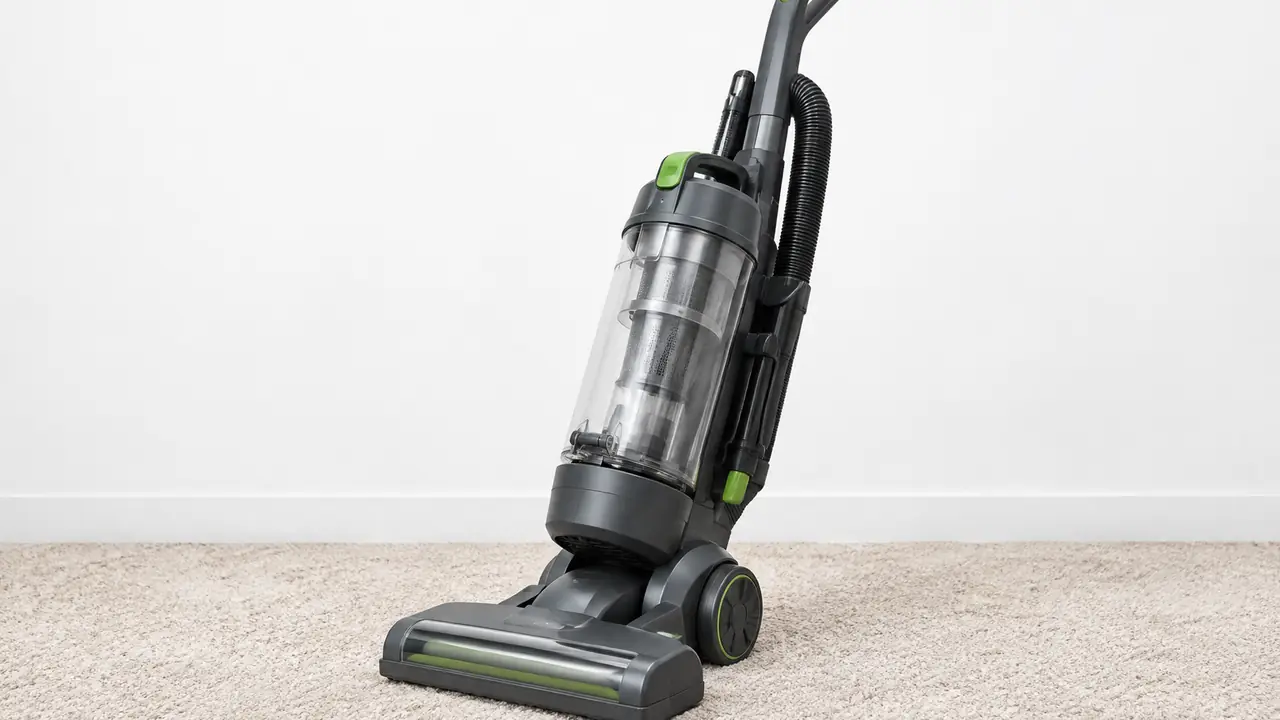
What an upright vacuum is
An upright vacuum puts the motor, the dust container and the brush head in one vertical body that the user pushes forward. It is a mains-powered line built around a driven brush roll, which makes it the effective choice for medium and thick carpet. It remains common in North America and in markets with large carpeted homes, and the corded design has a practical edge: no battery to age, no runtime limit and a unit cost that stays low for the airflow delivered. In retail it is a staple of the mid-price band, so it is one of the lines retail chains build their private label ranges around (see solutions for retail chains).
Most uprights are built in Zhejiang, where the Cixi cluster is known for corded appliances and a deep supplier base for motors, cords and moulded parts; see the clusters. Because the technology is mature, differences between models come down to brush design, filtration, ease of emptying and noise.
The six parts on the card
| Part | What decides performance | Typical options |
|---|---|---|
| 1 Handle | Ergonomics, switches, cord storage | Fixed or folding; hook cord wrap; mode switch for floor type |
| 2 Bag or bin housing | Capacity, emptying method, hygiene | Bagged 2-4 L; bagless cyclone bin 1.0-2.0 L with bottom or top release |
| 3 Filter | Grade, washability, sealing | Foam pre-filter with HEPA H12-H13 post-filter in the premium tier |
| 4 Motor | Power rating, efficiency, lifetime | Mains motor; EU models under 900 W; thermal protection |
| 5 Brush roll | Drive type, agitation, hair handling | Belt or direct drive, bristle strips, anti-tangle design, on/off switch |
| 6 Base head | Seal against the floor, height adjustment, lighting | Pile height dial, edge lights, wide or swivel head |
Figures are typical ranges seen across the category, per model datasheet. The headline watt rating of a mains machine describes input power, not cleaning; the watts vs suction article explains why airflow and the brush head matter more.
Bagged or bagless
A bagged upright keeps the dust sealed and holds fine particles well, but it needs bags as consumables. A bagless upright with a cyclone bin is cheaper to run and shows the user how much dust was collected, but the bin needs emptying and the filter needs regular washing. Retail buyers should plan filter and bag SKUs together with the machine so replacements are in stock when the first customers need them. The two systems are compared in bagged vs bagless vacuums.
EU ecodesign for corded uprights
A mains-operated household vacuum placed on the EU market falls under ecodesign Regulation (EU) 666/2013. In summary it requires rated input power below 900 W, annual energy consumption below 43 kWh, a motor life of at least 500 hours and minimum dust pick-up and emission limits. The energy label under 665/2013 was annulled by the EU court in 2018, so there is no mandatory label, but the ecodesign limits still apply, and CE (LVD, EMC, RoHS) is needed on top. For North America the route is UL 1017 or ETL to the same standard. The desk collects the test reports from the partner plant for each market. More at EU ecodesign 666/2013 for vacuums.
Where the upright fits in a range
Retail ranges usually carry an upright as the workhorse for carpet and a lighter alternative for convenience, so the upright is typically positioned against a cordless stick and a canister rather than alone. A buyer selling in a carpet-heavy market may lead with the upright; one selling into hard-floor homes will carry it as a secondary line. The choice of brush, filter and bin shape then decides which shelf price band the model can credibly occupy. Sending the target market and band with a request lets the desk match a plant platform to the position; see household vacuum lines for the full set.
Options worth specifying
- Brush control. A switch that stops the roll on hard floors protects surfaces and cuts noise.
- Tools. Onboard crevice tool and upholstery brush, a hose with a wand, or a lift-off pod for stairs.
- Cord. Length and gauge set by the model; automatic rewind adds cost and a part to test.
- Finish and packaging. Colour palette, soft-touch grip and carton design; see OEM and private label.
Inspection before shipment
- Input power, airflow and suction against the model's own test report on sampled units.
- Hi-pot and earth-continuity on every unit, as the plant's safety routine requires.
- Brush roll, belt or drive check, switch and cord-pull test.
- Noise at one metre compared with the retained sample.
- Cord, label, manual and pack contents against the approved sheet; carton drop test.
The plan is confirmed for each program; see quality control, MOQ and lead time and the quote form.