
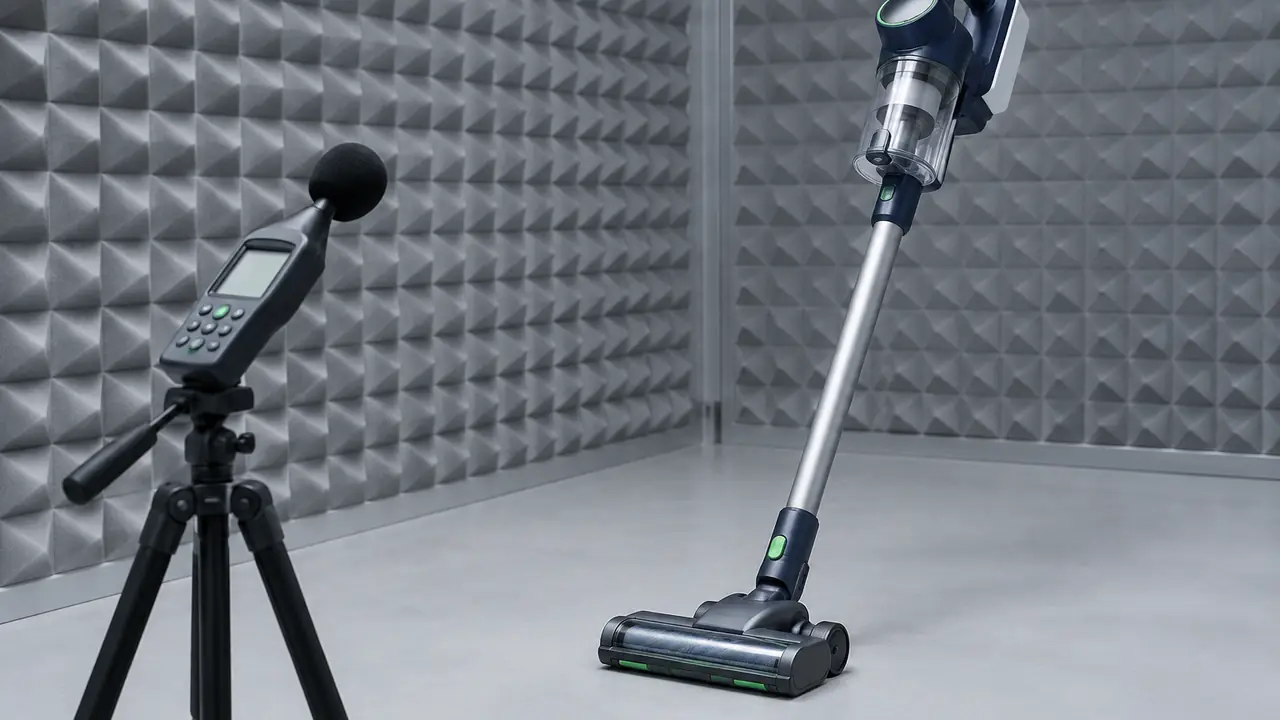
How noise is measured
Vacuum noise is quoted in decibels with A-weighting, written dB(A). The A-weighting filter reduces the contribution of very low and very high frequencies to match how the human ear hears. A decibel scale is logarithmic: a 3 dB increase doubles the sound energy, and a 10 dB increase is heard as roughly twice as loud. So a drop from 80 to 70 dB(A) is a large change that listeners notice at once, while a 1 dB difference is hard to hear. The scale also reminds buyers that two figures from different tests are not comparable unless the method and distance match.
The IEC 60704-2-1 method
IEC 60704-2-1 sets the test method for the airborne noise of vacuum cleaners. It specifies the test room or chamber, the measurement positions around the machine, the floor surface and the operating condition. The result is generally reported as a sound power level, which describes the noise the machine radiates, independent of the room. Sound pressure at one metre is also quoted by some plants for quick checks and it varies with room and distance. For a listing or a retailer spec, ask for the method name, the mode tested (standard, eco or boost) and the date of the report. A plant's incoming check at one metre against a retained sample is useful on the line, but it is not a substitute for the report; see testing and inspection.
Typical ranges by type
The ranges are typical across the category and per model datasheet, not a measured value for any product.
| Type | Typical noise | Main reason |
|---|---|---|
| Cordless stick | 65-80 dB(A), higher in boost | High-speed brushless motor, small fan, brush motor |
| Canister | Typically lower, often 60s to low 70s dB(A) | Larger body, insulated motor chamber, no brush load on the hand |
| Upright | Mid to upper range, set by the model | Brush roll and base head add to motor noise |
| Robot | Set by the model; lower in eco mode | Fan, side brush, drive wheels |
| Backpack and commercial | Quiet-mode versions exist for hospitality | Dual-speed motor, damped housing |
| Wet-dry and industrial | Generally higher | High-power motors, unsilenced exhaust |
Where vacuum noise comes from
- Motor and fan. A high-speed motor makes a tonal whine from the rotor, bearings and blades. Brushless motors at 90,000 rpm and above are efficient but need good damping.
- Airflow. Air rushing through the nozzle, hose bends and filters produces broadband noise, which rises with airflow speed and any restriction.
- Brush roll. A rotating brush striking a floor or carpet adds a mid-frequency component, and a worn bearing adds a rattle.
- Housing resonance. Thin plastic panels vibrate with the motor and amplify it. Loose parts and unseated bins buzz.
A sudden rise in noise in service usually means a blockage, a worn bearing or a loose filter; the article on loud vacuums lists the checks in order.
Design levers for a quieter machine
The largest gains come from the motor chamber: a damped mount, an insulated cover and a muffled exhaust path reduce motor tone before it leaves the machine. A fan matched to the motor speed, smooth ducts with gentle bends and a larger filter area lower airflow noise. A brush motor with a bearing seal and a softer roller reduce brush noise. A dual-power design, which runs quietly in standard mode and loudly only in boost, lets a single model serve both a night-time user and a heavy-duty cleaning task. Each lever costs something in size, weight or runtime, so a specification should set a noise target together with suction and runtime targets, not alone. The vacuum motor line lists the main motor types.
Hotels, offices and other quiet sites
Hospitality and office cleaning is frequently done early in the morning or after hours, near guests and other tenants, and procurement specs often set a maximum dB(A) at the work position. Backpack vacuums and quiet-mode canisters are the usual choice, with a dual-speed switch to drop to a low-noise setting. When writing a tender, set the method, the mode and the target level, and ask suppliers for the report. The cleaning services and hospitality page covers the buyer's other checks, and the backpack vacuum line shows the typical configurations. For the first quote, send the target noise level and the machine type through the quote form.