
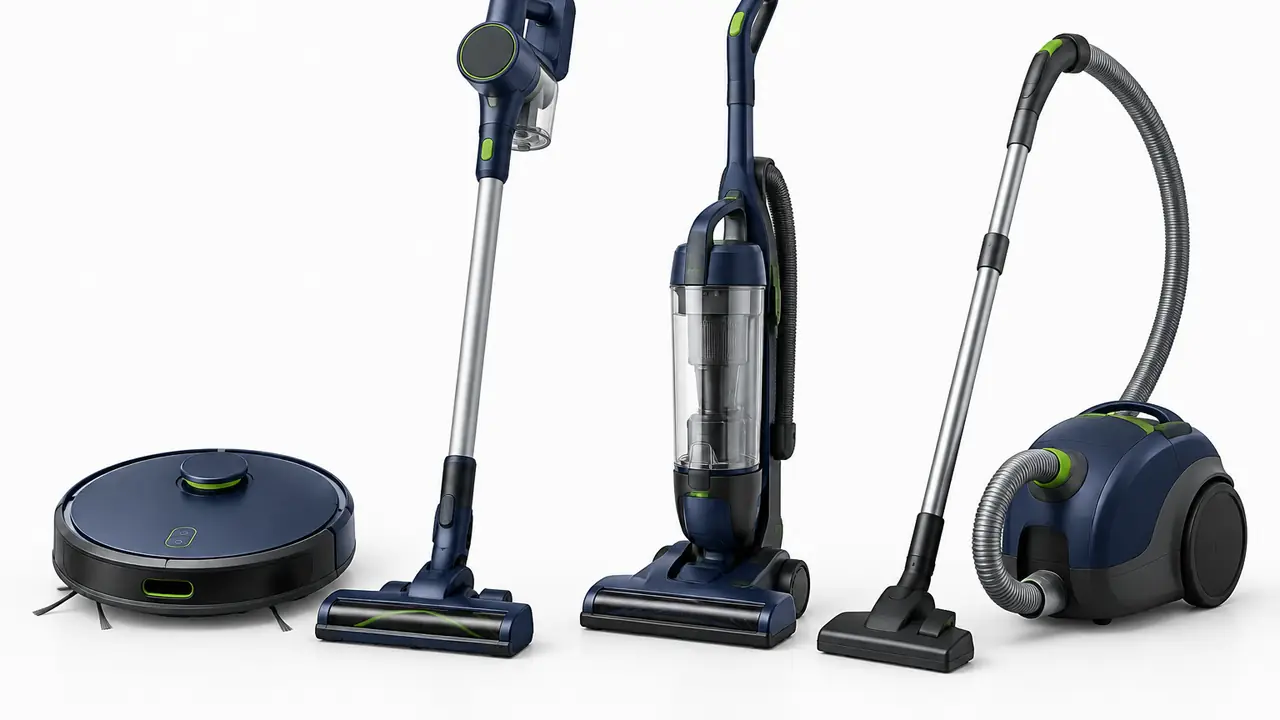
Where the upright fits
An upright is a mains-powered machine in which the head, the motor and the dust container form one stack. Corded power gives it continuous output with no battery to degrade, and the wide head and driven roller make it effective on carpet. It is sold mainly by appliance retail chains and home-improvement style channels, where private label programs sit alongside branded ranges and the price band is set by the retailer. Plants making uprights are concentrated in Zhejiang, particularly around Cixi, where corded machines and their motors and cords are produced alongside a deep supply of small-appliance components. For a comparison with the other corded body style, see upright vs canister vacuums.
The parts that decide performance
| Part | Typical options | Why it matters |
|---|---|---|
| Motor | Universal brushed series motor, single speed or two speed | Sets suction, noise and life; rated life is part of EU rules |
| Brush drive | Belt-driven roller from the main motor, or a separate brush motor | Carpet agitation, belt wear, jam protection |
| Dust container | Cyclonic bin, filter bag or both | Emptying, hygiene, cost of consumables |
| Filtration | Pre-motor foam, post-motor filter, HEPA H11-H13 option | Exhaust quality and cleaning interval |
| Head and height adjustment | Manual or automatic height, edge cleaning, headlights | Pile height range and low furniture reach |
| Cord and storage | Fixed cord with hooks, quick release cord | Convenience and safety wear points |
Each of these has a catalogue page: see brush rolls, filters and dust bags and bins. A corded motor does not run on a pack, so the useful numbers are rated input power, sealed suction and airflow through the head; the how-to is in suction and airflow.
The brush drive decides carpet results
A roller driven by a belt from the main motor is simple and economical, and the belt is a wear part that users replace. A separate brush motor allows a brush that stops when the head is lifted and a roller that can be switched off for hard floors; it adds a motor, wiring in the neck and a point that can fail. Both are common. For the buyer, the right question is not which is better but whether the plant has shipped the design in volume and which parts will be sold as spares. Specify the roller material, the bristle density, the end bearings and a hair-cut feature if the target is a pet household. Ask for a belt as a bundled spare in the carton, which reduces early support contacts.
Cord, capacity and weight
Cord length is a retail claim that is worth writing in the specification, with a conductor gauge and a rating for the target market; detail is in cords and cord reels. Bin capacity is quoted in litres or as a bag size; always ask whether the figure is the maximum fill line or the volume of the container, because they differ. Weight affects stairs and handling: a heavier machine with a large bin can feel more stable on carpet but is harder to carry. Quote the complete assembled weight with the standard tool set.
- Cord: length, gauge, plug type for each market, cord wrap and hook design.
- Capacity: container volume and the fill line, plus the bag part number if bagged.
- Tools: crevice tool, upholstery brush, extension wand and their storage on the body.
- Weight: assembled, with tools, in kilograms.
Spare parts, packaging and returns
Uprights are bulky, so packaging drives freight cost as much as the machine does. Ask whether the unit ships fully assembled or in a flat-pack form with a handle and a head to be joined, and how many fit in a container at the carton size you will sell. A flat-pack carton raises the units per container but adds assembly steps for the customer, which can raise returns if the instructions are weak. The packaging page describes drop-test and print choices.
Plan the spares before the first order. Belts, filters, bags, rollers and the hose are the parts a retail chain will be asked for within the first year. Agree part numbers, minimum quantities and a price basis in writing with the plant, and keep a small stock of each at your warehouse. Returns most often trace to a clogged filter, a worn belt or a blocked hose, so a short manual section on these three items reduces support contacts more than any design change.
Certification: UL 1017 or the EU route
For North America an upright follows UL 1017 or an ETL listing to the same standard, with the safety lab named in the plant's documents. For Europe the safety standard is IEC/EN 60335-2-2 with IEC 60335-1, and CE covers LVD, EMC and RoHS, with REACH for substances. Because an upright is a mains-operated household vacuum, ecodesign regulation 666/2013 also applies: rated input power must stay below 900 W, annual energy use below 43 kWh under the test method, and the motor must have a rated life of at least 500 hours. The 665/2013 energy label was annulled in 2018 and is no longer required. Noise is declared per IEC 60704-2-1 where the market asks. Typical timing is 2-4 weeks for CE with third-party reports and 4-8 weeks for UL or ETL, confirmed per program, and the certifications guide lays out the sequence. Customs classification often falls under HS 8508.11 for machines up to 1,500 W with a bag or container up to 20 L, but your broker confirms the code.
MOQ, samples and plant questions
As a reference range, an existing-mould upright starts at about 200-500 units per model, a branded version at 500-1,000 and a new mould at 1,000-3,000 plus tooling, all confirmed in writing for each program. Stock-model samples take 7-15 working days, branded samples 15-25 days. Bulk lead time is 30-45 days for stock models, 35-50 for branded ones and 60-120 for ODM first orders including certification, per MOQ and lead time.
- Ask which motor supplier and which rated life the plant will document for the EU.
- Ask for the belt or brush-motor design and the number of spare belts in the box.
- Ask for the pile-height range and for sample test pictures on your target carpet.
- Ask for the filter part numbers and the cleaning interval stated in the manual.
- Ask for the cord and plug approvals for each destination.
Send quantities, target markets and tooling intent through the quote form. The desk shortlists partner plants that already hold the relevant market reports.