
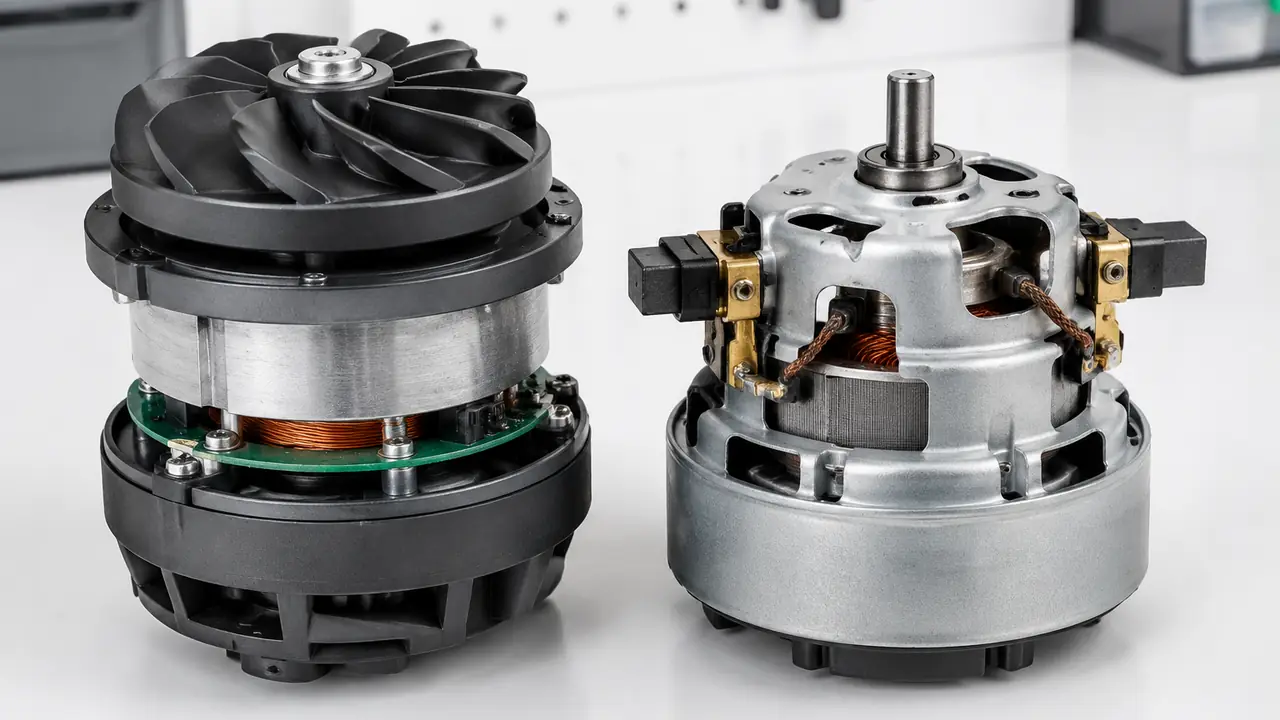
What a vacuum motor does
A vacuum motor is a spinning fan on a shaft. The fan pulls air through the nozzle, the filter and the dust container, and the pressure drop across that path is the suction the user feels. Power in watts describes what the motor draws from the wall or the battery, not how well it moves air, which is why two 600 W machines can clean very differently. The watts versus suction article explains the gap, and the suction and airflow guide shows how kPa and airflow are measured.
For a brand, the motor is the part that is hardest to change late. The housing, the cooling path, the controller and the noise profile all follow from it, so the motor platform is chosen before the plastics are drawn.
Brushed universal versus brushless DC
| Point | Universal brushed | Brushless DC |
|---|---|---|
| Typical use | Corded upright, canister, wet and dry | Cordless stick, robot, handheld, premium corded |
| Typical speed | 20-35k rpm | 90-120k rpm in high-speed designs |
| Wear part | Carbon brushes and commutator | Bearings only |
| Control | Simple triac or none | Needs an electronic controller |
| Efficiency | Lower, more heat | Higher, runs cooler |
| Cost drivers | Copper, laminations, brushes | Magnets, controller, balancing |
Brushed motors are cheap and proven, and still dominate low-cost corded machines. Brushless motors have no brushes to wear out, so life is set by the bearings, and the controller can cut power on a blocked hose to protect the winding. Cordless machines need brushless motors for runtime reasons, since every watt wasted is battery capacity lost. For a longer comparison, read brushless versus brushed motors.
The six parts on the card
The exploded sketch numbers the motor assembly in the order a plant quotes it. Housing, rotor, impeller, bearing and shaft, controller and mount can each be specified, but they are matched as a set: change the impeller and the controller tuning follows; change the bearing and the noise changes.
- Impeller stages. More stages raise pressure at the cost of length and weight; one or two stages are typical for handhelds and sticks, three for high-suction mains machines.
- Bypass or flow-through. Bypass motors keep dust air away from the winding and last longer in wet and dry duty; flow-through motors are simpler and smaller.
- Bearings and grease. A sealed pair suits high speed; grease choice matters at temperature and for noise.
- Mount. A rubber isolation ring is a low-cost way to cut vibration noise and should be tested with the real housing.
Motor life and EU ecodesign
For corded household vacuums sold in the EU, Regulation (EU) 666/2013 sets ecodesign requirements including a minimum motor lifetime of 500 hours, together with a rated power limit (under 900 W) and an annual energy limit. It applies to mains-operated household machines; cordless machines fall outside it, and the 665/2013 energy label was annulled in 2018. A brushed motor intended for that market must show a life-test record, and the plant should state the test conditions, since a result on a bench is not the same as one in a finished machine. See energy efficiency and ErP rules.
Typical ranges and how to read them
Across the category, handheld and robot motors sit at the low end of the range, with cordless sticks around 100-150 W of input, corded household machines in the 600-900 W region and commercial and wet and dry machines up to 1,600 W. Speed, airflow and noise depend on the fan design and the housing, so they appear only per model datasheet. Treat every figure on this page as a typical range, never as a datasheet; the figure a brand prints must be confirmed from a test report on the actual motor.
Sourcing and checks
- Send the target machine type, input power, voltage, size envelope and noise goal.
- The desk shortlists partner plants with a matching platform and requests a fitted sample.
- Check the sample on the real housing: current, speed, airflow, vibration and temperature rise.
- Agree life-test records, incoming inspection and a retained sample in writing.
- Run batch checks: current and speed on sampled units, bearing noise, insulation test.
Motors are counted in thousands per variant; see MOQ and lead time for the reference ranges. If you are comparing platforms, send the details through the quote form. Motors are usually bought alongside the battery pack and the brush roll for the same machine.