
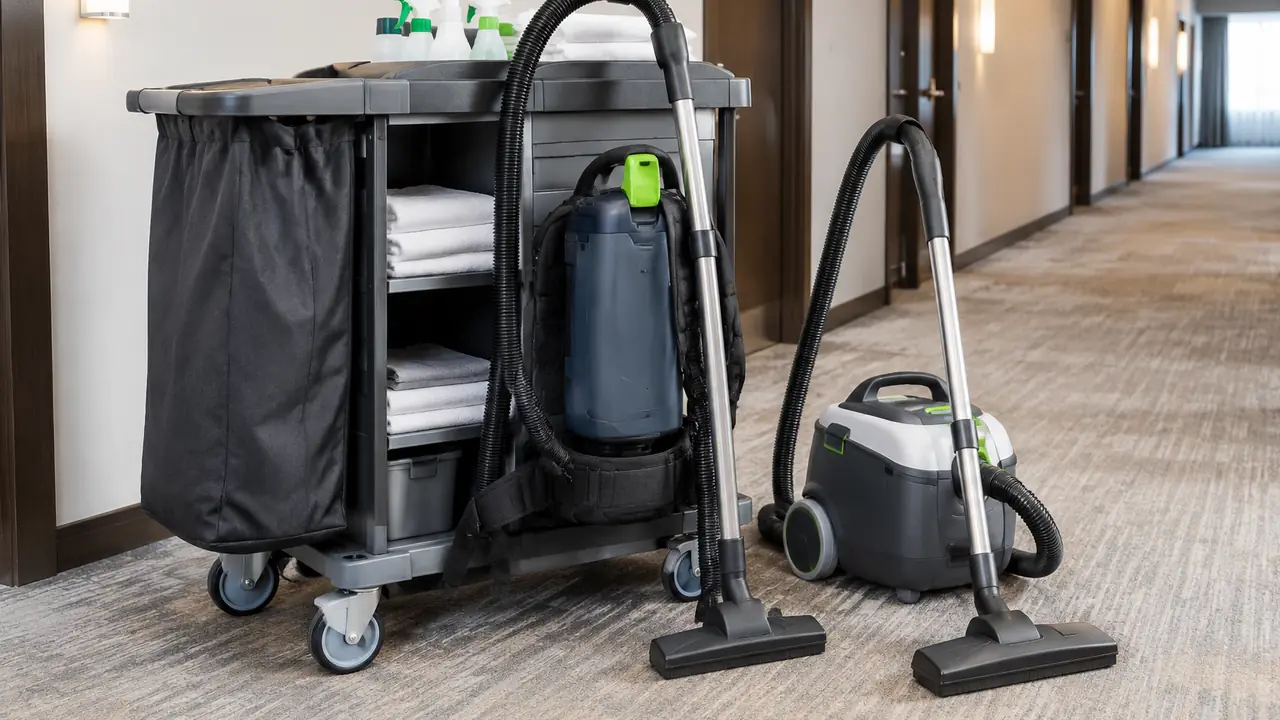
What professional buyers weigh differently
A household buyer compares price and appearance. A cleaning contractor or hotel group compares hours of use, downtime and the cost of keeping the fleet running. A machine that fails on a Monday morning costs more than the price difference between models. Vaculent coordinates partner plants, mainly in Guangdong and Zhejiang, that build backpack, commercial and wet dry machines, and it asks buyers to state the use case first: how many hours per day, what floors, what noise limit, and how many machines in service. Professional lines are typically available from about 20-100 units per model, which suits a contractor or a small hotel group.
Lines for professional use
| Line | Typical specification | Best for |
|---|---|---|
| Backpack | 6-10 L bag; about 1,000-1,400 W or lithium; about 4-6 kg | Hotels, offices, stairs, theatres; fast coverage |
| Commercial upright or canister | Long power cord, durable body, HEPA optional | Corridors, large carpeted areas, serviced offices |
| Wet dry | 1,000-1,600 W, single or dual motor, 20-80 L tank | Kitchens, laundries, entrances, spill response |
For the comparison between formats, see backpack vs upright for commercial cleaning.
Durability and the parts that fail
Ask where professional machines usually fail: cord and strain relief, switch, hose cuff, wheel and caster, motor bearings and filter seals. A written specification can address each: cord gauge and length, hose wall thickness, replaceable carbon brushes where a brushed motor is used, serviceable casters and a metal or reinforced hose connection. Ask for an endurance run on the sampled unit and a drop test on the housing. The motor-life requirement in EU Regulation 666/2013 applies to household mains vacuums, not to professional machines, so durability for a professional unit is set by the order specification, not by that rule.
Noise and cord length
Noise matters in hotels, offices and healthcare-adjacent sites where cleaning happens near people. Typical household figures run from about 65 to 80 dB(A), and commercial machines vary widely; the figure is only meaningful with the test method, for example IEC 60704-2-1. Request the model's own report and compare at the same method. Cord length is a quiet cost driver: a 10-15 m cord saves unplugging across corridors but adds weight and a wear point. Specify length, wire gauge and a hook for cord storage in the order sheet, and consider lithium backpacks where the site forbids trailing cords.
Filtration and wet dry duty
Many contracts ask for better filtration in offices and guest rooms. Describe it by grade only: an EN 1822 H13 filter captures at least 99.95% at the most penetrating particle size, and the seal around it matters as much as the media. Wet dry machines need a float shut-off, a foam or cartridge filter rated for wet use and a tank that can be drained and cleaned quickly. Never specify a dry paper filter for a wet pick-up, and keep a spare filter per machine on site. The filtration grades guide explains the grades, and wet dry vs dry-only vacuums helps choose by site.
Spare filters and bags for years
- Consumables. Agree filter and bag part numbers per model and a minimum supply period in writing.
- Wear parts. Hoses, wands, floor tools, wheels and carbon brushes should be listed with the first order.
- Batteries. For lithium backpacks, state the cell supplier and a replacement route; UN 38.3 papers apply to each pack shipped.
- Stock plan. A first spare shipment of about 10-20% consumables by value is a common planning rule of thumb, not a standard.
Planning guidance is in warranty and spare parts planning.
An illustrative example
As an illustration only, a cleaning contractor with sixty staff might order twenty-five backpack units and ten dry commercial canisters, plus six wet dry machines for kitchens. The desk would ask for the noise report of the backpack, the cord length of the canister, and a spare filter and bag plan for three years. The order would be confirmed in writing, inspected on a sample and shipped on one pallet. This example is anonymous and does not describe a real customer.
Next step
Send the use case, hours per day, floor types, noise limit and quantity through the quote form. The desk returns a shortlist and a sample plan. Reference lead times are on MOQ and lead time.