
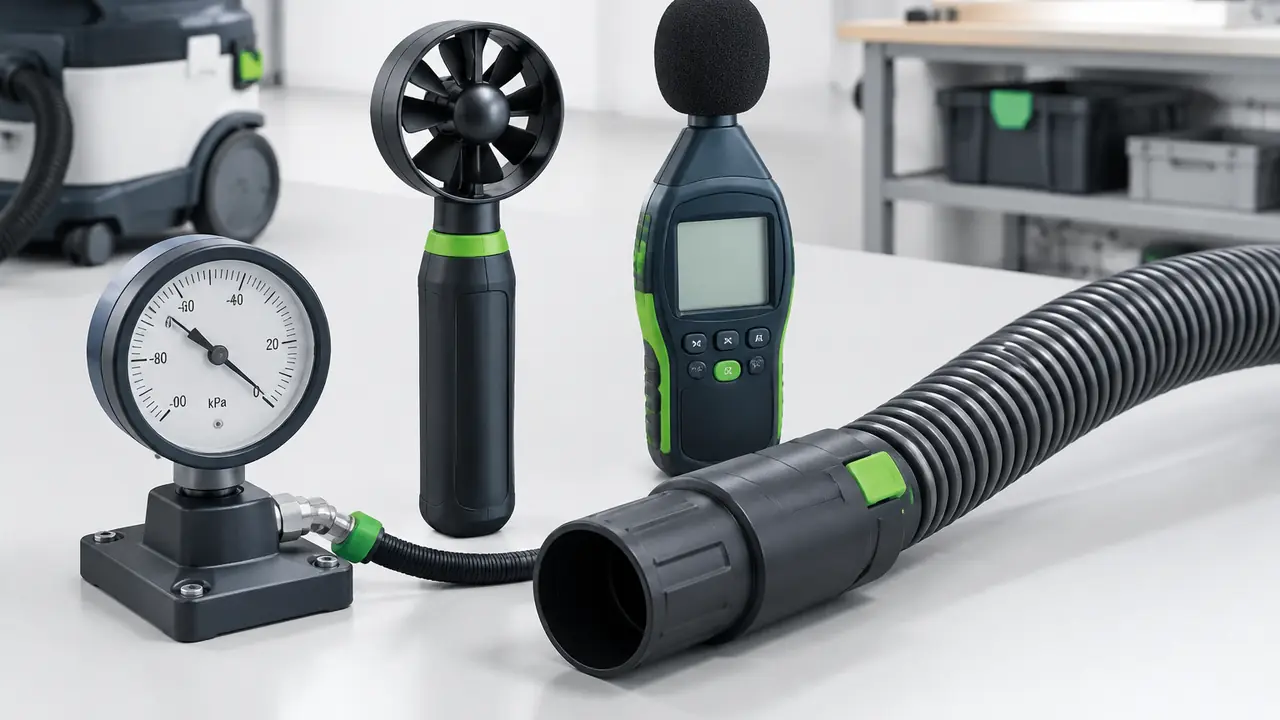
What dB(A) means
The decibel is a logarithmic unit, and the A in dB(A) means the reading is weighted to follow how the human ear responds, giving less weight to very low and very high frequencies. Two points about the scale matter for buyers. First, every 3 dB step is roughly a doubling of sound energy, so a machine rated 3 dB quieter has half the acoustic output. Second, a 10 dB difference is heard by most listeners as about twice or half as loud. A product described as "5 dB quieter" is a real change; one described as "1 dB quieter" is not likely to be noticed.
The typical noise range for cordless stick vacuums is about 65-80 dB(A), per model datasheet. Corded canisters, robots and commercial machines have their own ranges, and the number alone rarely tells you which type of reading it is.
Sound pressure and sound power are different things
There are two ways a datasheet can quote noise, and they are not interchangeable.
| Quantity | What it is | Depends on | Where it appears |
|---|---|---|---|
| Sound pressure level, Lp | What a microphone reads at a point | Distance, room, reflections | Marketing copy, quick checks |
| Sound power level, Lw | Total acoustic energy emitted by the machine | The machine only (measured in a defined room) | IEC 60704-2-1 reports, EU declarations |
Sound power is the figure that can be compared between machines because it removes the room and the distance. A sound pressure reading from a living room has a different baseline from one in a test chamber. A datasheet that says "62 dB" with no statement of which quantity, where, and in which mode, should be queried before it is accepted.
The method behind the number
IEC 60704-2-1 is the standard for measuring airborne noise from vacuum cleaners. In summary, the machine is operated in a defined test room, normally on a standard carpet or floor surface, with the nozzle attached and a defined power setting, and the sound is measured at several microphone positions around it. The microphone readings are converted to a sound power level, with the background noise subtracted. The test is repeated for the stated operating modes, and the results are reported to a stated precision. Because the method fixes the surface and the nozzle, reports from different labs can be compared. Corded EU models are often declared on this basis; the 666/2013 regulation includes noise as a required product information item, while cordless products follow the same method voluntarily or on request. The test standards note places it beside the performance series.
Where vacuum noise comes from
- Airflow. The rush of air through the nozzle, the cyclone and the exhaust creates broadband noise that rises quickly with airflow speed.
- Motor and impeller. At 90,000-120,000 rpm the motor produces a high-frequency whine, strongly affected by rotor balance and the blade count and spacing of the impeller.
- Brush roll. A motorised head adds bearing, gear or belt noise, and bristle impact on the floor.
- Housing vibration. Thin plastic panels resonate; unsupported motor mounts transmit vibration to the casing.
- Floor interaction. Hard floors reflect noise; carpets absorb part of it. The same machine reads differently on each.
Design choices that lower noise
Quiet design is mostly a set of small, unglamorous decisions that add up. The motor mount uses rubber isolators, so that vibration does not reach the housing. The impeller and rotor are dynamically balanced at the plant, and the balance is checked as part of the incoming and end-of-line tests. The airway has gentle bends and a wide exhaust area, so the velocity of the leaving air is lower. Acoustic foam or labyrinth paths are placed around the motor chamber; the exhaust filter doubles as a diffuser. Lower power modes drop the motor speed, which lowers noise more than it lowers airflow, and "quiet" modes in hotels and offices rely on this. Brushless motors, because they have no commutator sparking and a smoother torque curve, often sound smoother, though high rpm can push the whine to a higher pitch. For the motor side, see brushless vs brushed vacuum motors.
Each of these has a cost in material, volume or airflow, which is why a quiet product is a design target set at the start, not a feature added at the end. The trade-off with suction is real: a larger exhaust path that lowers noise may also lower pressure unless the motor is re-matched.
Noise by product type
Expectations differ by type, and the specification should respect them. Cordless sticks are judged against the 65-80 dB(A) band and are bought largely on suction and runtime, so noise is a secondary line unless the brand positions on it. Canisters have a name for being quieter because the motor is separated from the user by a hose and a body with room for damping. Robot vacuums are judged by how they sound while the household is at home, where the sound of the fan at its quietest mode is the usual selling point. Commercial machines used in hotel corridors and office floors often have a dedicated low-noise mode so that cleaning can take place during working hours. Wet dry vacuums and industrial extractors are the loudest group, and in those the relevant buyer question is hearing protection and workplace exposure rather than comfort, which is a matter for the site's own safety rules.
Specifying and verifying noise
- Decide the quantity: sound power Lw to IEC 60704-2-1 for comparison, sound pressure only for in-house checks.
- Set the target per mode, for example the main mode and the maximum mode.
- State the surface and the nozzle in the order, because they change the result.
- Agree a tolerance for batch variation and a sampling rule for the line, confirmed in writing.
- Check the first samples against the plant's own report in a test room or with a trusted lab, then spot check at pre-shipment.
Buyers for hotels, offices and cleaning services often ask for a lower mode specifically; see cleaning services and hospitality and backpack vacuums for typical requirements. The desk asks partner plants for the sound power report and the test conditions at quotation; use the quote form to state your target, and see how to read vacuum specs for the full sheet review.