
Two kinds of noise
Vacuum noise has an aerodynamic part and a mechanical part. The aerodynamic part is the air itself: the impeller blades chopping the airstream, turbulence in the hose and the whistle of air squeezed through a gap. The mechanical part is the motor, the bearings, the brush roll and anything that vibrates against the housing. A new machine rated at, say, 65-80 dB(A) typical for a cordless stick is mostly aerodynamic. A machine that becomes louder or acquires a new tone has usually gained a mechanical or leak component, and that is the sound to diagnose.
Noise ratings are measured under IEC 60704-2-1 for household vacuums, which fixes the room, the microphone position and the floor so that readings can be compared. A sound power or dB(A) figure on a datasheet describes the machine in good condition. It does not say how the sound will change with wear, and that is where the complaints arise.
Causes in order of likelihood
| Rank | What it sounds like | Likely cause | Owner |
|---|---|---|---|
| 1 | Higher-pitched whine, motor speeds up | Blocked airway or clogged filter, less load on the motor | User, plus design |
| 2 | Whistle or flutter | Air leak at a seal, cuff, lid or loose filter | Tolerances, assembly |
| 3 | Rattle or buzz | Loose screw, cracked part, debris in the bin or fan area | Assembly, QC |
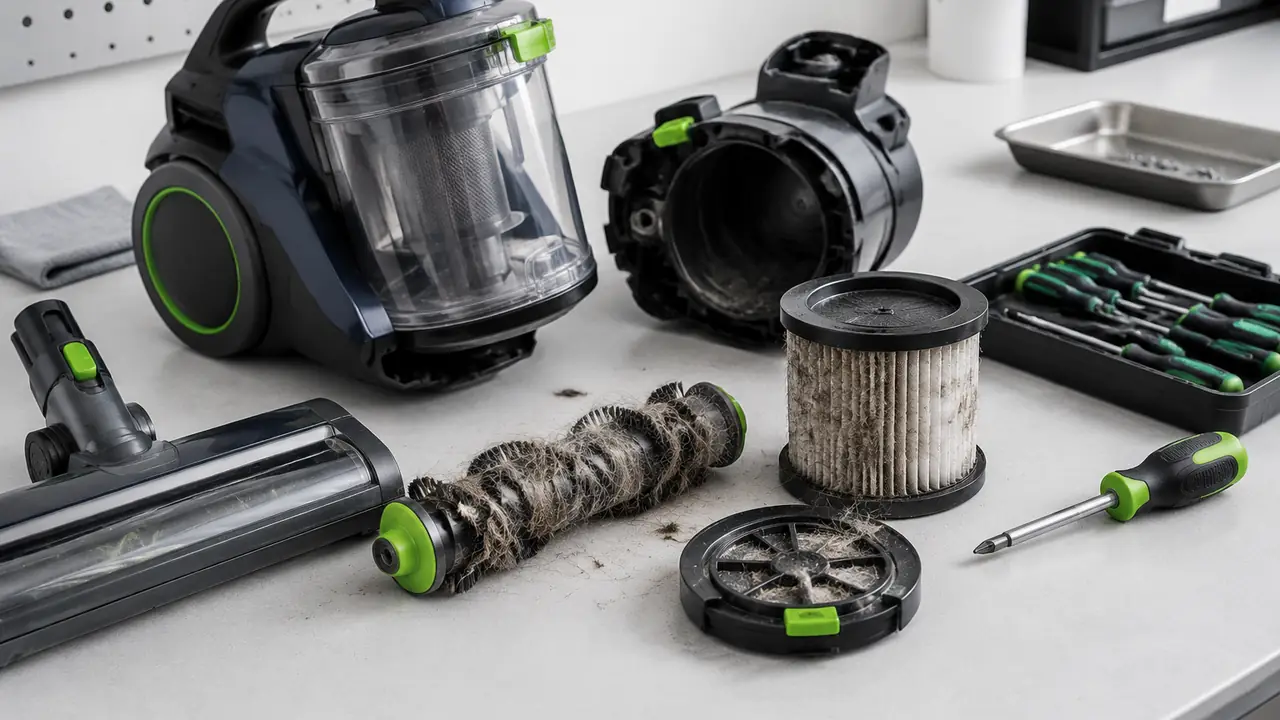
| 4 | Rumbling or thumping from the head | Brush roll with hair wrap, worn bearing, damaged belt | User, wear parts |
| 5 | Grinding, squeal or rising growl from the motor | Worn bearings, unbalanced rotor | Motor quality |
| 6 | Louder overall, no new tone | Worn or missing foam or sound-damping parts, higher power mode | Design |
The first sign is counter-intuitive. A blocked vacuum often gets higher and sometimes louder because the motor spins faster with less air to move. A user may read this as a motor fault and keep running the machine, which can lead to overheating, as covered in overheating and thermal cutoff.
Checks in order
- Switch off and check the airway, bin and filters, because a blockage changes the sound more than any mechanical fault.
- Run the machine with the floor tool removed, then with the brush off if the head has a switch. If the noise vanishes, the brush roll, belt or head bearing is the source.
- Listen with the nozzle partly closed. A steady whistle that changes with the seal points to a leak.
- Shake the empty machine gently and listen for loose parts.
- If the sound is a grind or growl from the motor bay with a clear airway, the bearings or the rotor balance are suspect and the motor needs a bench check.
What it means for a brand
Bearings and balance decide the noise life. A suction motor spins at 90,000-120,000 rpm in a cordless machine, and a few milligrams of imbalance or a rough bearing become audible at that speed. The motor supplier's incoming checks, such as run-in noise, vibration limit and bearing grade, have more effect on noise after a year than the headline dB(A). For corded machines, brush wear in universal motors produces its own noise and sparking near end of life; see vacuum motors.
Housing and gasket design matters for leaks and rattles. Two-part housings joined by clips can resonate, while foam gaskets and rubber mounts isolate the motor. A change in foam density or a missing mount between pilot samples and mass production will raise noise with the motor unchanged.
Brush roll noise is a spare-part topic. Rollers and belts wear, and a user who cannot buy a replacement will live with the sound or return the machine. See brush rolls and the note on brush roll faults.
Hotels and offices buy on noise. For cleaning service and hospitality buyers, a quiet machine is a selling point, and complaints from staff about increasing noise often precede replacement. Commercial lines need a noise requirement stated per datasheet, plus a wear-part plan.
Design choices that lower noise, and their cost
Quiet is a set of small choices rather than one component. A larger, slower impeller moves the same air at lower pitch than a small, fast one, but it needs more space and a different motor. A diffuser or a bypass path after the fan smooths turbulence. Foam lining in the motor bay absorbs mid-frequency sound and costs little, but it must not block ventilation, which ties the noise decision back to temperature. A flexible hose cuff, rubber motor mounts and a heavier bin lid reduce vibration passed to the housing. Each choice adds some weight, cost or size, and in a cordless stick, where weight is a selling point, the trade has to be made explicitly. The desk asks for the noise target before the motor is chosen, not after, because a late request often ends with a lower power mode, and the brand then has to explain a lower suction figure to its customers.
A second trade-off concerns modes. Many cordless machines offer an eco mode that is much quieter than the maximum mode. Publishing the noise value for the mode most users will actually run is more honest and produces fewer complaints than publishing the quietest figure while customers run the loudest.
What to specify
- Noise rating in dB(A) with the method named: IEC 60704-2-1, stated as typical across the category and per model datasheet.
- Motor supplier's vibration and run-in noise check at incoming inspection.
- Acceptance of the approved sample sound as a reference, with a listening or microphone check on production samples.
- Screw-locking, gasket and mount specification written into the drawing so that substitutions require approval.
- Wear parts available as spares: belts, rollers, foams and filters.
Inspection and the production line
Noise is easy to measure and cheap to check. A pre-shipment inspection that runs a random sample of units in a quiet area, compares the sound with the approved reference and rejects units with unusual tones or a rattle catches most assembly faults. The same step finds units where a gasket was left out. Plan the sample size and the pass-fail band with the partner plant and confirm them in writing for the order. Testing and inspection lists the items usually covered, and quality control explains how the desk follows them through production.
Send the target noise range, market and volume through the quote form and the desk will shortlist plants with the right motor supply.