
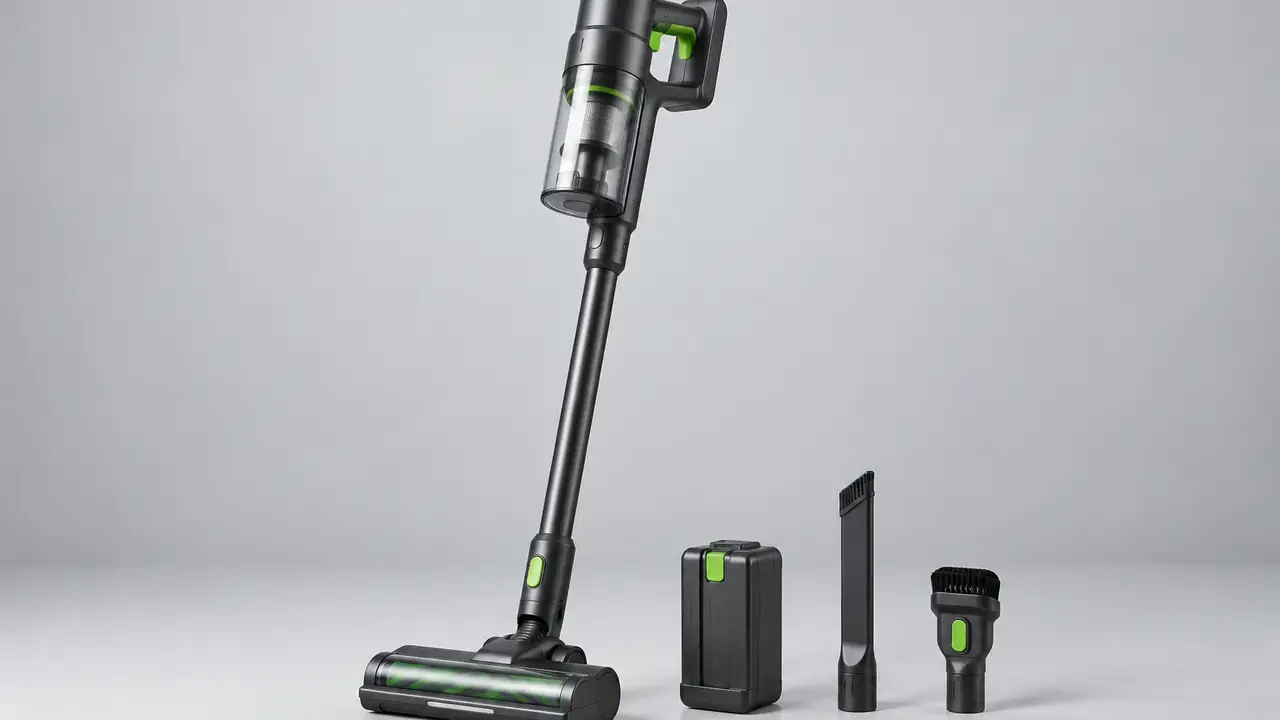
What a cordless stick vacuum is
A cordless stick vacuum puts the motor, the dust separation and the battery in one hand-held head, then adds a wand and a floor head so the same unit cleans floors standing up and furniture or cars as a handheld. The category replaced the corded upright as the default new purchase in most Western markets during the last decade; Fortune Business Insights puts the stick segment at about USD 4.2 billion in 2025 with cordless models around four fifths of it. For a brand it is attractive because the parts are modular and the tooling is mature: a plant can build a new model from an existing motor platform with a fresh housing in months rather than years.
The trade-off is that every performance number depends on parts the buyer never sees. Two sticks with the same 25 kPa headline can differ in runtime by half, in noise by ten decibels and in how long the brush motor lasts, because the battery cells, the motor controller and the brush bearings are different. That is why the BOM card on this page lists six parts and what can change in each.
The six parts on the card
The exploded sketch numbers the parts in the order a plant quotes them.
| Part | What decides performance | Typical options |
|---|---|---|
| 1 Motor head | Motor type and speed, impeller, controller | Brushless DC 100-150 W is standard; brushed motors survive only in entry models |
| 2 Battery pack | Cell brand grade, capacity, BMS protection | 6 or 7 cells; 2,000 mAh for entry, 3,000-4,000 mAh for 45-60 min; removable preferred for retail |
| 3 Cyclone and filter | Separation efficiency, filter grade, washability | Single cyclone with foam pre-filter; multi-cyclone with HEPA H12-H13 post-filter |
| 4 Dust bin | Volume, release mechanism, material clarity | 0.5-1.0 L; bottom-release flap |
| 5 Brush head | Roller type, brush motor, LED, swivel | Bristle for carpet, fluffy for hard floor, anti-tangle for pet hair |
| 6 Wand | Length, weight, release latch | Fixed aluminium tube; telescopic adds cost and a joint to test |
Suction (kPa), airflow, runtime and noise are typical ranges seen across the category, not a datasheet. Each model carries its own test report, and the figures a brand prints are confirmed from that report, not from this page. The suction and airflow guide explains why a high kPa number alone says little.
Battery, runtime and the rules that come with it
Runtime is the number customers complain about most. A 2,500 mAh pack at 22.2 V stores about 55 Wh; at a normal-mode draw of 60-80 W that is 40-50 minutes on paper and 30-45 in use, and 10-15 minutes in boost. Cells are the first thing to specify: ask for the cell maker's grade, the cycle-life figure the plant will stand behind in writing and the BMS protections (over-charge, over-discharge, over-current, temperature). A removable pack doubles as a spare-parts SKU and keeps the machine sellable after the first pack ages. Shipping any of this needs UN 38.3 test reports for the pack and, in most markets, IEC 62133-2 or UL 2054; the battery and runtime guide and shipping cordless vacuums cover the paperwork.
Filtration and the pet-hair variant
A washable foam pre-filter catches most of what the cyclone misses; the post-filter decides what the exhaust carries. H12 is common in mid-range sticks and H13 (at least 99.95% at the most penetrating particle size under EN 1822) in models sold on allergen control. Filtration is described by grade only; the filtration grades guide explains the test. Brands that target pet owners usually take the same platform with an anti-tangle roller, a mini motorised tool and a larger bin, which is the pet hair vacuum line on this site.
Options worth specifying
- Housing colour and finish. Two-tone ABS with a soft-touch grip is standard; matte and metallic finishes are tooled per program.
- Display. None, LED mode indicator, or a small screen for runtime and filter alerts.
- Accessories. Crevice tool and dusting brush as a minimum; mini motorised tool, flexible hose, wall dock with tool holders.
- Packaging. Plain brown carton for marketplaces or a colour box with inserts for retail; see packaging.
- Branding. Logo by pad print, laser or moulded-in; manual and app assets by the brand; see OEM and private label.
Where the machines are built
Cordless sticks come from the Suzhou cluster in Jiangsu, where the brushless motor, battery and whole-machine plants sit close together, and from Shenzhen and Dongguan in Guangdong. Robot and stick platforms often share a motor supplier, which is why a brand that already runs a robot program can add a stick with less qualification work. The desk shortlists plants by motor platform, battery supplier and the test lab they use rather than by catalogue size. More on the clusters.
Inspection before shipment
- Suction and airflow at the nozzle on sampled units against the model's own test report.
- Runtime in normal and boost mode from a full charge; charge time to full.
- Noise at one metre, compared with the retained sample.
- Hi-pot and ground continuity on every unit, as the plant's safety routine requires.
- Brush roll run, wand latch, bin release, filter seating and cosmetic check on sampled units.
- Carton drop test and label, manual and pack contents against the approved sheet.
The plan is written per program and confirmed before the first batch; see quality control. For reference quantities and timing, the MOQ and lead time page sets the ranges, and the quote form asks what a plant will ask.