
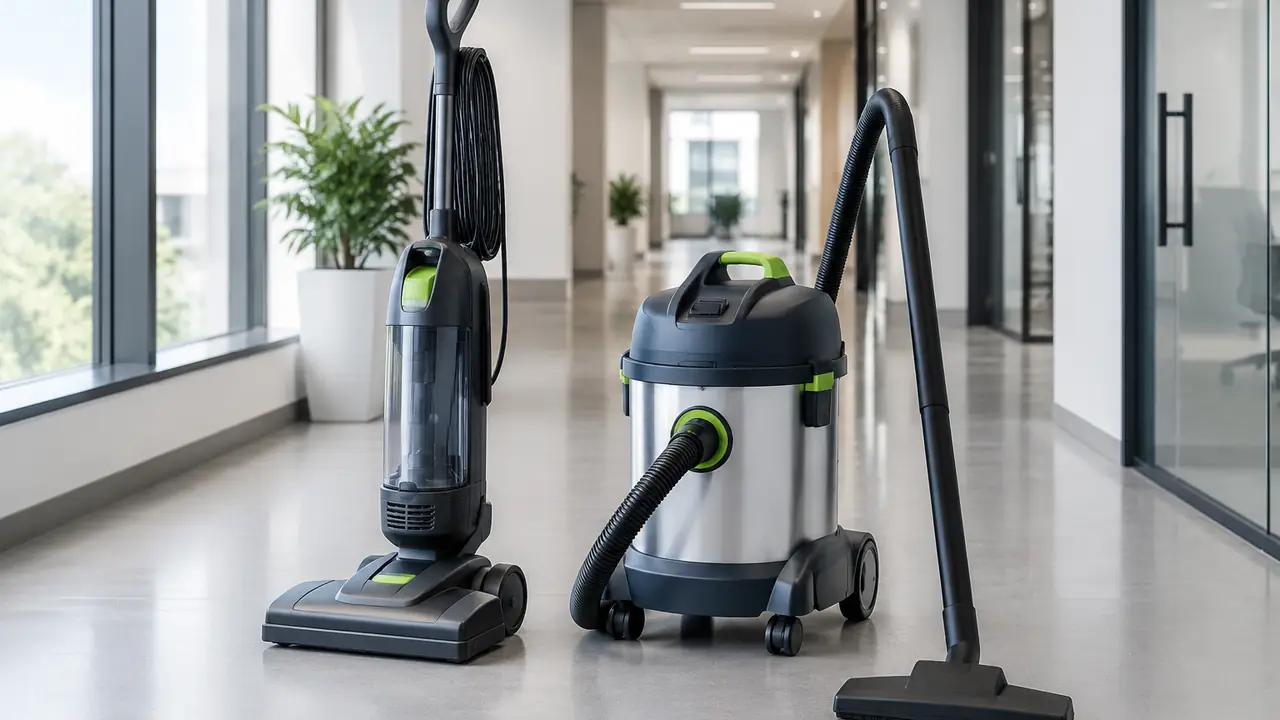
What makes a vacuum commercial
A commercial upright or canister looks like its household cousin, but the differences are in what the buyer does not see on a shelf. The housing is thicker or reinforced, the cable is 10-15 m rather than 5-7 m, the switch and the wheels are rated for thousands of cycles and the motor is protected against overheating when a bag is full or a hose is blocked. The machine is expected to run for hours each day and to be repaired, with parts such as the belt, the brush strip, the bag collar and the filter sold as separate items. The audience is cleaning contractors, property managers, schools and hospitality groups rather than households.
The main commercial choices are the layout (upright for large carpeted areas, canister for stairs, hard floors and quiet work), the capture system (paper bag or washable bin) and the exhaust filter. The buyer's view is in the commercial vacuum buyer guide, and the comparison with other commercial types in backpack vs upright for commercial cleaning.
The six parts on the card
| Part | What decides performance | Typical options |
|---|---|---|
| 1 Handle | Ergonomics, switch, cable hook, fold mechanism | Fixed or adjustable handle; top cable hook; optional foot release |
| 2 Bag or bin housing | Capacity, seal, ease of change, material | 5-12 L paper bag or washable bin; ABS shell or steel-reinforced housing |
| 3 Filter | Grade, area, access | Pre-motor foam; exhaust filter pleated or HEPA-grade (EN 1822 H12-H13) option |
| 4 Motor | Power, thermal protection, brush life, cooling | Mains bypass motor typically 1,000-1,400 W; thermal cut-out; replaceable carbon brushes |
| 5 Brush roll | Width, bristle, strip, height adjustment | 300-400 mm roller with replaceable strip; none on canisters |
| 6 Base head | Plate, bumper, wheels, height control | Metal-reinforced base; rubber bumper; large wheels for thick carpet |
Power and capacity are typical ranges across the category, per model datasheet. Rated watts are not suction; compare using the method in the suction and airflow guide.
Durability and spare parts
Total cost over several years decides the choice of commercial machines more than the unit price. Look at the points that fail first: the cable at the strain relief, the switch, the brush roll bearings, the belt and the hose cuffs. A good commercial specification states the parts that are replaceable without tools, the spare-parts list and the lead time for replacements. Plan for a parts kit with bags, belts, filters and a brush strip sold with each lot; see warranty and spare parts planning. Cleaning companies value a machine that returns to service within a shift.
Noise and filtration
Noise matters because commercial cleaning often happens in occupied spaces. Typical commercial machines sit between 60 and 75 dB(A) depending on the motor and housing, and quiet-mode versions lower the lower end. Ask for the method as well as the number; the noise guide explains why. Where a HEPA-grade exhaust filter is specified, it is described by its EN 1822 grade only (H13 captures at least 99.95% at the most penetrating particle size), and the housing must be sealed so air cannot bypass the filter. See the filtration grades guide.
Options worth specifying
- Cable. Length, gauge and plug per market; a removable cable on a twist-lock for fast replacement.
- Layout. Upright with a wide head for corridors; canister with a power nozzle for stairs.
- Livery. Housing colour, logo plate and a number label for fleet tracking.
- Accessory set. Hose, wands, crevice and dusting tools on the machine.
- Packaging. A plain shipper for contractors, a colour box for distribution; see packaging and OEM and private label.
Standards and inspection
Safety is assessed to IEC/EN 60335-2-2 and, for commercial use, IEC/EN 60335-2-69, with CE marking in Europe and UL 1017 via UL or ETL in North America. Household ecodesign rule 666/2013 does not apply to commercial machines. A typical pre-shipment plan checks suction on sampled units, noise at one metre, hi-pot and ground continuity on every unit, cable pull test, thermal cut-out function and a carton drop test. The plan is agreed in writing before the first batch; see quality control. Send cable length, voltage and volume through the quote form, or read how the desk handles cleaning services and hospitality programs.