
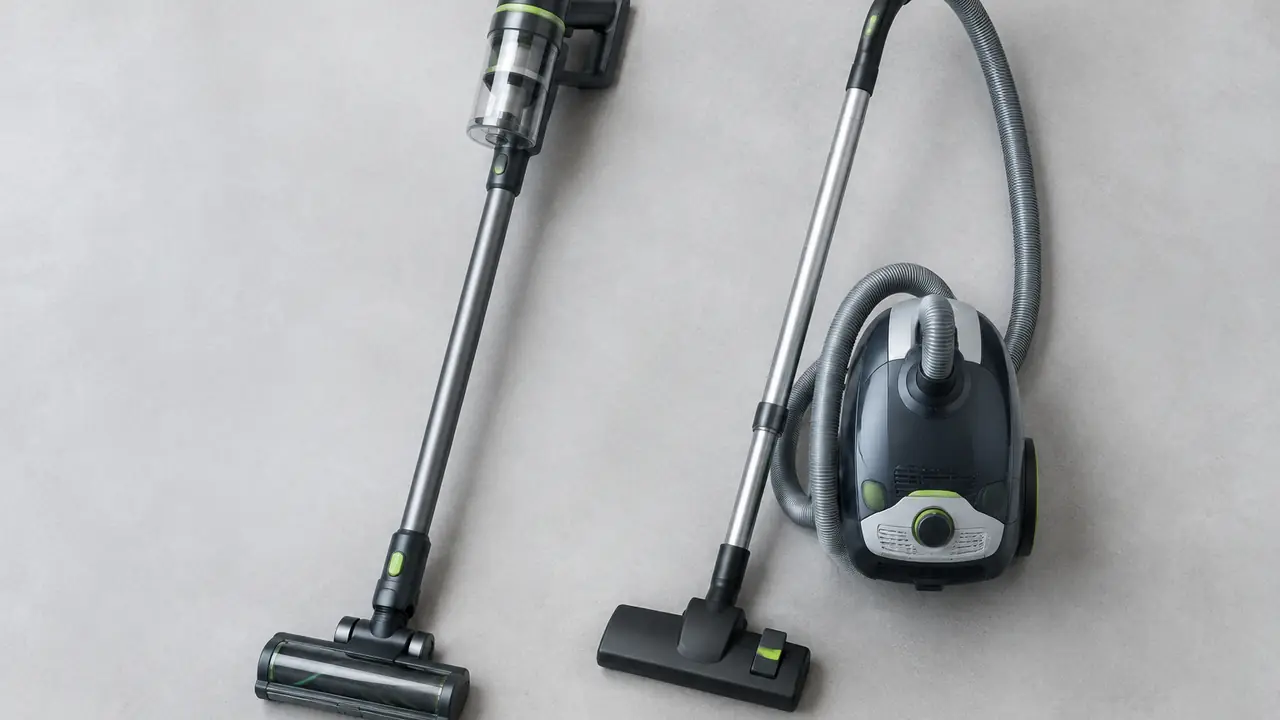
Two ways to carry the same job
A commercial upright carries its weight on the floor: the motor, the bag or bin and the brush head sit in one wheeled body that the operator pushes. A backpack carries its weight on the operator: a body with a 6-10 L bag, a motor and a filter rides in a harness, and the operator holds a wand and a floor tool. Both are corded in most professional use, with a longer cable than household machines, although battery backpacks exist for contractors who cannot trail a cord. Typical backpack units run at about 1,000-1,400 W and weigh around 4-6 kg. The difference is not capability in the abstract. It is the place where the cleaning happens: wide carpeted areas favour the upright, while stairs, corridors, tight rooms and upholstery favour the backpack.
Side by side
| Factor | Backpack | Commercial upright |
|---|---|---|
| Performance | About 1,000-1,400 W, 6-10 L bag, wand and floor tool; good reach, moderate agitation | Wide driven brush head, larger bag or bin; strongest on broad carpet |
| Productivity | Faster on stairs, corridors and mixed spaces; hands-free movement; cord handling is the limit | Faster on large open carpet; slower on stairs and tight rooms |
| Cost drivers | Harness, bag and filter, hose and tool set, compact motor, strain relief | Brush motor or belt, base casting or heavy plastic, handle and cord reel, bigger bag housing |
| Certification route | IEC/EN 60335-2-2, CE LVD/EMC/RoHS, UL 1017; battery versions add UN 38.3 and IEC 62133-2 | IEC/EN 60335-2-2, CE LVD/EMC/RoHS, UL 1017; ErP 666/2013 applies only to mains household models |
| MOQ reference | Commercial machines often 20-100 units; samples per project | Same band for commercial builds; public-mould household-size platforms 200-500 |
| Fits which buyer | Hotels, offices, stairs-heavy buildings, cleaning contractors | Large carpeted spaces, rental fleets, property managers who value brush power |
Figures are typical for the category and confirmed per model datasheet. Quantities and timing come from MOQ and lead time and are confirmed in writing for each program.
Ergonomics decide more than watts
Operators cause most of the lost productivity in a professional fleet, and operators are people with backs and shoulders. A backpack moves 4-6 kg from the arms to the hips if the harness is well designed, which means padding, adjustable straps, a hip belt and a good centre of gravity. A poor harness shifts the problem to the shoulders and the machine ends up in a cupboard. An upright removes the carrying load but adds pushing force, particularly with an aggressive brush head on thick carpet, and it requires the operator to bend, reach and lift over stairs. Ask for weight with the bag empty and full, handle length options and harness adjustment range. Cord management also matters: a cable that is too short loses productivity at every socket, so cord length and hook design belong in the specification. Noise near guests is a related matter, covered in the noise levels guide, and hotels often specify a quiet mode in dB(A) per IEC 60704-2-1.
Bag, filter and hygiene
Both formats usually use a bag, because a bag makes changeover fast and keeps staff away from the dust. Backpack bags are small, 6-10 L, and need changing more often; upright bags are bigger but harder to fit into a compact body. A HEPA-class exhaust stage graded under EN 1822 is available on both, and hospitality buyers often request it. Specify the grade by name, for instance H13, which captures at least 99.95% at the most penetrating particle size, and make sure the housing is sealed so the air passes through the filter. See the vacuum filter and HEPA page and the dust bag and bin page.
Durability, spare parts and the fleet view
Cleaning companies run fleets, and the cost that matters is cost per working hour including downtime. Bags, filters, hoses, wands, cords, harness buckles, belts and brush rolls are the usual wearing parts, and a design that uses the same bag, filter and cord across models is cheaper to support. Cords are the failure that appears first in a commercial fleet, followed by hoses and wheels. Agree a spare parts list with minimum stock, packaging per part and a reorder lead time, and record it in the specification. A strong commercial build uses thicker housing walls, metal fasteners at stress points, replaceable cord sets and bearings that can be serviced; the question to the plant is whether the model was built for several hours a day or for the household duty cycle in a heavier case.
Sourcing notes
Commercial cleaning machines cluster differently from household ones. Shenzhen and Guangzhou in Guangdong host many commercial cleaning machinery builders, while Zhejiang plants supply corded household-derived platforms that can be hardened for light commercial use. Because commercial runs start at about 20-100 units, a buyer can order a pilot batch for one hotel group or contractor before committing to a larger program, which suits a trial in a few buildings. Samples for commercial builds are scheduled per project, and the desk confirms the sample plan, the test sequence and the production lead time in writing. A trial run should log hours of use, bag changes per shift, faults and operator comments, because that record is the best input for the second order.
Where each wins
- Backpack wins in hotels with long corridors and stairs, offices with cubicles, theatres and transport interiors, where moving fast and reaching under furniture saves time.
- Upright wins in wide carpeted areas, conference floors, shops and fleets that value brush agitation and a stable machine without a harness.
- Both belong in a mixed contractor fleet; sharing a bag and filter family keeps spare parts simple.
The cleaning services and hospitality page describes how these buyers normally assemble a range.
What to specify
- Weight empty and with a full bag, and harness or handle adjustments.
- Rated power, noise at a stated distance and method, and quiet mode if wanted.
- Cord length, cord reel or hooks, and plug type for the market.
- Bag capacity, filter stack and EN 1822 grade where relevant.
- Duty cycle in hours per day and expected service life of the motor.
- Spare parts list with minimum stock.
Describe the buildings, crew size and quantity through the quote form, and the desk will shortlist partner plants with commercial platforms. For the machine type background read what is a backpack vacuum.