
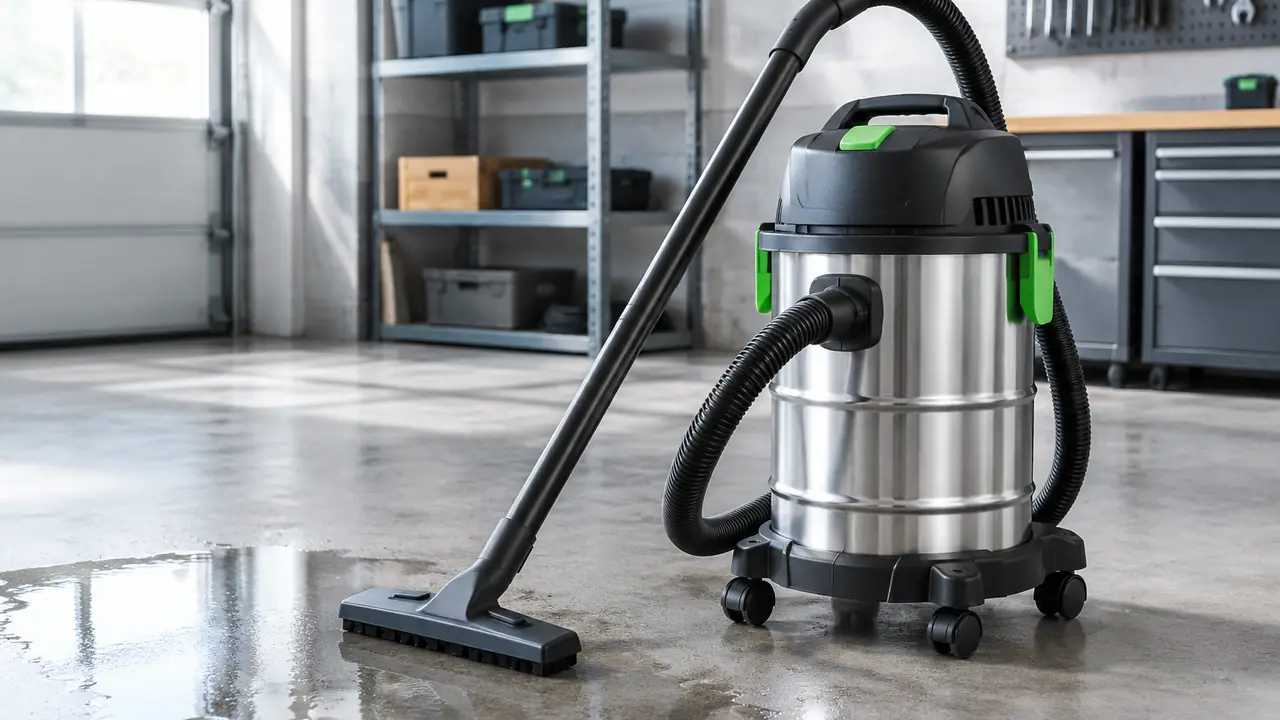
What a wet dry vacuum is
A wet dry vacuum is a tank with a motor head on top. Air is drawn through a hose into the tank, the heavy debris and liquid fall out, and the motor draws what remains through a filter. Unlike a household bagged or cyclone machine, the tank takes water, mud, sawdust and sharp debris without a bag, and a float cage shuts off airflow when the tank is full so the motor does not ingest liquid. The same machine becomes a dry-dust vacuum when a bag or a fine cartridge is fitted, and many models have a blower port for clearing leaves or drying a surface.
It is the most widely sold line in this family because the tooling is simple and the uses are broad: workshops, garages, car valeting, building sites, schools, food service and flood recovery. For a distributor, the tank sizes and the motor count create a natural good, better, best ladder from a single platform.
The six parts on the card
| Part | What decides performance | Typical options |
|---|---|---|
| 1 Motor head | Number of motors, bypass design, cooling, switch | One motor around 1,000-1,200 W; two motors up to about 1,600 W; blower port optional |
| 2 Float cage | Float mass, cage venting, foam sleeve for wet use | Standard on all wet models; reviewed with the tank to avoid foam problems |
| 3 Cartridge filter | Media, area, washability, sealing | Wet and dry cartridge; fine-dust or HEPA-grade option; paper or fleece bag as an add-on |
| 4 Tank | Volume, material, wall thickness, drain port | 20-80 L; stainless steel for durability, PP drum for weight and cost |
| 5 Hose | Diameter, length, cuff fit, crush resistance | 32-40 mm, 2-3.5 m; tool set with wand, floor nozzle, squeegee and crevice |
| 6 Casters | Wheel count, brake, diameter, trolley frame | Three or four swivel casters; larger wheels for rough floors |
The power, tank and noise ranges above are typical across the category, per model datasheet. Rated watts describe input power, not cleaning performance; suction and airflow need to be read together, as the suction and airflow guide explains.
Single, dual and triple motor
A single motor is quieter, lighter and cheaper to run, and is enough for most garage and light commercial use. Two motors add airflow and are chosen for larger tanks and heavy debris; three-motor models exist for demanding sites. More motors mean more heat and more noise, and one motor can run while the other is switched off. The trade-offs are covered in single vs dual motor wet dry vacuums, and the buyer-side view is in the wet dry buyer guide.
Tank, filter and the foam problem
Stainless steel tanks resist impact and cleaning chemicals and look right in a workshop; plastic drums are lighter and cheaper and are common in garage models. Whichever is chosen, the filter is the part that decides daily experience. A cartridge washed after wet use keeps airflow up; a paper or fleece bag keeps fine dust out of the cartridge. Foam sleeves protect the motor when picking up liquid that foams, a recurring issue covered in float valve and foam problems. If the machine will pick up fine dust such as plaster or sawdust, the filter must be matched to that dust; dust classes are a separate certification path, scoped per project.
Options worth specifying
- Drain port. A bottom drain or pump-out outlet saves lifting the tank.
- Power tool socket. An outlet on the head that starts the vacuum when a tool is switched on; common in workshop models.
- Accessory storage. On-board holders for the hose, cable and tools.
- Colour and branding. Head and tank colours, logo by pad print or label; see OEM and private label.
- Packaging. Tanks above 40 L are bulky; carton size and pallet pattern decide freight, see packaging.
Standards and inspection
Safety is assessed to IEC/EN 60335-2-2 and, for commercial and industrial use, IEC/EN 60335-2-69, with CE marking in Europe and UL 1017 via UL or ETL in North America; documents are verified per project. Before shipment, a typical plan checks float shut-off, suction and airflow on sampled units, noise at one metre, hi-pot and ground continuity on every unit, tank seal, hose cuffs and a carton drop test. The plan is agreed in writing before the first batch; see quality control, and use the quote form to send tank size, voltage and volume.