
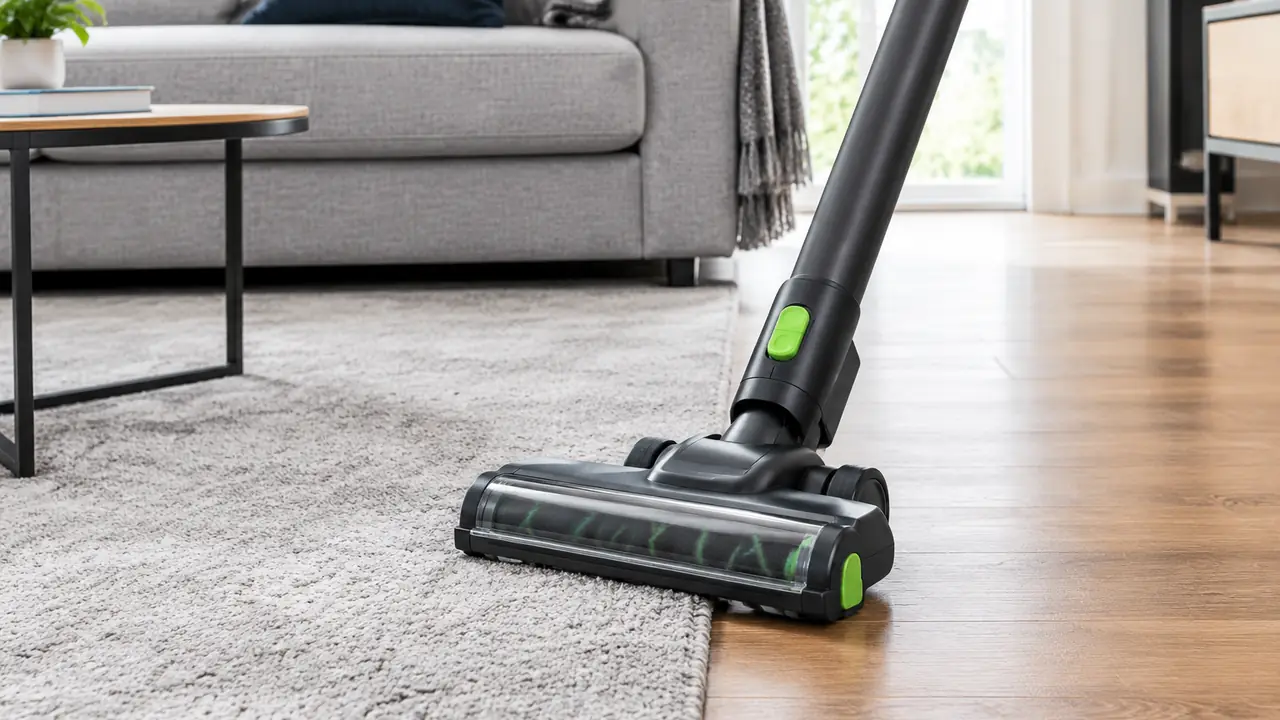
What changes on a hard floor
On a hard surface there is no pile to hold dirt, so the problem moves from release to containment. Fine dust, crumbs and hair sit on top of the floor and can be pushed ahead of a brush, flicked sideways by bristles or blown out of the way by the machine's own air. The right machine keeps contact with the floor, seals along the front edge so that air is drawn across the surface, and uses a soft agitator that lifts rather than whips. A tile floor adds grout lines where grit hides, and a wood floor adds the risk of fine scratches, so the head material and the wheels matter as much as the motor.
For a brand or retailer, this is the surface where a modest machine with a good head beats a powerful one with a poor head. The range plan should start from the head design and the seal, then choose the type.
Head and roller choices
The head is the part that touches the floor, and it decides how well the machine performs here.
- Soft fluffy roller. A roller wrapped in soft fibre picks up fine dust and larger crumbs together, and its contact is gentle on finishes. It is the usual hard floor option on cordless sticks.
- Bristle roller with a cut-out. Suited to mixed floors; a hard bristle is better kept for carpet.
- Passive floor tool. A felt-lined or rubber-edged brush without a motor. It is quiet, light and low-cost, common on canisters, and it leaves the airflow to do the work.
- Wet-capable heads. Floor washers and wet heads use a water tank and a damp roller; they belong to a separate category and are not a variant of a dry vacuum. Wet and dry options are compared in wet dry vs dry-only vacuums.
Supporting details count: a sealed skirt around the head, a clear front window and LED lights that show dust in the beam, and soft wheels that do not mark wood. These are tooling details, and the plant will want them settled before the head mould is cut. The brush roll page lists the roller options and wear parts.
Which types fit hard floors
| Type | Why it fits | Watch for |
|---|---|---|
| Cordless stick | Light, quick to deploy, soft-roller head; typical 15-30 kPa sealed suction and 30-60 min runtime | Head seal and edge cleaning; runtime on boost |
| Robot vacuum | Daily upkeep on hard floors; typical 2,000-6,000 Pa and 90-180 min runtime; mop-pad docks on some models | Edge and corner coverage; obstacles; radio compliance for Wi-Fi models |
| Canister with floor tool | Quiet, large bag, good reach under furniture | Hose weight; wheel marks if casters are hard |
| Handheld | Spot cleaning of spills and crumbs, typical 5-15 kPa | Limited area and runtime |
| Wet dry vacuum | Liquid spills in kitchens and garages | Not designed for daily floor care |
The ranges are typical across the category and are confirmed per model datasheet. For lines see cordless stick vacuums, robot vacuum cleaners and canister vacuum cleaners.
Suction and airflow on hard floors
Because the head is almost fully sealed against a smooth surface, a hard-floor machine can show a high pressure and a low airflow, which is the opposite of what a user wants. A fully sealed head can also drag and hold the machine on the floor. Good heads therefore include a small bleed gap or a skirt that allows air to pass under the edge. When a datasheet quotes only sealed suction in kPa, ask for airflow at the nozzle measured with a floor tool and for the standard used. The IEC 62885 series gives methods for dry household machines and for robots, which makes figures from different plants comparable. The suction and airflow guide discusses how to read the two figures together.
Noise and the home setting
Hard floors reflect sound, so the same motor sounds louder in a tiled kitchen than on a carpeted living room. Typical cordless sticks sit around 65-80 dB(A) per datasheet, measured with a method such as IEC 60704-2-1, and the figure depends on power mode. For a range sold into apartments, ask for noise in the normal mode, with the measuring distance stated. The noise levels guide lists what plants can do through motor mounts and airpath design.
Filtration and exhaust
Hard floors hold fine dust on the surface, which is easily drawn into the machine but is also easily resuspended if the exhaust is leaky. A two-stage system with a washable pre-filter and a pleated cartridge is standard. A HEPA stage is optional and is described by its EN 1822 grade, for example H13 for at least 99.95% capture at the most penetrating particle size. Include the filter in the spare-parts plan so customers can replace it at the interval the manual states.
Packaging and retail presentation
Hard-floor machines sell on what the shopper can see in a store or a listing: the head lit up, the roller visible, a floor-contact demonstration photographed on wood and tile. A clear head window and an exposed roller photograph well, and the carton can carry a short specification strip that lists runtime, noise mode and filter grade in the same format across the range. The desk coordinates the packaging partner for retail boxes, drop tests and pallet patterns; see retail chains for how a private-label range is usually planned with the retailer.
Compliance in brief
Corded canisters are tested to IEC/EN 60335-2-2 with IEC 60335-1, and in North America to UL 1017; in the EU, mains-operated household vacuums also fall under ecodesign regulation 666/2013. Cordless sticks and robots need UN 38.3 and IEC 62133-2 or UL 2054 for the battery, and robots with Wi-Fi add CE RED and FCC. Documents come from the partner plant and are verified per project. The certifications guide lists the routes by market.
Planning checklist
- Choose the surface mix of the target home: all hard floor, or hard floor with rugs.
- Select the type, then specify the head: soft roller, seal, lights, wheel material.
- Ask for airflow at the nozzle with a floor tool, plus noise in normal mode.
- Decide whether a washable filter or a HEPA stage fits the price band and the manual.
- Add a rug or carpet head option as a second variant; see choosing a vacuum type for carpet.
- Send the market and volume through the quote form. Reference quantities are on MOQ and lead time, always confirmed in writing for each program.