
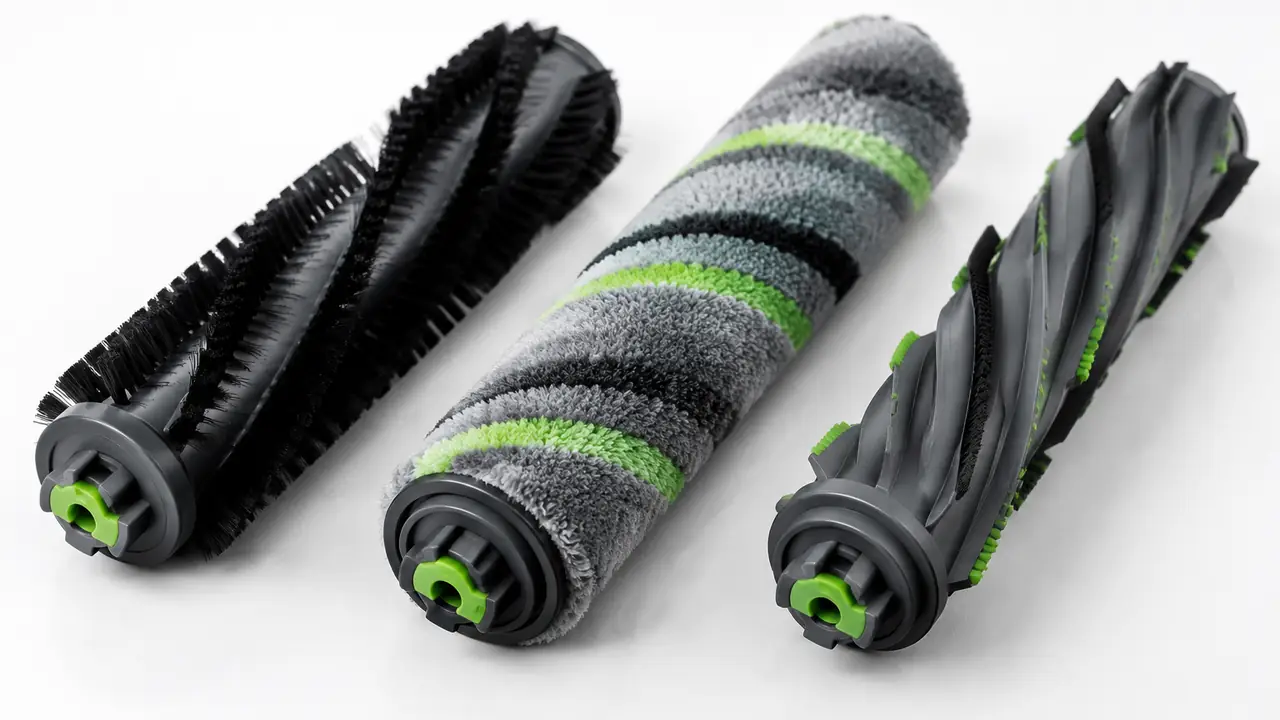
What a brush roll does
A brush roll is a rotating cylinder in the floor head. It agitates a carpet so that dirt rises into the airflow and, on hard floors, it sweeps debris toward the opening. The design is a balance between three things: how deep it cleans, how well it releases hair and how much it loads the motor. A roller that cleans carpet well but wraps with hair will generate returns, so the roller type is a product decision, not a detail. The related buyer guides cover brush roll designs and why a roll stops spinning.
Roller types
| Type | Construction | Best for | Watch for |
|---|---|---|---|
| Bristle | Nylon tufts in rows or spiral | Carpet and rugs | Hair wraps; hard floors can scatter debris |
| Fluffy | Soft microfibre pile, often with carbon-fibre strips | Hard floors, tile and wood | Less depth in thick carpet; wears with grit |
| Anti-tangle | Combed or comb-and-blade design, or V-shaped tufts | Pet hair, long hair | Needs a matching comb in the head |
| Dual or hybrid | Bristle and soft pile combined | Mixed floors | More complex to tool; heavier |
No type removes hair wrapping completely. Anti-tangle designs reduce it and make the hair easier to cut away, which is usually what pet-owner customers want.
The six parts on the card
- Roller core. Length, diameter and balance. An unbalanced core causes noise and early bearing wear.
- Bristles. Fibre type, tuft density and height. Stiffer fibre suits carpet; soft pile suits hard floors.
- End caps and bearings. A weak bearing is the most common reason for a noisy head. Sealed bearings keep hair and grit out.
- Brush motor. A separate DC motor of about 20-30 W lets a stick vacuum drive its head at a steady speed; it adds weight and cost.
- Belt or gear. Belts are cheap and quiet but stretch; gears last longer and cost more.
- Head housing. The nozzle opening, the clear window, wheels and LED lights; moulded in ABS and tooled per program.
Motor, belt and what wears
The parts that wear fastest are the belt, the bearings and the bristles, which makes them the best candidates for spare-part SKUs. Belts are small and light, so they ship cheaply, and a belt kit with two or three sizes covers a range of machines. Bearings fail when hair works inside, so the end-cap design should include a hair guard. The brush motor needs a load-sensing circuit that cuts power if the roller jams; ask the plant to describe the cut-off current and test it by blocking the roller on a sample.
Fit, drawings and tolerances
A replacement roller must fit the head within tolerance on length, diameter, drive end and idle end. A few tenths of a millimetre at the end cap can decide whether the roller turns freely or binds. The working method is a drawing, a sample on the original machine, a signed approval and a retained sample for later batches. Keep the drive-end shape in the drawing: a belt pulley, a gear or a socket that engages the brush motor differs between models.
Matching the roller to the market
North American buyers lean toward uprights with a belt-driven bristle roll and carpet as the main floor; European buyers lean toward hard floors and fluffy rollers on cordless sticks; pet-heavy markets ask for anti-tangle designs whatever the floor. A range of machines usually needs two roller options, one for carpet and one for hard floor, sold as an accessory or as a spare-part SKU. Packaging should show the roller length and the compatible model list, since a wrong-size roller is the typical return reason for this line. Add a short cleaning instruction and a cutter or comb tool in the box if the design calls for one; both reduce service questions and cost little per unit.
Sourcing flow
- Send the original roller and the machine model, or a drawing with tolerances.
- Choose the type: bristle, fluffy, anti-tangle or dual, and state the floors it is for.
- The desk asks partner plants for a fitted sample and a test on carpet and hard floor.
- Check noise, current draw, hair wrap and bearing play on the sample; approve the drawing.
- Agree batch checks: length, weight, tuft pull force and bearing spin.
Brush rolls are counted in thousands per variant; see MOQ and lead time for the reference figures. Send your roller and machine details through the quote form. Rollers are used in the cordless stick and upright lines and are often bought with the motor.