
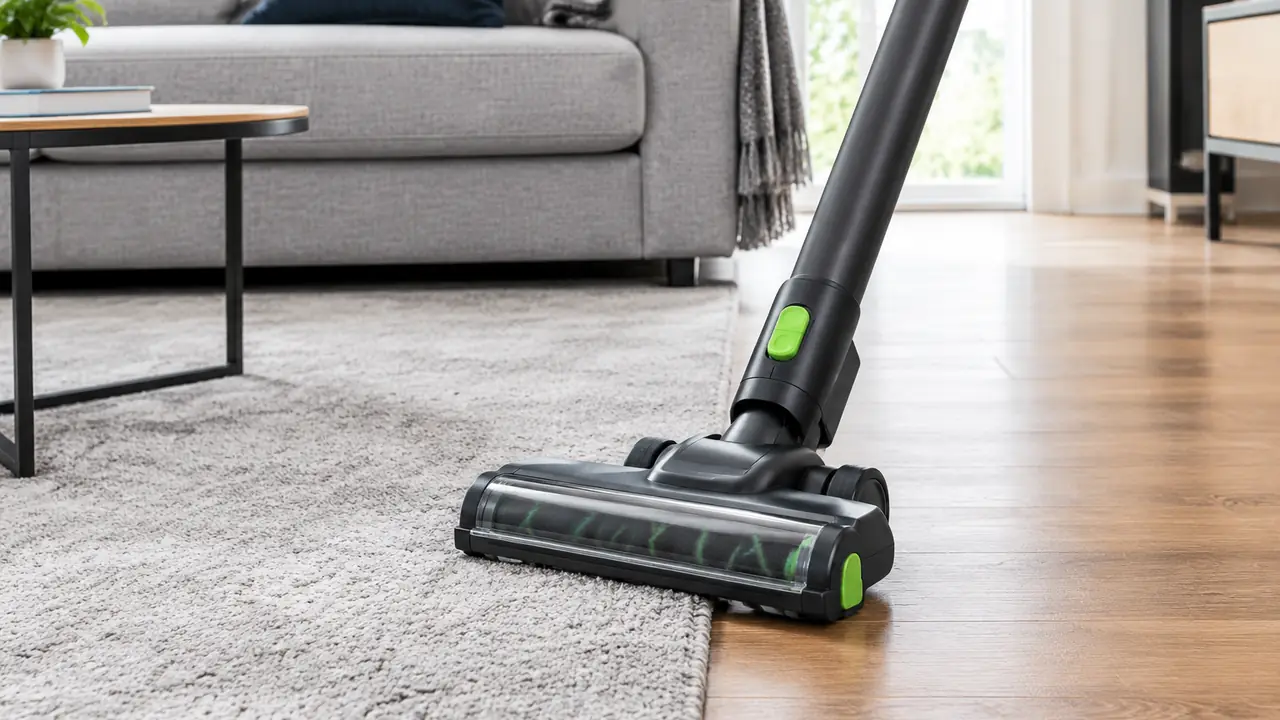
Why carpet is a different problem
On a hard floor, dirt lies on the surface and airflow can lift most of it. On carpet, fine dust, sand and hair are held between the fibres, sometimes down at the backing. Two things have to happen: the brush must beat or comb the pile so that particles are released, and a stream of air must pass through the pile fast enough to carry them into the nozzle. Pressure alone does little here. A sealed-nozzle kPa figure tells a buyer how hard the fan can pull against a closed opening, but a carpet head is never closed. What decides the result is the airflow reaching the brush chamber, the seal between head and floor, and how aggressively the roller works the pile.
That is why a range plan for carpet starts with the head and the airpath, and only then with the motor. The suction and airflow guide explains the two numbers in more detail, and the same logic runs through every type below.
Which types fit carpet
Four types are routinely sold for carpet, and each has a different strength.
- Uprights put a motor-driven brush head directly under the body, with a wide nozzle and a short, direct airpath. They remain the reference machine for deep-pile carpet, particularly in North America, and the corded supply lets the plant fit a larger motor and a stronger brush drive. See upright vacuum cleaners.
- Cordless sticks carry a motorised head on a wand. A brushless motor and a typical 15-30 kPa sealed suction give good carpet results in normal mode, but runtime falls sharply on boost, and the head motor draws from the same pack. See cordless stick vacuums.
- Canisters with a powered head separate the motor from the floor tool. They are quiet and have the largest bags, and an electric head restores the agitation that a passive tool lacks. See canister vacuum cleaners.
- Robot vacuums handle low-pile carpet well and maintain it between deeper cleans. Typical suction is 2,000-6,000 Pa and a roller brush does the agitation; a robot is a maintenance tool, not a replacement for a deep clean on thick pile. See robot vacuum cleaners.
Specification table for carpet ranges
| Parameter | What matters on carpet | Typical across the category |
|---|---|---|
| Brush roll | Motor-driven, stiff-to-medium bristle, tuned to pile height | Hard bristle, soft pile, anti-tangle or combination rollers |
| Head width and seal | A wide head with a good skirt keeps airflow in the pile | Per model datasheet |
| Sealed suction | Necessary, but not sufficient | Cordless stick 15-30 kPa; handheld 5-15 kPa; robot 2,000-6,000 Pa |
| Airflow at nozzle | The figure that predicts pick-up | Ask for the method, such as the IEC 62885 series |
| Runtime (cordless) | Carpet draws more than hard floor | 30-60 min in normal mode on 21.6-25.2 V packs |
| Filter | Carpet releases fine dust on every pass, so exhaust filtration counts | Pleated cartridge or HEPA H11-H14 under EN 1822 |
| Bin or bag size | Carpet fills a bin faster than hard floor | Bag or bin sized for a full room per emptying |
The numbers above are typical across the category and are confirmed per model datasheet. They are not claims for any one product.
The brush roll decides more than the motor
A brush roll choice involves trade-offs that buyers rarely see on a spec sheet. A stiff-bristle roller works deep pile but can scatter fine dust on hard floors and wear thin rugs. A soft roller with fluffy fibres picks up fine dust on mixed floors but does little for embedded grit. Anti-tangle designs shed hair along an angled bristle pattern or a cut-away core, which suits households with long hair or pets. The roller needs its own bearings, end caps and, in most motorised heads, a belt or gear to the head motor, and each of those is a wear item that belongs in a spare-parts plan. The brush roll page lists the options a plant will ask about. If a range targets pet owners, the pet hair vacuum line already combines the roller with a HEPA-class filter and a de-mite tool.
A practical way to plan is to carry two heads on one platform: a carpet-tuned head with a firmer roller and a multi-surface head with a soft roller, both fitting the same wand. Tooling for the head is separate from tooling for the body, so the extra variant adds less than a new model would.
Airflow, filters and exhaust air
Carpet puts more fine dust into the airpath than any other surface, and a vacuum that agitates the pile also stirs it. The pre-filter and the main filter have to hold that dust without choking the airflow. A foam pre-filter plus a pleated cartridge is typical; a HEPA stage adds capture at the exhaust. EN 1822 defines grades H11 to H14 by capture at the most penetrating particle size, with H13 at least 99.95%. A grade describes the media on a test rig; the machine also depends on seals around it. Describing a machine by its EN 1822 grade is accurate and gives the retail buyer a comparable figure. The filtration grades guide covers the trade-off between grade and airflow.
Power type and the paperwork it brings
Corded uprights and canisters follow IEC/EN 60335-2-2 with IEC 60335-1, and in North America UL 1017. In the EU a mains-operated household vacuum is also subject to ecodesign regulation 666/2013, which caps rated input power at 900 W and sets minimums for dust pick-up on carpet and for motor life. That cap shapes the carpet design: with fewer watts available, the plant must put more engineering into the nozzle and airpath. Cordless sticks are outside 666/2013 but need UN 38.3 for transport and IEC 62133-2 or UL 2054 for the pack. Partner documents are verified per project; the desk does not hold certificates. The certifications guide sets out the routes by market.
A short planning sequence
- Decide the pile height and the main market. Deep-pile North American homes favour uprights; European and mixed-surface homes favour canisters and sticks.
- Pick the type, then the head. Ask for two roller options and the head width.
- Request airflow at the nozzle and the test method, not only sealed kPa.
- Check runtime on the carpet head in normal mode, since boost is a short burst.
- Plan spare parts early: rollers, belts, filters and, for cordless, battery packs.
- Send quantities and markets through the quote form. Reference MOQ and lead times are on MOQ and lead time and are confirmed in writing for each program.
For hard-surface ranges read choosing a vacuum type for hardwood and tile, and for retail range planning see retail chains.