
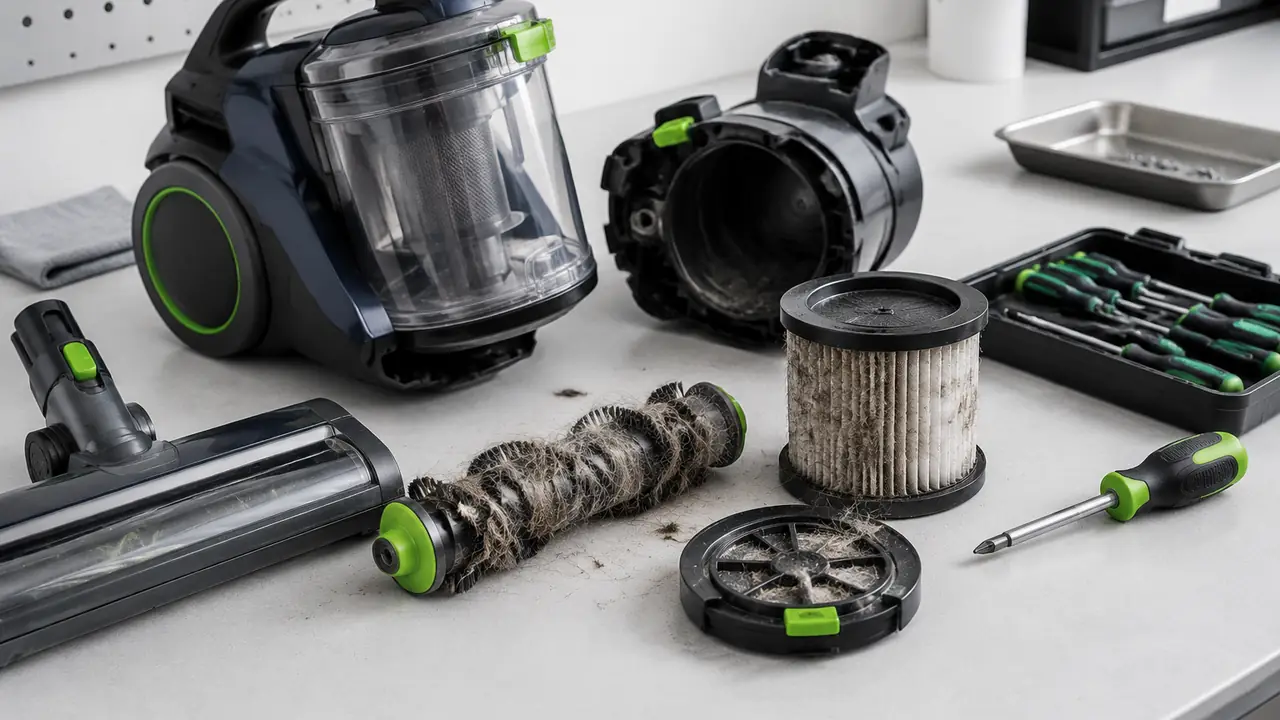
How a brush roll is driven
There are three drive systems. In a belt-driven head, a motor inside the machine body or head turns a rubber belt that spins the roller. In a direct-drive head, a small electric motor and gear train sit inside or beside the roller, with no belt. In an air-driven turbine head, the airstream spins a small fan that turns the roller, which is common on cordless handheld tools and some uprights. Each fails differently. Belts stretch and snap, direct-drive heads fail at the gearbox or the brush motor, and turbines stall when airflow is weak or the bearings are dirty.
Roller design also matters. Bristle, fluffy soft-roller and anti-tangle designs each handle hair differently, and the choice sets how often the roller needs cleaning. The design options are covered by the related note on brush roll designs in the components group; this article stays with the faults.
Causes in order of likelihood
| Rank | Cause | Typical sign | Owner |
|---|---|---|---|
| 1 | Hair and thread wrapped on roller and bearing ends | Roller stiff or stopped, motor strain, burnt smell | User, plus roller design |
| 2 | Debris jam: coin, sock, large grit between roller and housing | Sudden stop, clicking sound | User, plus clearance design |
| 3 | Belt slipped, stretched or snapped | Motor runs, roller does not turn | Wear part, spare supply |
| 4 | Bearing seized or worn | Roller hard to turn by hand, squeal | Bearing quality, sealing |
| 5 | Brush motor, gearbox or contacts fault (direct drive) | No power at roller, intermittent spin | Motor quality, QC |
| 6 | Brush switch, thermal trip or lockout | Brush stops when the machine is warm or on hard floors | Design, controller logic |
Checks in order
- Switch off and unplug or remove the battery before touching the head.
- Open the head, remove the roller and cut off wrapped hair with scissors. Check the bearing ends for thread.
- Spin the roller by hand. It should turn freely. Stiffness points to a bearing or a jammed end cap.
- Inspect the belt for stretch, cracks, shine or a snapped end. A belt that is slack or glazed should be replaced.
- For direct-drive heads, check the contacts between body and head and listen for the brush motor with the roller removed.
- Check whether the machine has an automatic brush stop on hard floors or after a jam, which resets after switching off.
What it means for a brand
Hair wrap decides the support load. On pet hair and long-hair households, a conventional bristle roller wraps within a few uses. Anti-tangle designs, with comb teeth, a conical end or a hairless soft-roller, reduce the problem, though none removes it. The spec for a pet hair line should state the roller type, a cutting slot or comb for hair, and a head that opens without a tool. A head that is hard to open will be left uncleaned and the brand will see more motor failures later.
Belts are wear parts. A belt may last a year or more in normal use and a few months in heavy use. The belt grade, the tension and the pulley finish affect life. The belt must be available as a spare, ideally in a pack of two, with a drawing in the manual. Without it, a three-month belt fault becomes a whole-machine return.
Direct-drive heads concentrate cost. A brush motor with gearbox adds weight and cost to the head, but it avoids belt issues and gives the roller steady torque on carpet. When the head fails the user needs a replacement head, so heads should be planned as a spare line item, not just a repair part. The related line pages are cordless stick vacuums and upright vacuum cleaners.
Bearings and sealing. Fine dust and hair reach the bearing ends. A bearing with a seal or a labyrinth shield, and an end cap that keeps hair out, extends life. Bearing grade is a small cost item with a large effect on noise, heat and brush stalls, so it belongs on the BOM.
Protection logic. Many machines stop the brush if current rises, which protects the motor and the user. The threshold needs to be set so that a thick carpet does not trip it but a jam does. Poorly tuned thresholds produce complaints that look like faults.
Reading returns data for brush faults
Brush complaints hide inside other labels. A buyer who writes poor pick-up on carpet or weak cleaning may have a stopped roller and a perfectly healthy motor. If the reason code list has a separate entry for brush not turning, and the return form asks for a photo of the opened head, the brand can see within weeks whether the main cause is hair wrap, belts or heads. Each points to a different action. Hair wrap calls for a better roller or clearer cleaning instructions. Belt failures call for a better belt grade or a spare in the box. Head failures call for a closer look at the brush motor, gearbox and contacts at the plant. The same data feeds the spare parts forecast, because the parts that fail first are the ones to stock first.
What to specify
- Drive type (belt, direct or turbine), roller type, bristle material and length per model datasheet.
- Bearing type, sealing and end cap design, and a head that opens without tools.
- Belt specification, spare supply and packaging with the product, or as an accessory.
- Brush stall current threshold and restart behaviour.
- Spare heads, rollers and belts planned for the life of the line, as covered in warranty and spare parts planning.
Inspection before shipment
A short inspection step catches most assembly faults on brush heads: spin the roller by hand to confirm free rotation, run each unit on a test carpet for a minute to confirm drive and brush stop behaviour, and check the belt tension and routing on belt-driven heads. A hair-wrap trial, using a standard hair sample on a test unit during approval, shows how the chosen roller behaves before mass production. Details are in testing and inspection, and the process is followed through quality control. To plan a head and brush roll program, use the quote form.