
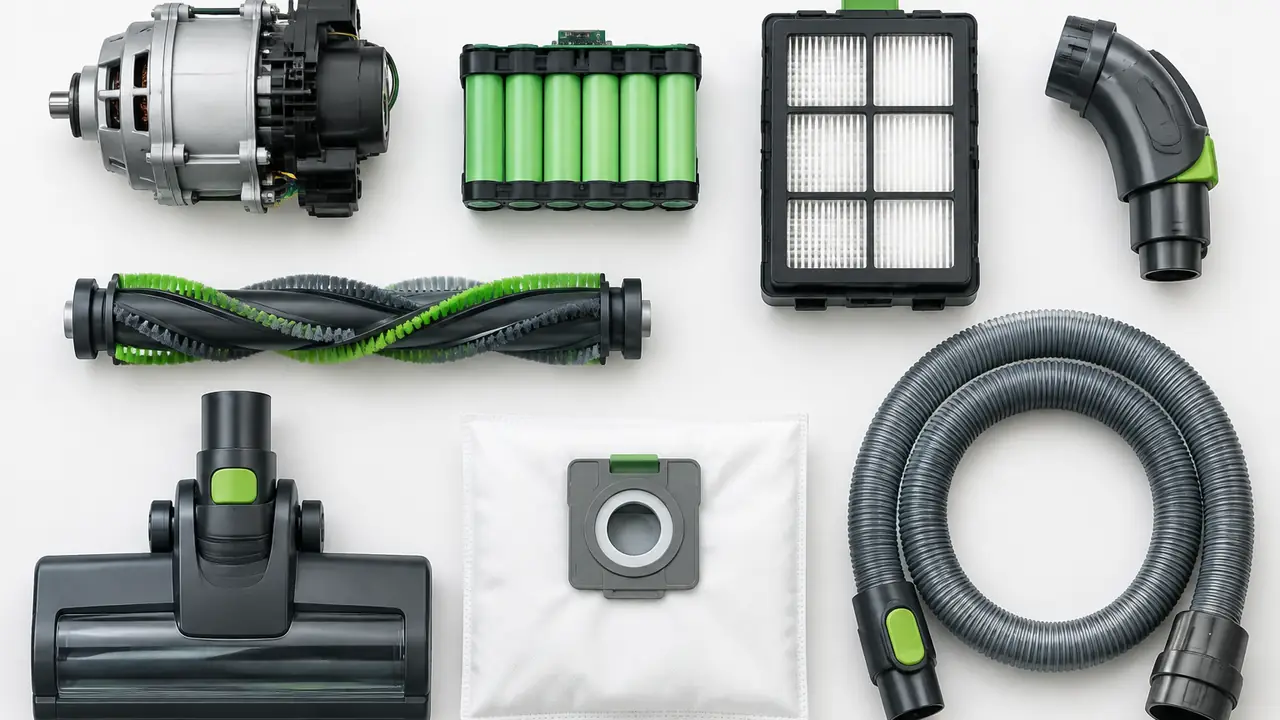
What a brush roll actually does
Airflow alone lifts light surface dust, but dust and hair sit in carpet pile or between floor boards, held by friction and static. A rotating roller agitates the surface, breaks that grip and flicks debris into the airstream, so the airflow only has to carry what the roller has loosened. This is why two machines with identical motors can feel very different: the head and roller geometry, the contact pressure and the sealing around the floor head decide how much of the motor's power reaches the floor. In a cordless or robot vacuum, where the motor power is limited, the roller carries a larger share of the cleaning job.
The brush roll is usually a standard replaceable part with a stable fitment to a head, which makes it a typical spare. It is a short-lived part by design; hair wrap, bristle wear and bearing wear mean replacement in the range of months to a few years depending on use. The wider floor-type guidance is covered in the carpet note and the hard floor note.
The main designs
| Design | Construction | Best on | Watch points |
|---|---|---|---|
| Stiff bristle roll | Rows of nylon or PP tufts on a plastic or metal core | Medium and deep carpet, rugs | Can scatter debris on hard floors; hair wraps around the core |
| Soft fluffy roller | Plush fibre or microfibre sleeve over a foam or plastic core | Hard floors, tile, laminate | Wears and flattens; less effective in deep pile; needs washing |
| Combination roll | Bristle strips and soft strips on the same core | Mixed floors in one pass | Compromise on both; more parts to wear |
| Anti-tangle roll | V-shaped or helical rubber blades, combs or split bristle rows | Pet hair, long hair households | Rubber friction on hard floors; shape and hardness need testing |
| Dual-roll head | Two counter-rotating rollers | Wide pickup, robot main brushes | More motor load and noise |
| Side or edge brush | Small spinning brush at the edge of a robot | Corners and edges | Hair wrap on the shaft |
These designs are categories rather than model data, and results vary with the compound and the head. The pet hair line puts the anti-tangle roll with a HEPA-class filter and a de-mite tool in one package; see pet hair vacuum cleaners.
Why hair wraps and how designs reduce it
Hair winds around a roller because a rotating cylinder with a rough surface pulls any filament into contact, and the filament then slides along the core until it meets resistance. Anti-tangle designs work in three ways. They replace long bristles with short rubber fins or comb strips, so there is less to catch. They add a comb or cutter edge that strips hair from the roller as it turns. They also give a clear path for hair to travel from the roller into the airflow instead of settling at the end caps. The end caps are an often-missed detail: hair that reaches the bearing gap will stall the roller regardless of the surface design. A good end cap has a shield or a labyrinth path, and a design that lets the user pull the roller out without tools.
Each of these has costs. Rubber blades increase friction and motor load on hard floors, which reduces cordless runtime; combs add parts; sealed end caps add cost. Buyers should therefore test the roller on the floors and hair types that matter to the target customer, not on a single bench trial. A table of test mix, such as long human hair, short pet hair and fibres, is a common practice in acceptance testing, defined in the order document rather than a published rule.
Drive methods
- Dedicated brush motor. A small motor in the floor head drives the roller through a belt or gears. It gives constant roller speed on carpet and is the default on cordless sticks and electric uprights.
- Air-driven turbine. Airflow spins a small turbine that turns the roller. No electrical connection is needed, but the roller slows under load and the airflow cost is real. It is common in cheaper canister heads and handheld tools.
- Belt drive from the main motor. Common in corded uprights. The belt is a service part and a regular reason for no-spin complaints.
- Direct-drive gear. A gearbox drives the roller directly. Quieter and more durable, but more expensive and heavier.
The drive choice also affects safety assessment, since a rotating roller must be guarded and a brush motor adds an electrical load that must be considered in the IEC/EN 60335-2-2 assessment. On a cordless machine the brush motor shares the battery with the main motor, which is why head drive and runtime are linked in the battery runtime guide.
Materials and wear
Bristle material is generally nylon or PP, with filament diameter and stiffness set per application. Soft rollers use microfibre or plush with a backing. Anti-tangle blades use TPE, silicone-type or rubber compounds, tested for hardness and abrasion. Cores are ABS, PP or aluminium. End caps and bearings are small parts with large effects: bearing wear, seal damage and hair intrusion cause most stalled-roller returns. Request wear data, not only a sample: a roller run on a test rig for a stated number of hours or metres, with a record of bristle loss, noise and current draw.
Specification checklist
- Target floors and hair types, and the competing machine they are compared with.
- Head width, roller diameter, length and end cap interface, with drawings.
- Roller type, bristle or blade material and the hardness or filament spec.
- Drive method and the electrical interface for a brush motor.
- Removal design: can the user take out the roller and clean it without tools?
- Acceptance test: hair test mix, runtime check on a hard floor and noise at the head.
- RoHS and REACH declarations for plastics, rubber and any dyes.
Ordering rollers as parts
Brush rolls are counted in thousands as parts and are often supplied by the same plants that make floor heads. The desk matches the roller to the head drawing, confirms the sample lead and batch lead in writing for each program, and recommends keeping a spare roller line in the range, as described in MOQ and lead time. Send the drawing and floor types through the quote form, and see the rest of the components category. If a roller stops turning in service, brush roll not spinning lists the checks.