
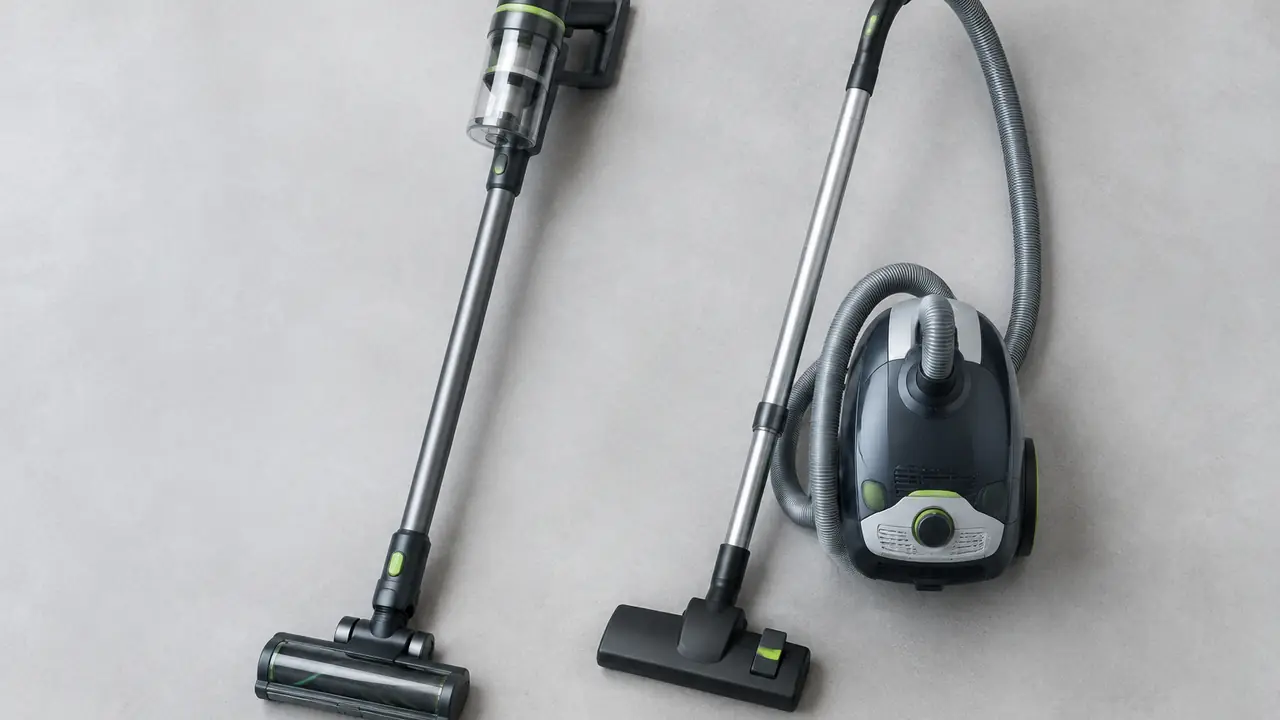
Two motors, two eras
A brushed universal motor is the traditional vacuum motor. Carbon brushes press against a rotating commutator to switch the current, and the motor runs on either alternating or direct current, which is why it is the default in corded machines. A brushless DC motor, written BLDC, has no brushes: a small controller switches the windings electronically, and the rotor carries magnets. Brushless motors dominate cordless sticks and robots, where efficiency decides runtime and where the controller is already part of the design. Typical cordless motors spin in the range of 90,000-120,000 rpm; the exact figure is per model datasheet. Brushless motors are not inherently stronger; they convert more of the input energy into airflow and less into heat, noise and wear.
Side by side
| Factor | Brushed (universal) | Brushless (BLDC) |
|---|---|---|
| Life | Limited by carbon brush wear; EU 666/2013 requires at least 500 h motor life for mains household models | No brush wear; life set by bearings and controller; usually longer than the product's expected use |
| Noise | Brush and commutator noise adds to fan noise; typical vacuums sit around 65-80 dB(A) per datasheet | Smoother running; quieter at the same airflow when the airpath is tuned; power mode still dominates |
| Efficiency | Lower; more heat for the same airflow | Higher; supports longer runtime on a given pack |
| Cost drivers | Simple winding, commutator, brushes; no electronics | Magnets, windings, controller board, rotor balancing; electronic design and testing |
| Certification route | IEC/EN 60335-2-2, CE LVD/EMC/RoHS, EU 666/2013 for mains models, UL 1017 | The same safety base plus EMC attention on the controller; battery tests for cordless; outside 666/2013 when battery powered |
| MOQ reference | Motors by the thousand from motor plants; machines 200-500 per model on public moulds | Same bands; custom controller or winding raises the minimum in ODM projects |
| Fits which buyer | Value-led corded ranges, rental and service fleets that want simple repair | Cordless and robot brands, premium corded lines, buyers who sell noise and runtime |
Ranges are typical for the category and confirmed per model datasheet. Timing and quantities come from MOQ and lead time and are confirmed in writing for each program.
Life and the repair question
Brush wear is the defining weakness of brushed motors. Carbon brushes shed dust and shorten with use, and the motor eventually loses power, sparks or stops. A motor that meets the 500-hour minimum in the EU technical file is not necessarily built to a longer target, and a commercial machine used for several hours a day may reach that figure within a year. For a service fleet, brushed motors have an advantage in repair: the part is cheap and widely available, and a technician can change brushes or the whole motor in minutes. Brushless motors usually outlive the product, but when one fails, the controller and the motor are often replaced as a unit, and the part is more specialised. A buyer should ask for the expected service life, the failure modes and the spare list, not just the headline.
Noise, heat and efficiency
Noise comes from the fan, the airflow and the motor. A brushless design removes one source, brush and commutator noise, and allows smoother speed control, so a plant can tune the airpath to lower the dominant tones. Heat is the other gain: a more efficient motor warms less, which protects the pack in a cordless machine and the bearings in all of them. A brushed motor in a corded machine can be made quiet with isolation mounts and a tuned housing, but it will normally need more insulation for the same level. Compare noise only with the same method and distance, for instance IEC 60704-2-1, and in the same power mode. The noise levels guide shows what to request.
Cost drivers without prices
Brushed motors are cheap because they are simple and made at very high volume. A brushless motor adds a magnet rotor, a more precise winding and a controller board, and it needs electronic design, firmware and testing. The price band of the finished machine should reflect that: a brushless motor on a budget corded upright is hard to justify, while a brushed motor on a cordless premium stick wastes battery. Cost also depends on whether the motor is a catalogue item or a custom design, how much testing is done per batch, and whether the controller is shared with other models. The desk does not quote prices in notes, and every figure is confirmed in writing for each program.
Supply chain and quality control
Motors are a component business. Brushed motors come from specialised motor plants with large catalogues, and a machine plant usually buys a standard frame with a custom winding or fan. Brushless motors come from plants that also supply the controller or work with a board supplier, which adds a second supplier to the chain and a second set of incoming checks. In both cases the quality plan should cover rotor balance, insulation and high-voltage tests on mains motors, no-load current and speed, bearing noise and a run-in test sample. For brushless designs add controller protection tests: over-temperature, stall and under-voltage cut-off. The desk records these checks in the inspection sheet agreed with the partner plant, as described on the quality control page, so a change of motor supplier during production is a written change and not a silent substitution.
Where each wins
- Choose brushless for cordless sticks, robots and handhelds, where runtime and noise decide reviews, and for premium corded lines that sell quietness. See cordless stick vacuums.
- Choose brushed for value-led corded ranges, wet dry units and fleets where repair speed and unit cost come first. See wet dry vacuums.
- Mix them deliberately in a range: a brushed entry model and a brushless upgrade on the same body, with the same filter and accessories.
What to specify
- Motor type, rated input power and speed range per datasheet.
- For brushed motors: expected life in hours, brush grade and replacement plan.
- For brushless motors: controller design, protection (over-temperature, stall) and EMC test report.
- Noise at a stated distance and mode; airflow and sealed suction with test method.
- Spare motor supply and who holds the drawings in ODM projects.
Send the target line, market and quantity through the quote form, and the desk will compare partner plants and motor suppliers against the same sheet. For the wider cordless decision read cordless vs corded vacuums.