
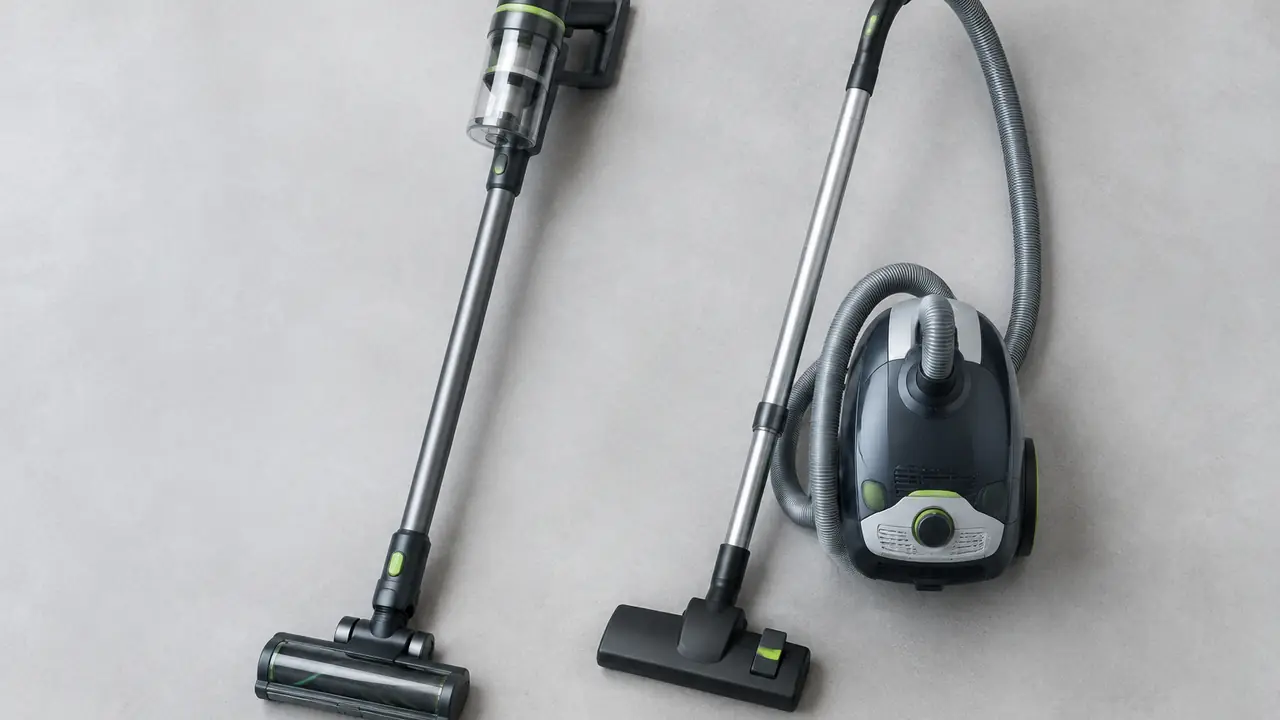
The decision in one paragraph
A corded machine takes unlimited energy from the wall and spends its design budget on the motor, the airpath and the brush. A cordless machine carries its energy in a lithium pack and spends its design budget on weight, runtime and heat. Everything else follows from that: the corded unit can run a heavier agitator for a whole house without a break, while the cordless unit wins on reach, speed of use and the way it fits a small storage space. Neither format is a better product in general. Each is the right answer for a different buyer, market and set of returns risks.
Side by side
| Factor | Cordless stick | Corded upright or canister |
|---|---|---|
| Performance | Typically 15-30 kPa sealed suction (entry models 10-20 kPa), brushless motor, power mode changes everything | Mains power holds a steady operating point; brushed universal motor common; ErP 666/2013 caps rated input at 900 W in the EU |
| Runtime | Typically 30-60 minutes in normal mode on 21.6-25.2 V packs of 2,000-4,000 mAh; far less on boost | Not limited by energy; limited by cord length and socket reach |
| Cost drivers | Cells, battery management board, brushless motor and controller, charger, lithium shipping | Motor, cord and plug set per region, bag or bin, housing size, regional ecodesign testing |
| Certification route | IEC/EN 60335-2-2, UN 38.3, IEC 62133-2 or UL 2054 for the pack, charger standard; UL 1017 in North America; outside 666/2013 | IEC/EN 60335-2-2, CE LVD/EMC/RoHS, EU 666/2013 for mains household models, UL 1017 in North America |
| MOQ reference | Public-mould about 200-500 units per model; private label about 500-1,000; ODM about 1,000-3,000 plus tooling | Same bands; corded platforms are mature, so more public-mould choices exist |
| Fits which buyer | Brands, e-commerce sellers, retail chains chasing new demand | Retail chains with fixed price bands, rental and service fleets, value-led brands |
The ranges above are typical across the category and are always confirmed per model datasheet. MOQ and lead times are references from MOQ and lead time and are confirmed in writing for each program.
When cordless wins
Cordless wins where convenience drives the purchase and the review. Small flats, stairs, cars and quick daily cleans reward a machine that can be grabbed and used in seconds. Cordless also wins on conversion in e-commerce, where video of a stick that converts into a handheld sells better than the specification sheet. The platform is modular: a plant can swap battery capacity, head type and filter without retooling the whole body, which suits brands that want two or three variants from one mould set. The trade-offs are runtime, battery ageing and the lithium paperwork. Battery packs are consumables, and a brand that sells cordless sticks without a plan for replacement packs and chargers is planning for returns. The battery runtime guide explains why runtime figures depend on the power mode quoted.
When corded wins
Corded wins where sustained power, a low unit cost and a mature supply chain matter. A large carpeted home, a rental fleet or a cleaning contractor needs a machine that works for an hour without a charge cycle, and a corded machine does so at lower cost. Corded platforms are also easier to ship and clear: no lithium packs in the carton, so no air-freight restrictions and no UN 38.3 documentation for the pack. Retail chains in Europe and North America still carry large corded ranges at fixed price bands, partly for these reasons and partly because spare-part supply for bags, filters and brush rolls is well understood. The downside is regulatory attention. In the EU a mains household vacuum falls under ecodesign regulation 666/2013, with a rated power limit of 900 W, an annual energy consumption limit of 43 kWh and a motor life of at least 500 hours, and these must be demonstrated in the technical documentation. The 665/2013 energy label was annulled in 2018, so a model should not carry that label. See canister vacuum cleaners for the quieter corded format.
Cost drivers without prices
The desk does not quote prices in notes like this one, but the structure of cost is useful. On a cordless stick the largest drivers are the cell chemistry and pack design, the brushless motor and its controller, and the charger. On a corded machine the largest drivers are the motor type, the quality of the brush head, the housing size and the cord set. Both are affected by tooling: public-mould platforms carry no mould cost, while ODM projects add a mould cost on top of a higher minimum. Certification adds cost per model and per market, and the cordless route is longer because battery tests come first. Typical references are CE test reports in about 2-4 weeks, UL or ETL in about 4-8 weeks and UN 38.3 in about 2-3 weeks, all inferred and confirmed per project.
What to specify in writing
- Target market, because it fixes plug type, ecodesign scope and the UL or CE route.
- For cordless: pack voltage, capacity, cell format, runtime in normal and boost mode, and replacement pack supply. See 18650 vs 21700 batteries for the cell question.
- For corded: rated input power, cord length, motor life evidence and noise at a stated method.
- Filter grade by EN 1822 name where HEPA-class filtration is claimed.
- Spare parts for the life of the product: filters, brush rolls, bags, packs.
Launching both, in order
Brands that need both formats usually start with the one that matches their channel. An online brand typically starts with a cordless stick and adds a corded canister or upright once it needs a lower price band for retail. A retail buyer typically starts corded for volume and adds a cordless line to follow demand. The shared parts, filters and brush heads are the savings: if both lines use the same filter family, the spare-parts business is simpler. For the next decision after this one, read robot vs stick vacuum, and for the fuller picture of formats read vacuum cleaner types explained.
Send the target market, annual volume and launch date through the quote form and the desk will shortlist partner plants for each format, with every figure confirmed in writing.