
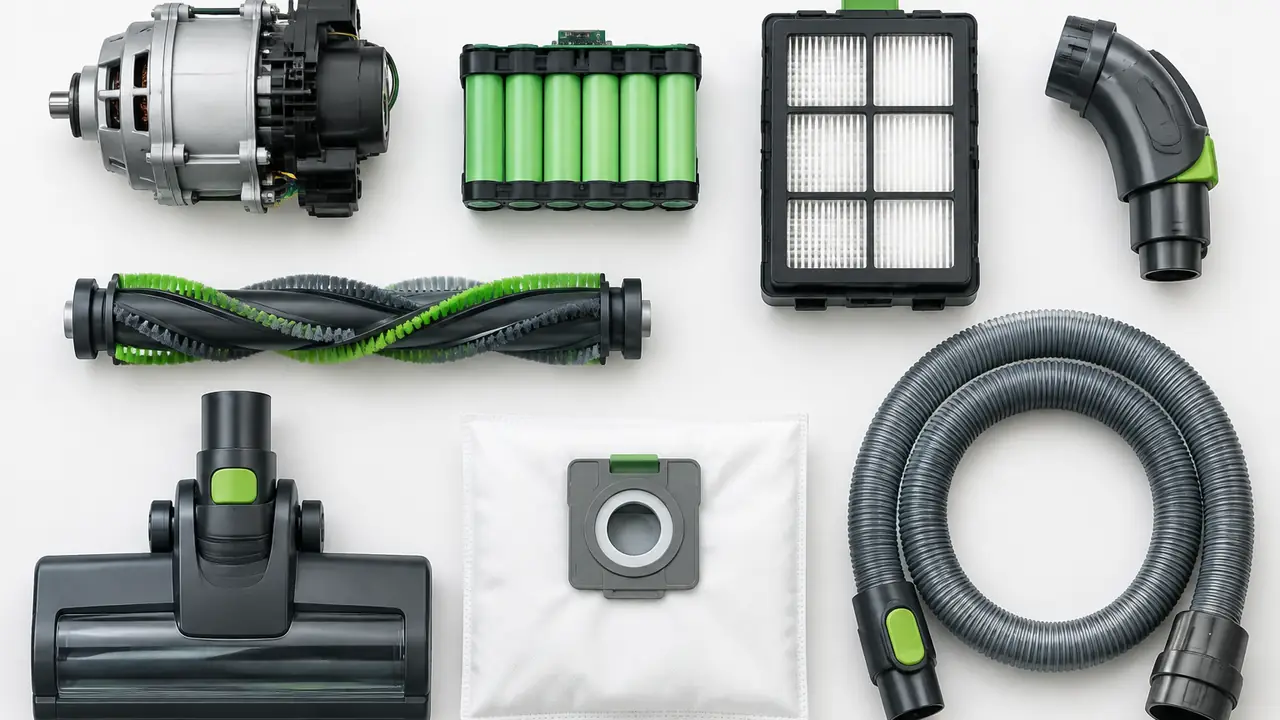
Two separate choices inside one part
People say vacuum motor as if it were one decision, but a motor unit is really two choices stacked together. The first is the electrical machine: how the rotor is driven and how current is switched. The second is the airflow design: how the fan stage or stages are arranged and whether the motor is cooled by the cleaning air or by its own air. A brushless motor can sit inside a bypass housing or a through-flow housing, and so can a brushed motor. Treating them separately makes quotation requests much cleaner, because plants price the electrical machine, the fan stages and the housing as different line items.
Across the category, the electrical choice follows the power type. Corded household machines overwhelmingly use a universal brushed series-wound motor, because it runs from mains voltage with no electronics. Cordless sticks, handhelds and robots use brushless DC motors, because a battery supplies direct current and the machine needs high speed from a small, light unit. The general background on airflow is in how a vacuum cleaner works.
Universal brushed motors
A universal motor is a series-wound machine with a commutator and carbon brushes. It is cheap, tolerates mains voltage swings, starts hard and can be speed-controlled with a simple phase-angle circuit. Typical corded vacuum units run in the tens of thousands of rpm. The trade-offs are well known. Carbon brushes wear and set the service life, commutator sparking produces electromagnetic noise that must be filtered for EMC, and the brush and commutator generate a characteristic high-pitched noise. In the EU, ecodesign regulation 666/2013 requires a motor life of at least 500 hours for mains-operated household vacuums, so a plant must be able to show brush wear data for the motor on the datasheet or in a test report.
For buyers the practical consequences are spare brushes on serviceable commercial machines and brush-wear testing on household ones. Wet dry vacuums, upright machines and canisters in the 1,000-1,600 W class are almost all universal-motor designs. The same logic is covered from a performance angle in brushless vs brushed vacuum motors.
Brushless DC motors
A brushless DC motor replaces carbon brushes and commutator with a permanent-magnet rotor and electronic switching. A small controller board reads rotor position, either through Hall sensors or by sensorless estimation, and energises the stator windings in sequence. Because nothing rubs, life is limited by bearings rather than brushes. Efficiency is higher, speed range is wider, and cordless sticks commonly specify rotor speeds in the range of 90,000-120,000 rpm for power in the region of 100-150 W electrical input per datasheet. The cost is the controller and the magnet, plus a more demanding bearing and balancing specification at those speeds.
The controller is part of the motor system, not an accessory. It sets under-voltage cutoff, current limit, thermal derating and the power curve as the battery falls. A buyer comparing two brushless motor quotations should confirm that both include the same controller scope, or the price comparison will be misleading. The motor, battery and brush decisions of a stick vacuum are bundled together in cordless stick vacuums.
Bypass and through-flow airflow designs
| Design | How the motor is cooled | Suited to | Watch points |
|---|---|---|---|
| Through-flow (direct) | The dirty-but-filtered cleaning air passes over the windings | Dry vacuums, compact household machines | Needs good filtration ahead of the motor; clogged filter raises motor temperature |
| Bypass | A separate cooling airstream; cleaning air only touches the fan | Wet dry vacuums, commercial machines | Larger housing, extra air path, but tolerates moisture and fine dust better |
| Single stage | Either of the above | Low-cost cordless and handheld | Lower pressure for the same speed |
| Multi-stage fan | Either of the above | Higher kPa machines, deep-pile carpet | More weight, longer motor, more precise balancing |
In a bypass motor the cleaning air does not pass over the windings, which is why wet dry vacuums and professional machines favour it: water, foam and dust cannot reach the electrical parts through the main airflow. A through-flow motor uses the cleaning air to cool itself, which saves space and parts but makes filter condition a motor-life issue. The airflow side of the specification, including how the fan stages shape kPa against flow, is explained in the suction and airflow guide.
What else belongs on a motor specification
- Rated voltage and input power. Mains voltage and frequency for universal motors; pack voltage range (for example 21.6-25.2 V) and peak current for brushless ones.
- Speed and air performance. Rated rpm, maximum sealed suction in kPa and airflow at a stated orifice, with the test method named, typically from the IEC 62885 series.
- Bearings and shaft. Bearing type, grease class, balance grade and shaft runout, since bearing wear is the end-of-life mechanism in a brushless motor.
- Insulation and thermal protection. Insulation class and the presence of a thermal cut-out, which are part of the IEC/EN 60335-2-2 assessment.
- Noise. The unit-level sound character matters as much as dB(A): tonal whine from high-speed rotors is noticed by users even when dB(A) is equal. See the noise levels guide.
- Mount and sealing. Rubber isolation, air seals and connector pinout, which decide whether a replacement motor fits an existing platform.
Ordering motors as parts
Brands and service importers sometimes buy motors on their own, either as replacement stock or to assemble a product with a partner. Motor orders are counted in thousands, as set out in MOQ and lead time, and the plant needs a drawing or a sample to match mounts and connectors. The desk coordinates with motor partner plants clustered in the Suzhou and Shunde belts where fan, magnet and controller suppliers are close together, and confirms dimensions, rpm, test method and sample lead in writing. Documents such as insulation reports or RoHS declarations are requested per project and verified before they are relied on. The wider parts category is at vacuum components.
Before a request, collect the target machine type, power type, desired suction and airflow with the test method, expected motor life, noise target and the market in which the machine will be sold. These data allow plants to propose a motor that fits instead of a catalogue item that nearly does. The quote form collects them in one place.