
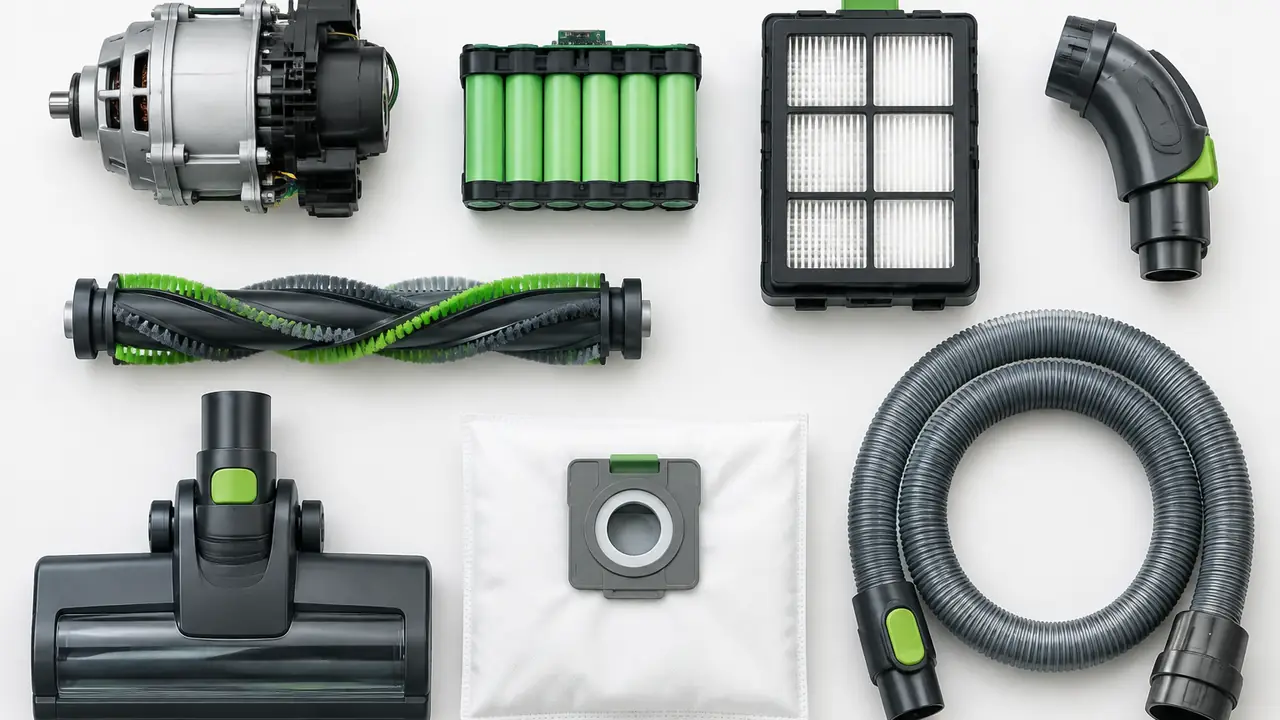
The air path outside the machine
In canister, wet dry, backpack and car vacuums, the hose is the air path between the floor tool and the body. In a stick, the wand does the same job as a rigid tube. Both are part of the pressure and airflow budget: a long, narrow or kinked hose adds resistance, and a leak in a cuff lets in air that never passes the nozzle. A hose is therefore not a passive accessory; it is a measured part of the airway, and changing it can change the result of a performance test. Test methods in the IEC 62885 series assume a defined hose and tool set, so a swap in the hose should be treated as a design change.
The hose also carries wiring in some machines. A canister with an electric floor head uses a hose with embedded conductors or a separate cable clipped along it, which affects the connector and the flex-life specification. The wand in a stick carries contacts or a cable to power the head. These electrical details belong to the safety assessment under IEC/EN 60335-2-2, so the hose and wand are part of the machine file, not just the parts list.
Hose materials compared
| Material | Typical use | Strengths | Limits |
|---|---|---|---|
| EVA | Household canister and handheld hoses, car hoses | Soft, flexible, lighter, good low-temperature behaviour, free of plasticiser concerns | Lower crush resistance than rigid PVC; can stretch with long use |
| PVC | Household and commercial hoses | Economical, good crush resistance, colour options | Stiffer in cold; plasticiser content must be controlled for REACH |
| PP | Wands, hose cuffs, some corrugated hoses | Lightweight, chemical resistant | Stiffer, can crack under repeated flex if poorly designed |
| Rubber or TPE | Wet dry and industrial hoses | Abrasion resistant, tolerant of cold and oil | Heavier and more costly |
| Anti-static reinforced hose | Workshop and extractor hoses | Grounding wire or conductive layer reduces static build-up | Needs correct fitting to carry the ground path |
Corrugated hoses use a reinforced spiral, usually a PP or wire helix inside a soft outer wall. The flexibility, the pitch of the helix, the wall thickness and the cuff bond decide crush resistance and kink recovery. A crush test, a flex test with the hose bent over and over, and a pull test on the cuff are the usual acceptance items. Their parameters are agreed per program rather than taken from a single published rule.
Wands and tubes
Wands in a stick are usually either plastic (ABS or PP) or aluminium, and either fixed or telescopic. Aluminium gives rigidity and a premium look at a modest weight penalty; plastic wands are lighter and cheaper, and can carry integrated conductors. Telescopic wands allow height adjustment and compact storage, but they add locking mechanisms that wear. A good telescopic design has a positive lock that survives repeated extension and a seal at the sliding interface, because a loose tube leaks air and rattles. Stainless tubes are used in commercial and wet dry machines where durability matters more than weight.
- Diameter. Common household tube diameters sit in the 32-38 mm range, with a smaller range for handhelds; the cuff must match the tool and the body inlet.
- Wall thickness and finish. Thin-wall aluminium dents; anodised or powder finishes affect appearance and wear.
- Locks and buttons. Release mechanisms should be tested for cycles, not only for strength.
- Electrical contacts. Where the wand carries power, contact material and plating decide resistance and corrosion.
Cuffs, connectors and the fit problem
Most field complaints about hoses and attachments are really fit complaints. A cuff that is a fraction too small cracks the first time it is forced on; one that is a fraction too large leaks and falls off. Standard-looking tube diameters differ by region and by model, so a replacement hose from a different source may not fit even though it looks the same. The remedy is a drawing with tolerances at the interfaces, a fit gauge or sample from the existing machine, and an agreed number of connect-disconnect cycles. A clip or a bayonet is more positive than a friction fit and may be worth the extra cost on commercial machines.
Attachment sets
Attachments are also where retail buyers differentiate. The usual tool set includes a crevice tool, an upholstery tool, a dusting brush and a floor nozzle, and may add a pet tool, a mattress head, an extension wand or a car kit. A list of tools should be matched to the end customer, not stuffed in to make the box look full. Each added tool is a tooling cost and a packaging cost, and a tool that is rarely used becomes a return reason when it goes missing. For car vacuums, a long flexible hose with a narrow crevice tool matters more than a wide floor head. See car vacuum cleaners and canister vacuum cleaners for how the sets are normally configured.
Length, diameter and airflow loss
Hose length and inner diameter set how much of the motor's output reaches the floor tool. As a rule of thumb across the category, a longer and narrower hose raises resistance, and a smooth-bore hose of the same diameter loses less than a corrugated one because the ribs create turbulence. Household canister hoses typically run about 1.5-2.0 m, car hoses are often longer and thinner, and commercial or workshop hoses are longer and larger in diameter. These are typical ranges, and the right figure depends on the machine and is listed on the model datasheet. When a brand lengthens the hose to improve reach, ask the plant to repeat the airflow measurement with the new hose; a gain in reach that costs a visible drop in pickup tends to appear later as a review problem.
Material compliance and quality checks
- RoHS and REACH declarations for hose compounds, plasticisers, colourants and cable sheaths, requested per project.
- Dimensional drawings with tolerances at cuffs, tube joints and bayonets.
- Flex, crush and pull tests on a stated sample size.
- Appearance standards for colour, sink marks and flash on tools.
- Incoming inspection of a sample from each batch for fit on the actual machine.
Chemical odour from new hoses is also a real complaint; ask the plant about its odour control and storage practice before the first order. The material rules are summarised in RoHS and REACH for vacuum plastics and cables.
Ordering hoses and attachments
As parts, hoses and attachment sets are counted in thousands, with timing on MOQ and lead time confirmed in writing for each program. Send the machine, drawing or sample and the tool list with the quote form. The wider parts range is in vacuum components.