
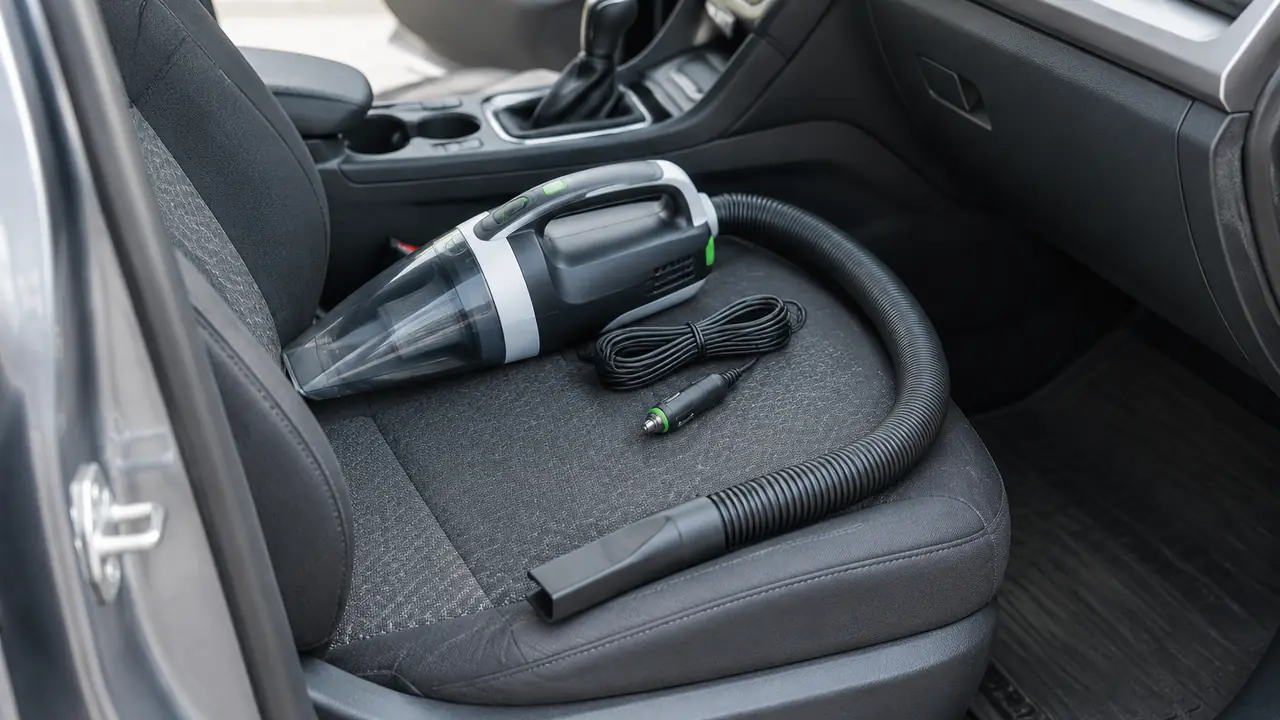
What a car vacuum is
A car vacuum is a handheld cleaner tuned for vehicle interiors. It comes in two forms. The 12 V version plugs into the vehicle accessory socket, typically draws 60-150 W and never runs out of power while the engine runs. The cordless version carries a small lithium pack, can be used in a garage or on a boat, and is charged at home. A third hybrid, with a battery and a 12 V charging lead, is common in gift and kit packages. The car owner usually buys on three expectations: it must reach tight seat gaps, it must pick up crumbs, sand and pet hair from carpet and plastic, and it must be easy to store in a door pocket or boot.
Car vacuums are built in the Guangdong small-appliance clusters and in Zhejiang, often by plants that also make portable handheld units; see the clusters. For the automotive aftermarket the commercial value is often in the kit rather than the machine: a bundle with tools, a storage bag and a gift box can open accessory-shop, petrol-station and online channels. Read solutions for the automotive aftermarket for that route.
The six parts on the card
| Part | What decides performance | Typical options |
|---|---|---|
| 1 Handle and trigger | Grip, switch, balance | In-line or pistol; slide switch with one or two speeds |
| 2 Motor | Input power, fan design, thermal limit | 12 V DC at 60-150 W; brushed in entry models, brushless on cordless |
| 3 12 V cord or battery | Cord length, plug and fuse, or cell grade | Socket plug with fuse; or cordless pack, per the handheld ranges |
| 4 Filter | Grade, washability, seal | Washable foam or cloth; HEPA-type post-filter optional |
| 5 Dust cup | Volume, visibility, emptying | 0.3-0.5 L, transparent, quick release |
| 6 Crevice tool | Length, tip shape, brush attachments | Long slim nozzle, soft brush, flexible hose |
Figures are typical ranges seen across the category, per model datasheet. A 12 V machine cannot be rated like a mains model: the supply is limited by the vehicle socket, so a 150 W claim on a 12 V circuit deserves a look at the fuse rating and the test report.
12 V design limits
A vehicle accessory socket is protected by a fuse, and the fuse rating sets the ceiling on what the vacuum can draw, which is why the category tops out around 150 W. A sound design keeps the motor inside the socket limit, fits a fuse in the plug and uses a cord gauge that does not drop voltage over a long run to the boot. Weak products overstate input power or use thin cord that heats up; ask the plant for the fuse rating, cord specification and temperature rise from the test report. The desk checks these on sampled units before approving a batch. See the car vacuum buyer guide for the checklist.
Compliance and shipping
Car vacuums follow IEC/EN 60335-2-2 and carry CE (LVD, EMC, RoHS) in Europe. Models with a mains charger need the charger standard (IEC 62368-1 or 60335-2-29). A cordless car vacuum needs UN 38.3 and IEC 62133-2 for the pack. The 12 V plug-in version has no battery, so it ships more simply and often by air in small batches. Where tool kits include accessories for the vehicle, keep the plastics within RoHS and REACH limits; see the certifications guide.
Cleaning jobs and tool choice
Most of the cleaning in a car is in places a floor head cannot reach, so the tool set decides the experience more than the motor does. Seat rails and the gap between the seat and the console need a long, slim crevice nozzle. Fabric seats and carpet respond to a soft brush that loosens crumbs and pet hair before they are drawn in. Vents, door pockets and cup holders need a short flexible hose. A reviewer who tries a car vacuum for ten minutes will judge it on whether these jobs work without swapping tools constantly, so the kit should be built around the three or four jobs the target customer does most. The same logic applies to RV and boat owners, who need slightly longer reach; see vacuums for RVs and boats and hose and attachments.
Options worth specifying
- Kit contents. Long crevice tool, soft brush, flexible hose, spare filter, storage bag.
- Cord. Length that reaches the boot; coiled or straight; fuse access.
- Light. LED on the nozzle for footwells.
- Packaging. Gift box or blister for retail, mailer-safe carton for online; see packaging.
Inspection before shipment
- Input power and suction at the nozzle on sampled units, tested on a regulated 12 V supply.
- Plug fit, fuse rating, cord temperature after a full run.
- Noise at one metre against the retained sample.
- Filter seating, cup release, tool fit and accessory count.
- Carton drop test, label and manual against the approved sheet.
The plan is agreed per program; see quality control, MOQ and lead time and the quote form.