
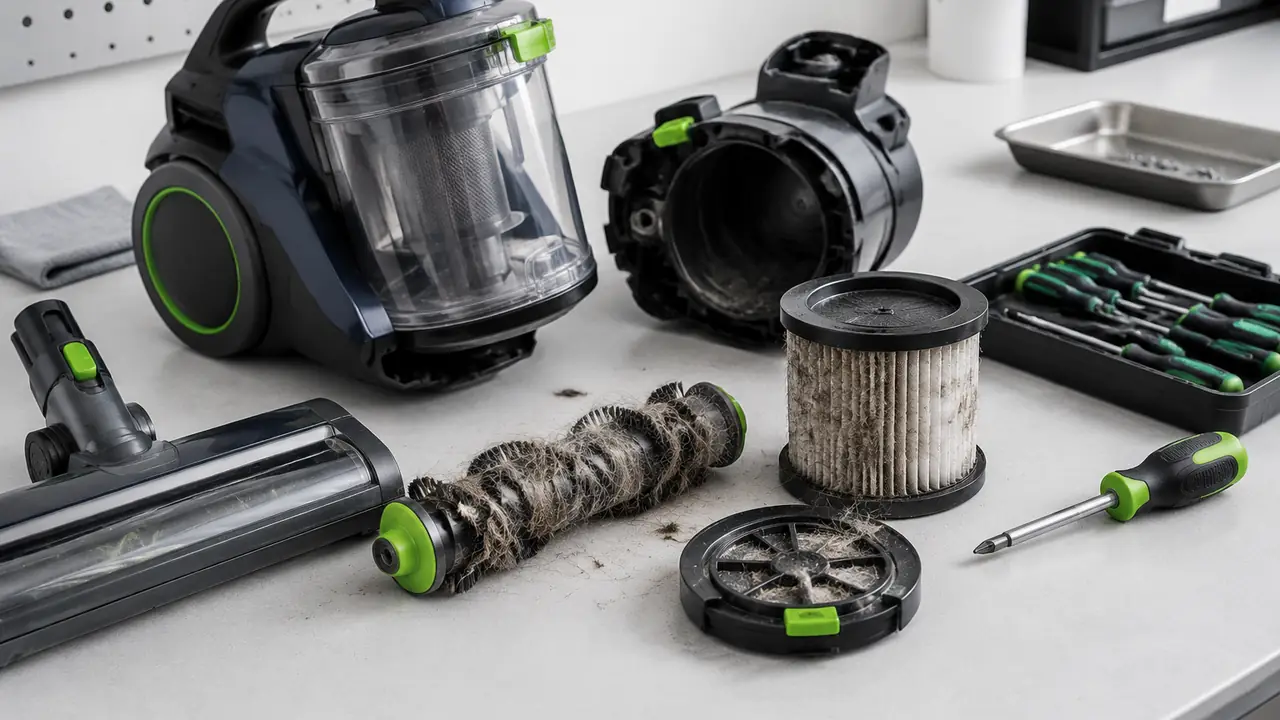
Why suction is rarely one fault
A vacuum cleaner is an airway with a motor at one end. Anything that narrows the airway, lets air in at the wrong place, or weakens the motor lowers what the user feels at the nozzle. Because the user only sees the result, a complaint of no suction can describe six different faults, and a returns desk that cannot tell them apart will refund every unit. For a brand, the useful question is which causes are the user's maintenance, which are design weaknesses and which are production defects, because each has a different fix.
The ranking below reflects typical field patterns across the category rather than any measured figure for a given model. It is a working order for diagnosis and for deciding where a specification needs a tighter requirement.
Causes in order of likelihood
| Rank | Cause | Typical sign | Usually owned by |
|---|---|---|---|
| 1 | Blockage in hose, wand, inlet or brush head | Suction at the motor, none at the floor tool | User, plus design of the airway |
| 2 | Full bin or bag | Power drops as the container fills | User, plus capacity and fill-line design |
| 3 | Clogged pre-filter or main filter | Weak suction, warm exhaust, dust smell | User, plus filter media and access design |
| 4 | Air leak at seal, latch, hose cuff or bin lid | Whistling, suction returns when pressed by hand | Tolerances and production assembly |
| 5 | Worn or tangled brush roll, damaged belt | Suction present but pick-up poor on carpet | Wear parts and spare-part supply |
| 6 | Weak motor or depleted battery | Low power even with a clean airway | Motor selection, battery management, QC |
The first three causes together are what most consumer guides describe, and they are mostly about maintenance. Causes four to six are where a sourcing program has leverage.
Checks in order
The same order works for a returns bench or for a user manual. Each step isolates one part of the airway.
- Remove the floor tool and test suction at the wand or hose end. If suction returns, the fault is in the brush head or its inlet.
- Disconnect the hose and wand and test at the machine inlet. If suction is good there, the blockage is in the hose or wand; a thin rod or a torch will find it.
- Empty the bin or replace the bag, and check the fill line. Many machines lose noticeable power well before the bin looks full.
- Inspect the pre-filter and main filter. A washable foam filter that has not fully dried, or a pleated filter coated with fine dust, restricts airflow while looking intact.
- Listen for a leak with the nozzle closed: a steady note is normal motor load, a whistle or flutter points to a seal, lid or cuff.
- Check the brush roll for hair wrap and the belt for stretch. Then, only after the airway is clear, suspect the motor or the battery.
What each cause means for a brand
Blockages are partly a design decision. A hose with a tight bend, a narrow wand joint or a brush head inlet smaller than the wand will clog on ordinary household debris. The spec should name minimum internal diameters at each joint, and the sample review should include a pick-up trial with realistic debris such as hair, crumbs and paper fragments.
Full containers are about capacity and visibility. A transparent bin with a clearly marked max line reduces complaints more cheaply than a larger motor. Dust capacity and emptying design are covered in the performance notes, and bag and bin options sit under dust bags and bins.
Filters decide how fast airflow decays between cleanings. A fine HEPA grade under EN 1822 such as H13 gives better filtration but clogs sooner than a coarse filter, so the pre-filter and the cleaning interval printed in the manual must match the media. Details are on the filters and HEPA page.
Leaks are a production topic. A seal that fits on a gauge sample may leave a gap once a latch wears or a housing warps from moulding stress. Sample-versus-batch drift shows up here first.
Motor and battery weakness is last in frequency but highest in cost per case. A brushless motor with a controller that limits power at low voltage may feel weak in the last third of battery charge even though nothing is faulty. The manual and the app, if any, should say so.
What to put in the specification
- Airflow and sealed-suction values per model datasheet, with the test method named: IEC 62885 series for performance.
- Minimum internal airway diameters at hose, wand and brush inlet.
- Filter grade, pre-filter type and the cleaning or replacement interval the manual will state.
- Seal and latch acceptance: a defined leak test or a pass-fail check on the line.
- Spare parts available at launch: filters, belts, brush rolls, hoses and bags, as discussed in warranty and spare parts planning.
Reading the complaint correctly
Returns data is only useful if the reason code is specific. A reason list that reads no suction, weak suction and poor pick-up merges three different faults. Splitting it into blocked airway, filter or bin maintenance, air leak, brush problem and motor or battery lets the brand see within one season which share of cases is education, which is design and which is production. Photographs of the filter and the brush roll, requested at the support stage, cost little and remove a large part of the guesswork. Brands that run this analysis usually find that a handful of cheap changes, such as a clearer fill line, a filter that is easier to reach and a printed cleaning interval, remove more cases than a motor upgrade would.
Inspection that catches it before shipment
Suction complaints that trace to leaks or weak motors are visible in a sample from the production batch. A pre-shipment check that records input power, sealed suction or airflow on a random sample, and compares it with the approved golden sample, will surface drift. The sampling plan and the pass-fail band are agreed in writing for each order, and the desk arranges the inspection with the partner plant. See testing and inspection for the items typically covered, and quality control for how the desk follows a program through production.
If you are specifying a new line or tightening an existing one, send the target market, power type and annual volume through the quote form, and the desk will return a shortlist of partner plants with the checks above built into the plan.