
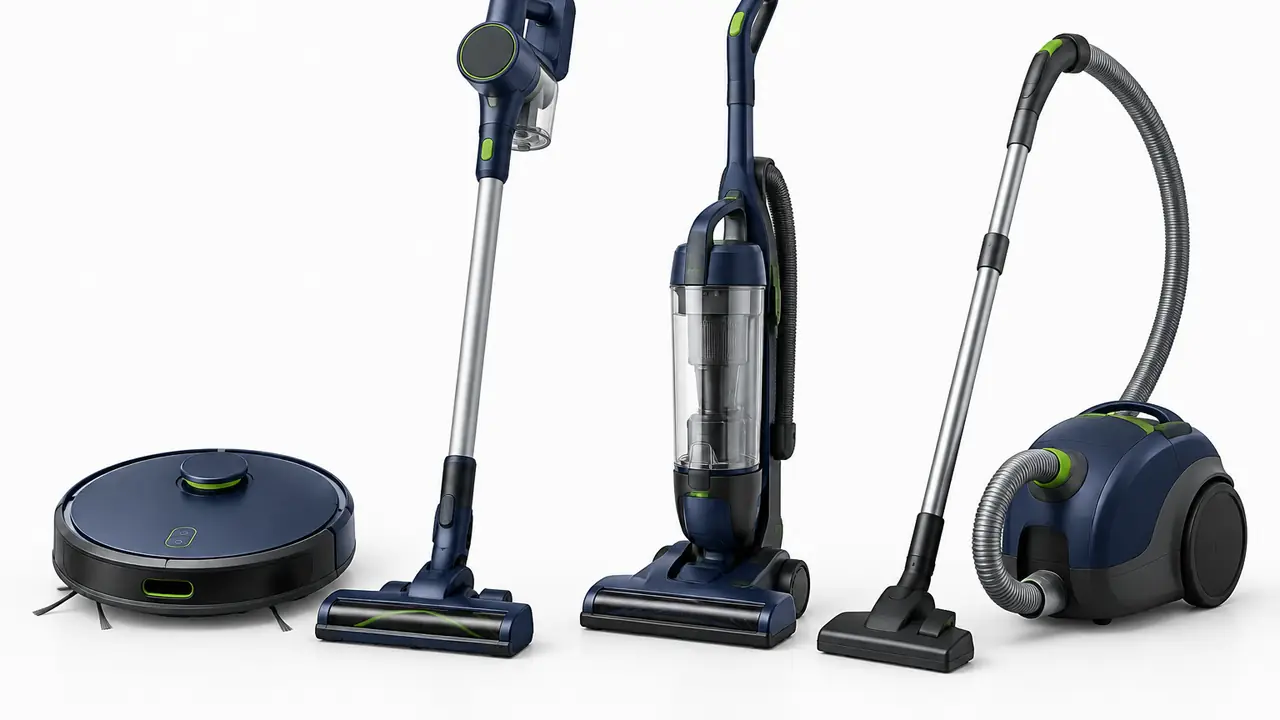
Why the stick platform dominates new programs
A cordless stick packs a motor head, a cyclone, a dust bin, a battery pack and a wand into one handheld body, and most plants in Suzhou and Shenzhen run several variants on the same internal platform. That is useful to a buyer: the platform has been through certification and drop testing, spare parts exist, and customisation can be confined to the parts the customer sees. Market estimates for cordless vary widely by scope, but one publisher, Fortune Business Insights, puts cordless at roughly 80% of the stick segment, which is why this line is often the first one a brand launches. The wider comparison is in cordless vs corded vacuums.
The four decisions that set the product
| Decision | Typical options | What it changes |
|---|---|---|
| Motor | Brushless DC, 100-150 W class, 90,000-120,000 rpm | Suction, noise, life, battery draw |
| Battery pack | 21.6-25.2 V, 2,000-4,000 mAh, fixed or removable | Runtime, weight, shipping rules |
| Brush head | Soft roller, bristle roller, anti-tangle roller, LED lighting | Carpet and hard floor results, hair wrap |
| Filtration | Foam and felt pre-filter, post-filter, HEPA H11-H13 option | Exhaust quality, cleaning interval, parts cost |
Typical across the category, suction is quoted at 15-30 kPa with entry units at 10-20 kPa, runtime at 30-60 minutes per model datasheet and noise at about 65-80 dB(A). These are ranges, not promises; every figure should be confirmed against a datasheet and a test method such as IEC 62885 for performance and IEC 60704-2-1 for noise.
Motor and battery: the pairing matters more than either number
A brushless motor draws a controlled current and lasts longer than a brushed one, but a high-power motor on a small pack either shortens runtime or triggers thermal protection. Plants usually offer a power-mode switch: a low mode for floors, a high mode for carpet and a boost for short bursts. Ask for runtime in each mode, not a single figure, and for the discharge rate the cells can sustain. Cell format and pack architecture are discussed in 18650 vs 21700 cells, and the runtime logic in the battery runtime guide.
A removable pack allows a second pack as an accessory and cuts the cost of a warranty repair, at the price of a connector and a latch that must survive years of use. A fixed pack is lighter and cheaper. Whichever you choose, confirm that the pack supplier is named in writing so a later cell substitution is a change you approve rather than discover. Pack options are on battery packs and motor options on vacuum motors.
Brush head, wand and filters
Most complaints about cordless sticks trace to the head rather than the motor. A roller that wraps hair, a head too tall for low furniture, a seal that leaks at the wand joint: all of these cost the user suction that the datasheet says exists. Specify the roller material, the end-cap bearings, the head width and whether the head has its own motor or is driven by air. For pet households, ask for an anti-tangle design and see pet hair vacuum buyer guide. Brush options are on brush rolls.
Filter access is the other sticking point. A washable pre-filter in a place the user can reach is a better product than a premium filter behind a screw. If HEPA is specified, write the EN 1822 grade, for example H13, and ask where the seals are, since exhaust quality depends on the seal and not only on the media. Ask also whether a replacement filter is a catalogue part, because the spare-parts line is where a brand earns repeat sales.
Ergonomics, accessories and packaging
Weight and balance decide whether a stick is used daily or left in the cupboard. Typical complete units weigh in the low single-digit kilograms, with the battery and motor at the top of the handle; a heavier head or a long wand shifts the balance forward and tires the wrist on stairs. Ask for the weight with the standard tool set, the length with and without the wand and whether the unit converts to handheld. Wall mounts, charging docks and tool sets are low-cost additions that change retail perception, and they also change the carton size and the pallet count. Settle the accessory list before the box is designed, because the box is the last thing that can be changed cheaply. Packaging options are on packaging and retail boxes.
Warranty planning belongs here too. A cordless stick has four parts that wear: the pack, the filters, the roller and the seals. Decide which are covered, which are sold as spares and how defective units are handled in a market without a service centre. Many brands agree a small percentage of free replacement parts shipped with each lot, written into the purchase agreement and confirmed per order.
Certification and shipping
A cordless stick is tested to IEC/EN 60335-2-2 with IEC 60335-1 for the vacuum and its charger, with CE covering LVD, EMC and RoHS plus REACH for Europe. Regulation 666/2013 does not cover cordless machines. The pack needs IEC 62133-2 and a UN 38.3 transport report, and for the United States a UL 2054 or UL 62133 route and UL 1017 or an ETL listing for the appliance. Document timing is a planning item: third-party CE reporting runs about 2-4 weeks, UL or ETL about 4-8 weeks and UN 38.3 about 2-3 weeks as a typical reference, and all are confirmed per program. Air freight of lithium goods needs the UN 38.3 report and the safety data sheet. See the certifications guide.
MOQ and what to ask a plant
Existing-mould units start at about 200-500 pieces per model; branded versions with your logo, carton and manual about 500-1,000; a new mould as an ODM program about 1,000-3,000 plus tooling, confirmed in writing for each program. Samples take roughly 7-15 working days for stock, 15-25 with branding and 45-90 for engineering samples. The reference ranges are on MOQ and lead time.
- Which cells and which pack builder, and is the BMS design owned or bought in?
- Runtime per mode and the test conditions behind each figure.
- Drop, wand-joint and charge-cycle durability tests the plant has run on this platform.
- Which parts are catalogue spares and what their minimum order is.
- Whether the charger is a listed unit or a bundled item.
Send your target market and quantities through the quote form and the desk will shortlist partner plants that already run a matching platform.