
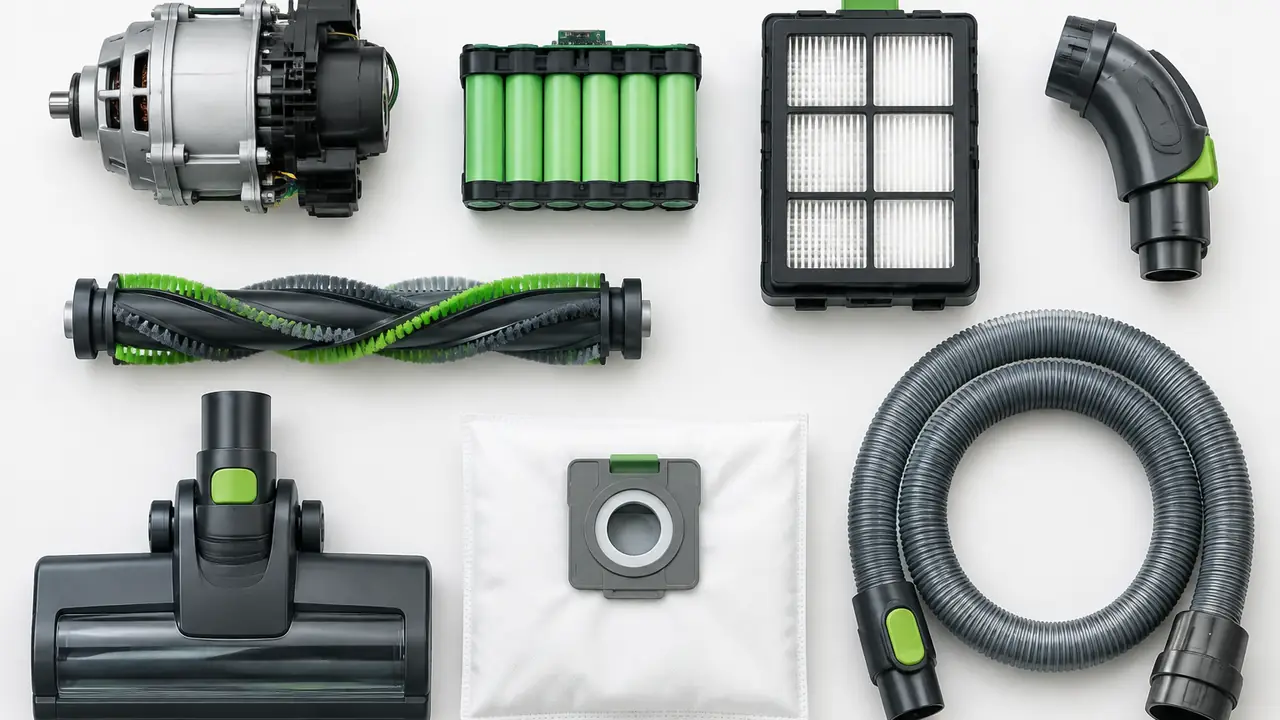
The cell is a cylinder with a naming code
The numbers 18650 and 21700 are simply dimensions. An 18650 cell is about 18 mm in diameter and 65 mm long; a 21700 cell is about 21 mm by 70 mm. Both are cylindrical lithium-ion cells in a steel can, produced in huge volumes for power tools, e-mobility and consumer electronics, which is why they are the default cell for cordless vacuums. A cell is rated by nominal voltage (about 3.6-3.7 V), capacity (in mAh or Ah), maximum continuous discharge current and internal resistance. Chemistry variants differ in how they trade energy against discharge capability, so two cells of the same size can behave very differently in a vacuum, which is a high-current load.
Because the machine is a high-power load, the cell capability that matters most is not capacity but the discharge rate at which the cell stays cool and keeps its voltage. A motor drawing 100-150 W from a pack of a few cells in series pulls several amperes continuously and more in boost mode. A high-capacity cell with high internal resistance can lose more energy as heat at that load than a lower-capacity, higher-power cell. Runtime figures in marketing therefore follow from the cell datasheet and the power mode, as the battery runtime note explains.
18650 versus 21700 side by side
| Item | 18650 | 21700 |
|---|---|---|
| Typical dimensions | About 18 mm by 65 mm | About 21 mm by 70 mm |
| Typical capacity range | Roughly 2,000-3,500 mAh per cell | Roughly 3,000-5,000 mAh per cell |
| Cells per pack at 21.6-25.2 V | 6 in series, 1-2 in parallel for typical sticks | 6 in series, 1 in parallel often enough |
| Pack volume for a given energy | Larger because more cells and more nickel strips | More compact, fewer welds |
| Supply and second-sourcing | Very broad, mature | Broad and growing |
| Typical use in vacuums | Existing platforms, handhelds, mid-range sticks | Newer sticks, longer-runtime or lighter packs |
The ranges above are typical across the category and are per cell datasheet; they are not a measured result from any machine. The longer comparison of the two formats is in 18650 vs 21700 batteries in vacuums. For the buyer, the key point is that the cell format is chosen with the housing, not afterwards: a 21700 pack is not a drop-in for a platform that has an 18650 tray.
Series, parallel and pack voltage
A pack is described as nSmP: n cells in series, m in parallel. Each series cell adds about 3.6 V nominal, so a 6S pack sits near 21.6 V nominal and 25.2 V fully charged. A 2S or 4S pack gives the 7.4 V or 14.8 V used in handhelds. Parallel cells add capacity and share current, which lowers the load on each cell. A 6S2P pack from 18650 cells and a 6S1P pack from 21700 cells can land at similar energy, but the second has fewer interconnects and a lower assembly cost while putting full load on each cell.
Voltage ranges used on this site, 7.4-25.2 V and 2,000-4,000 mAh for sticks, are the reference values from the category and per model datasheet. The battery runtime guide shows how pack energy, motor power and mode combine into the 30-60 minute runtimes typical of a stick.
What a pack is made of
- Cells and holders. The cells themselves, usually spot-welded in a cell block or sometimes sat in a plastic holder.
- Nickel strips and welds. The interconnect that carries current between cells. Strip thickness and weld quality determine resistance and heat, and are a typical audit point.
- BMS board. Monitors cell voltage, current and temperature; see BMS and battery safety in cordless vacuums.
- Casing and connector. The plastic shell, the contact terminals and the latch that engages the machine; this is the platform interface that decides compatibility.
- Label and fuse. Rating label, markings required by the market, and a protective fuse or thermal element.
These six elements are also the numbered parts on the exploded sketch of the pack line page. Which elements a brand can customise is usually the casing, the connector pinout, the label and the capacity, while the cell and BMS come from the partner plant's approved list.
Thermal design and cell matching
A vacuum pack is used in bursts at high current, charged right after use, and kept in warm places in kitchens and cars. Three design points decide whether it ages gracefully. First, cell matching: cells in a series string should come from the same lot with close capacity and internal resistance, because a weak cell reaches its voltage limit first and drags the string. Second, thermal paths: the pack needs space or thermal material so that heat from the middle cells can reach the casing. Third, current density at the strips and connector: a thin strip or small contact can become the hottest point in the pack at boost power. When comparing pack quotations, ask for the cell datasheet, the nSmP layout, the strip material and thickness, and the connector current rating.
Standards, transport and paperwork
A lithium-ion pack travels under UN 38.3 transport testing, with IEC 62133-2 as the common safety standard for cells and packs in the EU and many other markets, and UL 2054 or UL 62133 in North America. Air freight also needs the correct documentation under IATA rules. These tests are reported on the cell and the pack, and a partner plant should be able to supply the reports, which are verified per project. The desk does not hold certificates itself. The rules are summarised in UN 38.3 and IEC 62133 battery tests.
Pack labelling and spare packs
Most cordless vacuum buyers also sell the pack as a spare part, so the label and the connector matter beyond the first order. The label should show nominal voltage, rated capacity or energy, the manufacturer code and the date code in a format the partner plant keeps traceable to the cell lot. A replacement pack should be keyed so that it cannot be inserted into a machine with a different voltage. Plan the spare pack volume alongside the machine volume, because the same partner plant that built the first batch can usually hold cell lots for a repeat order, while a pack requested two years later may need a re-qualified cell.
Ordering a pack
Packs are counted in thousands, with sample lead and batch lead confirmed in writing for each program, as in MOQ and lead time. Provide the machine drawing or the existing pack, the target voltage and capacity range, the target market and the shipping mode. Send them through the quote form, and the desk will shortlist battery partner plants that can show the relevant test reports. Related parts are in the components category.