
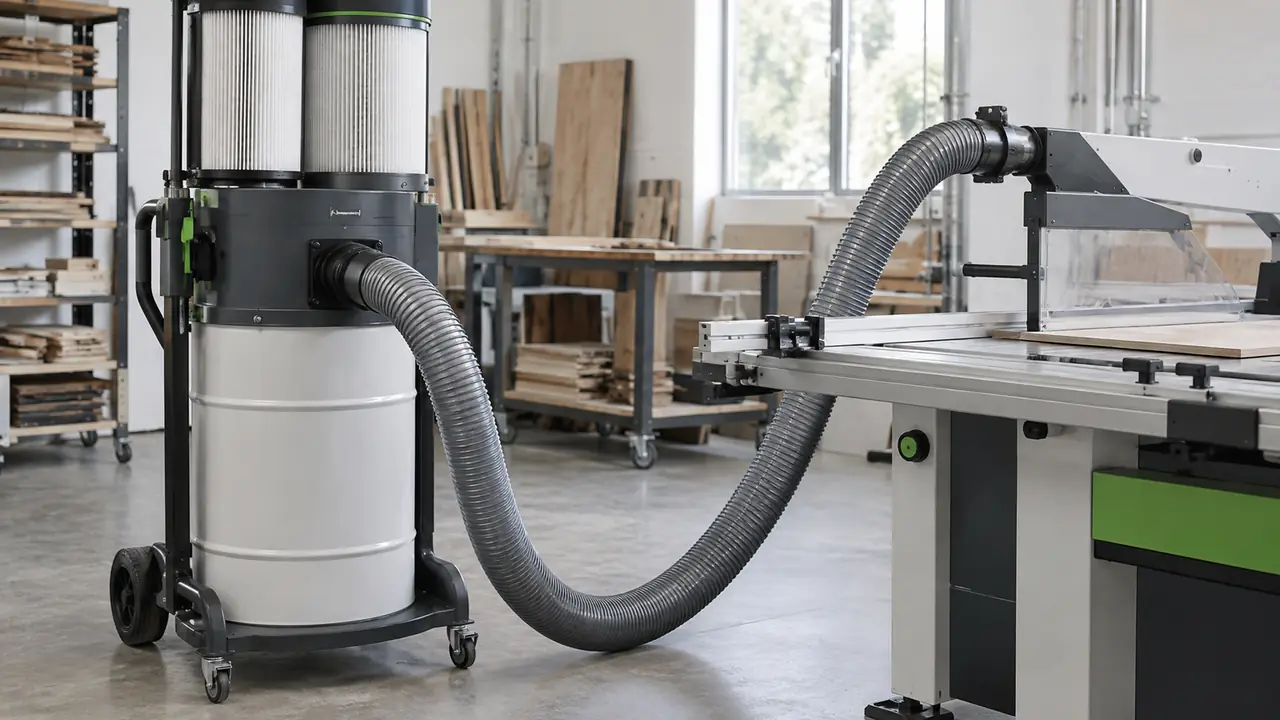
What an industrial dust extractor is
An industrial dust extractor is built to take dust from a source, such as a saw, a sander or a grinding station, or from the floor of a plant, and hold it until the operator disposes of it. Compared with a wet dry vacuum it has a stronger motor, a much larger filter area and a bigger collection volume, and it is meant to run for hours rather than minutes. Buyers range from joinery workshops that need one machine per bench to factories that connect extractors to a ducted network.
The central questions are what dust it will collect, how much of it, and what the site power supply is. A machine suited to soft wood chips is not automatically suited to fine metal powder or abrasive stone dust, and the supply phase limits which motors are available. The buyer-side view is in the industrial vacuum buyer guide and what is a dust extractor.
The six parts on the card
| Part | What decides performance | Typical options |
|---|---|---|
| 1 Motor head | Motor type, phase, cooling, switch gear | 1.5-7.5 kW; single-phase up to a few kW, three-phase above; star-delta or soft start on larger sizes |
| 2 Filter bank | Filter area, media, cleaning method | Pleated cartridges with manual shake, pulse-jet or reverse-air cleaning; bag filters on simpler models |
| 3 Drum | Volume, material, lid clamps, base | Painted or stainless steel drum; large bin; inlet baffle to drop heavy particles |
| 4 Collection bag | Bag type, seal, disposal method | Fixed plastic bag, or continuous-feed long bag for safe disposal |
| 5 Hose | Diameter, material, anti-static, tool connection | 50-100 mm hose with cuffs; anti-static version for fine dust |
| 6 Trolley | Frame, casters, stability | Steel trolley with large swivel casters, or fixed base for installation |
Power and noise are typical ranges across the category, per model datasheet. Rated kW describes motor input and not the airflow at the tool; airflow and static suction must be read together, as in the suction and airflow guide.
Single-phase or three-phase
Smaller extractors up to a few kilowatts run on single-phase mains and plug into a standard industrial socket. Larger units at the upper end of 1.5-7.5 kW normally use three-phase supply, which gives smoother torque and lower current per conductor. Voltage and frequency differ by market (400 V at 50 Hz is common in Europe, other values elsewhere), and the motor, the contactor and the cable are specified to match. State the site supply, plug and any local rules in the first enquiry. Retrofitting a different supply to a built machine is rarely practical.
Filtration, dust classes and ATEX
Filtration is usually staged: a baffle drops heavy particles, a primary cartridge or bag filter catches the bulk, and a final filter can be added for fine dust. Where a HEPA-grade final filter is fitted, it is described by its EN 1822 grade only. Dust classes (for example the L, M and H classes used for fine and hazardous dust) and explosion protection (ATEX) are separate certification paths with their own test houses. They are not claimed for any model on this site; if a project requires them, they are scoped and confirmed per project, and the construction, the earthing and the hose are specified around that requirement from the start. See vacuums and extractors for woodworking shops and warehouses and factories.
Options worth specifying
- Cleaning method. Manual shaker for light duty, pulse-jet for continuous use.
- Tool connection. Automatic start from a power-tool socket, with a delayed stop to clear the hose.
- Drum and finish. Painted or stainless; colour to the brand palette.
- Disposal. Continuous-feed bag to avoid dust cloud when emptying.
- Packaging. Steel units are heavy; crating and pallet pattern decide freight, see packaging.
Standards and inspection
Safety is assessed to IEC/EN 60335-2-69 for commercial and industrial use, with CE marking and any further directive applicable to the installation checked per project; North American supply follows UL 1017 or the buyer's own listing route. Before shipment, a typical plan runs airflow and vacuum on sampled units, motor current against the nameplate, noise, insulation and earth continuity on every unit, filter seating and cleaning mechanism function, and a crate drop or lift test. The plan is agreed in writing before the first batch; see quality control. Send phase, dust type and volume through the quote form.