
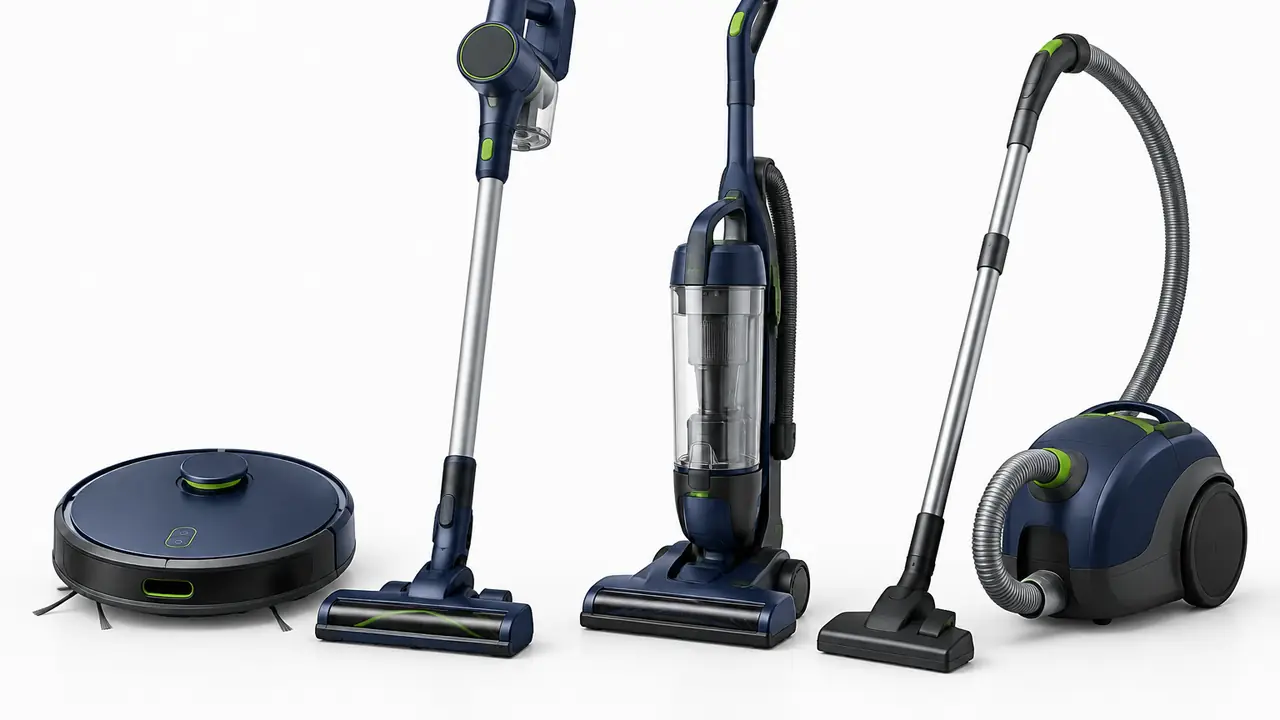
How the machine differs from a household vacuum
A household vacuum is designed to move dry dust through a bag or bin; a wet dry vacuum has to survive water. Its motor head sits above a tank, the air enters the tank through a hose, and a float cage shuts the airway when the water reaches a set level, so the motor never pulls water. The filter is usually a cartridge with a foam sleeve for wet use and a paper or pleated stage for dry use. These design points, rather than the headline power, decide whether a unit lasts in a workshop. Plants making these machines concentrate in Guangdong and Zhejiang, where commercial cleaning machinery sits alongside the household appliance clusters. For the basics, see what is a wet dry vacuum, and for the float problems, float valve and foam problems.
Tank size and material
Typical across the category, the tank holds 20-80 L. Smaller tanks suit households, cars and benchtops; mid-size tanks suit garages and workshops; larger tanks suit contractors and light industrial users. Material is the second decision. A stainless steel tank resists dents, heat and solvents and carries a higher perceived value; a plastic tank is lighter, cheaper and resists corrosion, but can crack in cold storage or after a hard drop. Write the wall thickness for stainless tanks, the plastic grade for plastic tanks, the drain plug position and the wheel set into the specification. Caster quality is a hidden quality marker: a four-wheel base that tips when the hose is pulled gets a bad review.
| Tank | Typical buyer | Common material | Points to check |
|---|---|---|---|
| 20-30 L | Households, garages, car care | Plastic or small stainless | Weight when full, storage footprint |
| 30-50 L | Workshops, cleaners, tool users | Stainless or plastic | Drain, casters, tank handle |
| 50-80 L | Contractors, light industrial | Stainless | Tip stability, lifting method, motor count |
Single or dual motor
Typical rated power is 1,000-1,600 W for a single-motor unit, and dual-motor units pair two motors in the head to raise airflow and vacuum. The dual motor is not twice as powerful in practice: airflow rises, but the heat, the noise and the current draw rise too, and a plug-in circuit in some markets limits the usable power. Ask for the rated input in watts, the current in amps and the breaker rating the plant assumed. Most buyers choose single motor for the lower price and the lighter body, and dual motor for larger tanks that need more airflow. The comparison is explored in single vs dual motor wet dry vacuums, and motor options are on vacuum motors. A blower function that reverses the airflow is an option for clearing leaves and drying surfaces; confirm that the hose connects to the exhaust port and that the filter is protected in that mode.
Filters, float and accessories
Ask three questions about the filter: is it a foam sleeve for wet use, is a pleated or paper cartridge available for fine dust, and is the filter rated to an EN 1822 grade if a HEPA-grade stage is offered? Foam sleeves are removed for wet use or left on, which the manual must state clearly. The float cage should be a material that does not warp in warm water, and the seal between the tank and head should be replaceable. See filters.
- Hose: length, diameter, cuff type and crush resistance. See hoses and attachments.
- Tools: crevice nozzle, wet and dry floor nozzle with squeegee, brush head and extension tubes.
- Power tool outlet: an auto-start socket for sanders and saws is a feature for workshops and calls for additional electrical checks.
- Drain, handle and cord storage: small features that affect daily use.
Manuals, warnings and use cases
The wet dry category produces more misuse than any other vacuum type, so the manual and the on-product labels are part of the specification. List what the machine must not collect: flammable liquids, hot embers, and fine dust such as drywall dust or wood dust unless a suitable filter is fitted and the unit is described for that use. State that the foam sleeve is fitted for liquids and removed or replaced for dry use according to the model. Show the maximum fill level, the empty procedure and the correct way to dry the tank before storage. A clear warning label placed where the user sees it on opening the box reduces warranty claims.
The use case defines the accessory set. A car care kit adds a soft brush and a crevice tool; a workshop kit adds a power tool socket and a long hose; a contractor kit adds a high-capacity filter and a lifting handle. Fine wood dust and similar material belong to a different class of machine, covered in industrial vacuum buyer guide. Agreeing which use cases are in scope also keeps the listing honest.
Certification route
A wet dry vacuum follows IEC/EN 60335-2-2, which includes particular rules for water-collecting machines, and IEC 60335-1; CE covers LVD, EMC and RoHS with REACH for substances. North America uses UL 1017 or an ETL listing. Because it is a mains-operated vacuum, a unit sold in the EU as a household machine may fall under 666/2013 limits, while the commercial class is treated differently; confirm the scope with the plant and the test lab before you print the market claim. Typical timing is 2-4 weeks for CE with third-party reports and 4-8 weeks for UL or ETL, confirmed per program. Customs often classify under HS 8508.60 for other vacuum cleaners or 8508.11 or 8508.19 for household machines, confirmed with your broker. See the certifications guide.
MOQ, shipping and plant questions
A wet dry unit is heavy and bulky, so freight is a large part of the landed cost and sea freight by full container is the norm. As a reference range, commercial and industrial machines can start as low as 20-100 units, while household-class wet dry units follow the 200-500 stock and 500-1,000 branded pattern, confirmed in writing for each program. See MOQ and lead time and logistics and shipping.
- Ask for the tank wall thickness or plastic grade and the drop test result.
- Ask for the float cage design and the water shut-off test.
- Ask for rated watts, amps and the circuit assumed.
- Ask for the casters, the tip test and the empty and full weights.
- Ask for a spares list: filters, foam sleeves, seals and hose cuffs.
Send site type and quantity through the quote form.