
Start with the dust, not the machine
An industrial extractor is chosen around the material. Wood dust, metal grinding dust, plaster and fibreglass differ in particle size, weight, stickiness and hazard, and the right machine follows from those facts. Before a quote, state the material, the source machines, the hours per day and how the dust will be discarded. Vaculent coordinates partner plants in the Guangdong and Zhejiang clusters that build industrial and wet dry machines, and the desk asks for the same information a plant engineer will ask for. Professional machines are typically available from about 20-100 units per model.
Dust volume, airflow and sizing
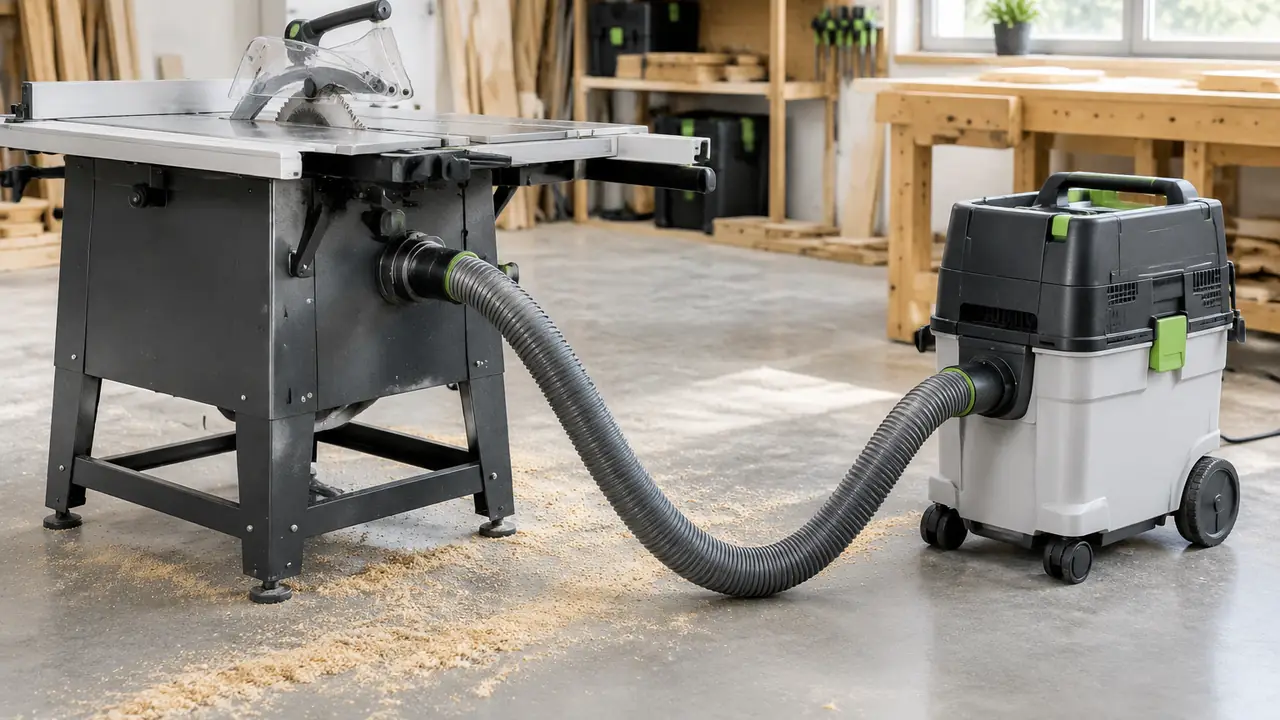
Extraction sizing is about airflow at the tool, not the motor wattage on the label. A planer or table saw port, a sander and a floor pick-up each need a different airflow, and a hose that is too long or narrow loses most of it. Typical industrial extractors cover roughly 1.5-7.5 kW, with large drums and filter banks, and they are used either as a single-tool unit or as a shared unit with blast gates. Ask for the airflow-versus-static-pressure curve of the model, not a single headline number, and size the hose and fitting diameters to the tool's dust port. The suction and airflow guide explains why.
Single-phase or three-phase
| Option | Typical range | When it fits |
|---|---|---|
| Wet dry vacuum, single phase | 1,000-1,600 W; 20-80 L tank | Hand tool extraction, site clean-up, mixed wet and dry work |
| Dust extractor, single phase | Up to about 2-3 kW class | Small workshops where only a standard socket is available |
| Dust extractor, three phase | About 3-7.5 kW class | Fixed machines, continuous shifts, larger drums and filter banks |
Voltage and frequency (for example 400 V 50 Hz or 480 V 60 Hz) are set per destination market and confirmed in writing; a three-phase unit also needs the right rotation, plug and breaker on site.
Filter banks and cleaning
Fine dust blinds a filter fast. Industrial machines therefore use larger filter banks, with pleated cartridges and a cleaning method such as a manual shaker, a reverse-pulse blast or a compressed-air pulse. State the dust, because dust that is oily, damp or very fine needs a different media. Where the exhaust returns to the room, name the filter grade by EN 1822 class and a seal that is tested after each change. For a bag or drum, use a collection bag that closes without releasing dust. See filtration grades and what is a dust extractor.
Dust classes and ATEX as separate paths
Some local rules classify dust by hazard, for example by a dust class system for hazardous dusts, and require a tested machine for that class. Explosive atmospheres fall under ATEX in the EU, which defines zones and equipment categories. A machine that is fine for wood chips in a normal workshop may not be acceptable in a zone with explosive dust, and the site owner decides the classification. If the project involves either, state it at the first message. Do not assume a standard unit can be upgraded afterwards.
Inspection and documents for industrial orders
Industrial orders are inspected against the order specification: motor rating and rotation, insulation and earth tests, airflow at the nozzle on a sampled unit, filter seating, drum and caster strength, and the packing of the filter bank so it arrives undamaged. Documents are collected per project and typically include the electrical declaration for the destination market, the test report, the manual in the site language and, where required, the dust class or ATEX file. Because freight for heavy machines is a large part of the landed cost, the desk also checks crate dimensions and weights early; see logistics and shipping.
Hoses, connections and spare parts
- Hose. Anti-static or conductive hose where required; diameter matched to the tool port.
- Fittings. Adapters for each tool, blast gates, couplers and clamps listed on the order.
- Filters. Spare cartridges and collection bags per machine.
- Casters and drum. Locking casters and a drum that can be lifted or tipped safely.
- Tool-start function. Automatic start with the tool, if the machine supports it.
See also vacuums and extractors for woodworking shops and hoses and attachments. Send the dust, power and quantity details through the quote form.