
The online seller's problem
An online seller usually wants five to fifteen models rather than one, each in a quantity that will sell through in a season. That runs against how plants prefer to work, where the lowest cost comes from long runs of one model. The desk therefore leans on stock models from partner plants, which have reference MOQs of about 200-500 units per model, and on handheld, car and cordless stick lines where several variants share one motor or battery platform. Vaculent coordinates plants in the Suzhou, Cixi and Shenzhen clusters; it does not hold stock itself, so planning starts with the quantity you can commit to.
Choosing lines for small batches
| Line | Typical power | Why it suits small batches | Watch-out |
|---|---|---|---|
| Handheld | Li-ion 7.4-14.8 V, suction about 5-15 kPa | Small and light, cheap to ship, many accessory variants | Battery shipping rules; claims for suction must match the datasheet |
| Car | 12 V socket 60-150 W, or cordless | Seasonal gift and accessory demand, light kits | Cord length and hose length are common complaints |
| Cordless stick | Li-ion 21.6-25.2 V, runtime about 30-60 min | Highest search demand; larger ticket | Bigger carton, higher return exposure, battery papers |
A sensible first range is two handhelds in different battery capacities, one 12 V car unit and one entry cordless stick. That gives four SKUs on two or three platforms, which is easier to inspect than four unrelated suppliers.
Listing content and spec accuracy
Most returns begin with a listing that promised more than the product delivers. Build the listing from the model's own datasheet and test report, not from the largest number a plant can print. Use the typical ranges only as a guide to what is plausible: if a handheld is listed at 15 kPa, check the report and the test method. Runtime must state the mode (normal or boost). Noise should state the method. Dimensions and weight must be the packed and the unpacked values, which also matter for freight cost. Avoid words that cannot be proven; for filtration, name the EN 1822 grade and nothing more. See vacuum listing content.
Lithium battery shipping
Cordless handhelds and sticks contain lithium-ion packs, and that changes how they travel. The pack needs a UN 38.3 test report, and most markets expect IEC 62133-2 or UL 2054 as well. Sea freight is the routine route for cartons; air freight follows IATA rules and needs the paperwork and correct marks, and samples sent by courier often take 3-7 days when the documents are in order. Fulfilment centres and carriers can ask for the report and a safety data sheet before accepting stock, so request them with the order, not after it. The rules are in shipping cordless vacuums and on logistics and shipping.
Managing many SKUs without losing control
Every extra SKU adds a manual, a carton, a test report and a set of spare parts. Keep a single sheet per model with the model code, the plant, the batch date, the accessory list, the certificates held and the listing text approved for it. When a customer asks about a filter or a charger, that sheet answers in a minute. Group models by shared battery or charger where possible, so one spare part serves several listings, and avoid colour variants in the first order, since each colour is a separate carton and a separate stock count. Seasonal items such as car units should be ordered early enough to clear the lead times on MOQ and lead time.
Plain cartons and returns reduction
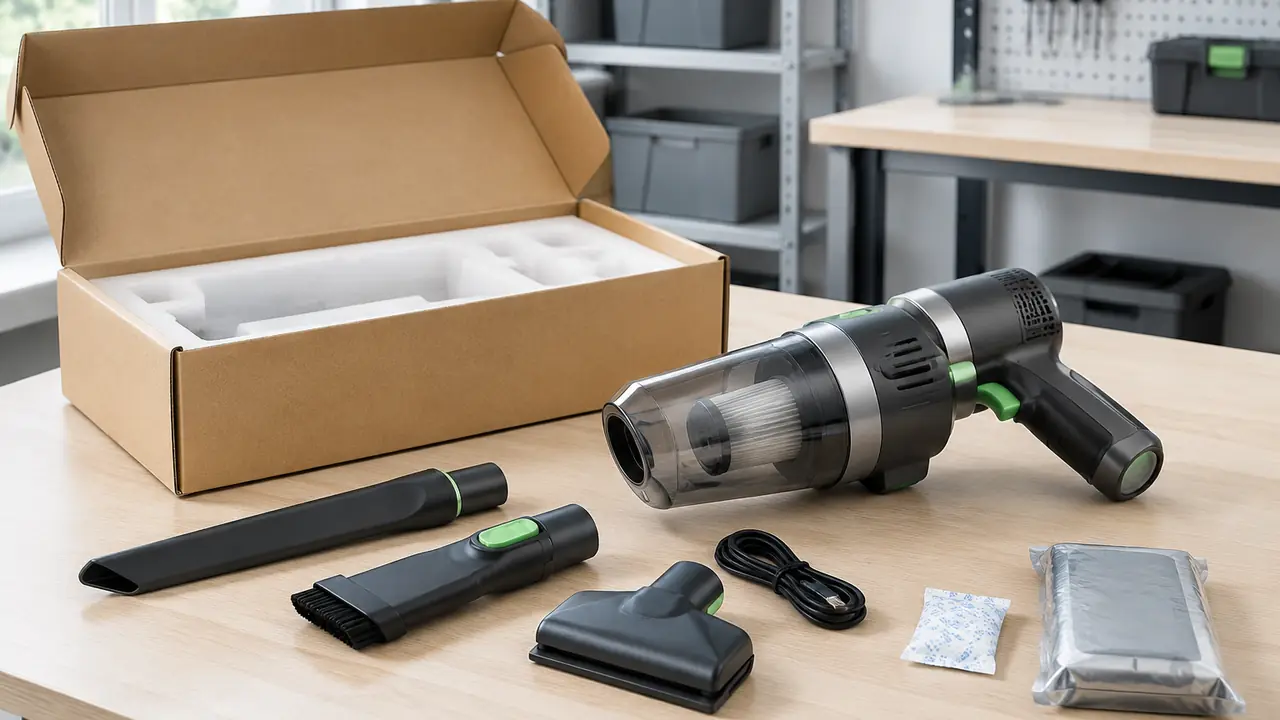
- Plain brown carton with a printed model code is the usual online choice: lower cost and fewer artwork proofs. Add inner foam and a drop test for parcel shipping.
- Manual and quick-start card in the destination language; a clear charging guide removes a large share of early support tickets.
- Accessory count checked at inspection against the listing photo.
- Spare filters in the box or as an add-on listing.
- Sample check of runtime and noise against the listing before the full batch is released.
Returns usually fall when suction claims, runtime and fit are verified before shipment. See reducing vacuum cleaner returns.
From first sample to second order
- Pick a stock model per line and ask for the datasheet and test report.
- Order a sample (7-15 working days typical) and test it as a customer would.
- Decide on logo and box; private label starts at about 500-1,000 units per model.
- Confirm market documents and battery papers before the batch.
- Inspect a sample of the finished goods, then ship.
All quantities and times are typical ranges confirmed in writing for each program. Send your target market and SKU list through the quote form.