
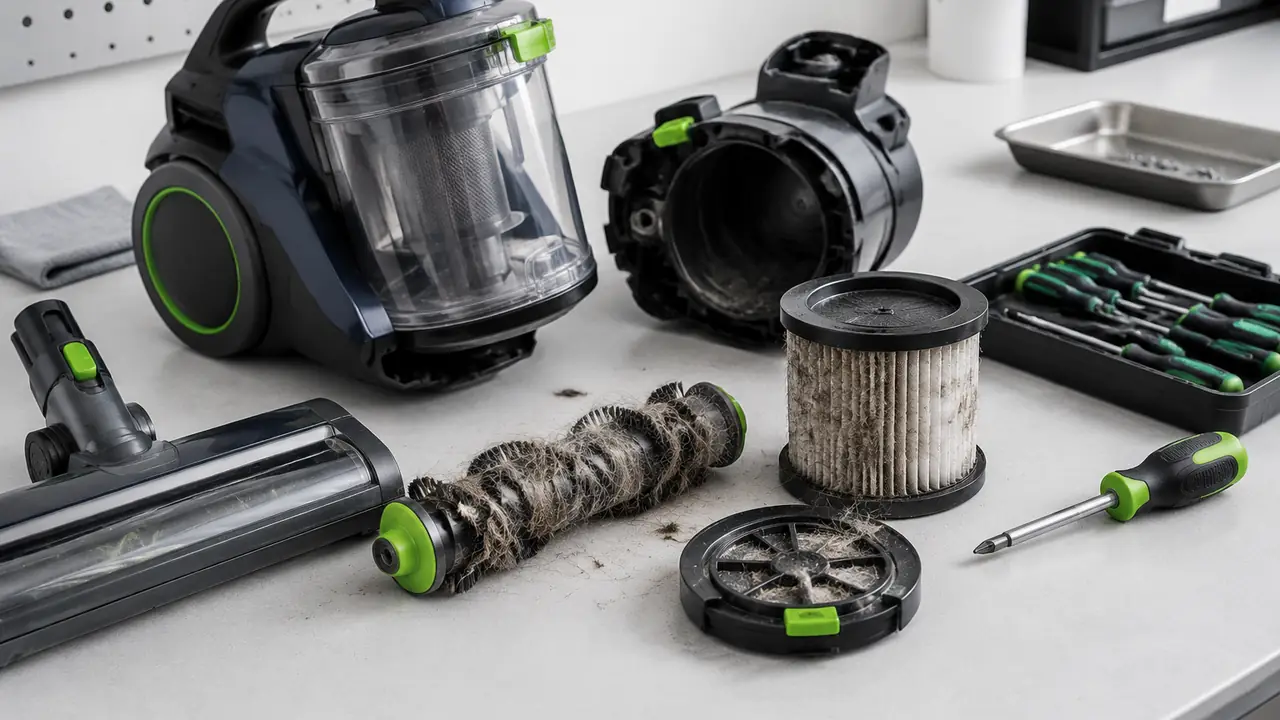
Why filters clog
A filter works by catching particles, and what it catches stays. As the cake of dust builds on the media, the openings narrow and air has to push harder to pass. At first this raises filtration efficiency slightly, which is why a lightly loaded filter is not a problem. Past a point the pressure drop grows quickly, airflow falls, the motor works harder, and the user sees a drop in pick-up. Fine household dust, cement and plaster dust, and fine wood dust load a filter far faster than coarse debris, and pet dander and skin particles bind to damp filters.
Three media are common. Foam filters trap coarse dust, wash well and are used as pre-filters and motor-protection filters. Pleated paper or non-woven media capture finer dust in a smaller volume. HEPA-class media under EN 1822, with grades H11-H14, capture the finest fraction, for example H13 at least 99.95% at the most penetrating particle size, but carry the highest pressure drop and the highest loading rate unless a good pre-filter protects them.
Cleaning and replacement by media
| Media | Typical role | Typical care | Replace when |
|---|---|---|---|
| Foam pre-filter or motor filter | Coarse dust, motor protection | Tap or rinse, dry fully | Torn, hardened or no longer springs back |
| Washable pleated filter | Main filter in many cordless sticks | Tap out, rinse as instructed, dry fully | Pleats deformed, media damaged, airflow does not recover |
| Paper or non-woven cartridge | Main filter, wet dry vacuums with a dry cartridge | Tap or blow out from the clean side | Oiled, wet, torn or loaded after cleaning |
| HEPA H11-H14 media | Final filter, exhaust protection | Dry brushing or tapping if allowed | On schedule or when airflow falls |
| Activated carbon layer | Odor control, optional | Not washable | Replace with the main filter |
Intervals are stated by the brand in its manual, not set by a standard. As a working guide across the category, pre-filters are cleaned every few uses to monthly, washable main filters monthly to every few months, and sealed HEPA filters are replaced on a schedule of months to a year depending on use. These are starting points, tested on the actual model and confirmed with the partner plant.
Checks in order
- Look at the filter before cleaning. Grey dust on the surface is normal; a solid cake, oil, or a damp patch is not.
- Tap the filter over a bin, clean side facing down, then brush lightly. Avoid blowing compressed air at HEPA media, which can damage it.
- Wash only filters marked washable, with cool water and no soap unless the manual says so, and allow full drying.
- Check seals and frames. A cracked frame or a flattened gasket lets dust bypass the media.
- Compare suction with a clean spare filter. If suction returns, replace the old one.
What it means for a brand
The pre-filter is cheap protection. A foam or mesh pre-filter ahead of the main media can double the time before the main filter clogs. It adds a part and an interval to the manual, but it is a low-cost way to hold suction over time. Cyclone separation helps in the same way, as set out in dust bags and bins.
Media and bypass decide real filtration. A HEPA-grade medium does not make a machine HEPA-tight. The whole path has to seal, from bin to filter frame to exhaust. A frame with a soft gasket, a snap-fit that cannot be fitted wrongly, and a filter keyed to its housing prevent bypass. Grade information should be listed as an EN 1822 grade, for example H13, and the partner plant should supply the media test report for the batch. See the filtration grades guide.
Washable does not mean permanent. Repeated washing and drying degrades media and frames, and users do not always dry them fully. Providing a spare filter in the box, which lets the user rotate one while the other dries, reduces damp-filter odor and mould complaints and keeps suction steady. Selling replacement filters in packs is also the most common repeat revenue in a vacuum line, covered in warranty and spare parts planning.
The manual has to match the product. If the manual promises washing every month and the media loses airflow after three washes, complaints follow. Interval statements should be tested on a sample unit with realistic dust loads before the manual is printed.
Testing a cleaning interval
A cleaning interval is a claim about the product, so it deserves a test. A practical method is to load a sample machine with a standard test dust or a household dust mix in steps, measure airflow or sealed suction at each step, clean the filter by the method in the draft manual and measure again. The result is a curve: airflow against dust loaded, before and after cleaning. If the filter recovers to a stated share of its new value after cleaning, the interval is credible. If it does not, the manual should say replace rather than wash. Running the test on two or three units from the pilot lot also shows variation between filters, which matters when the media comes from a different supplier than the one used for approval. The plant can run this in its own lab, with the method and acceptance band written into the order, and the desk reviews the data with the brand.
What to specify
- Filter stack: pre-filter, main filter, final HEPA grade if any, and carbon option, per model datasheet.
- Washable or sealed, with drying time and number of washes the media is designed for.
- Frame and gasket design, and keyed fit to prevent wrong installation.
- Airflow retention check: airflow with a new filter versus after a defined loading, agreed with the plant.
- Spare filter packs ordered with the first batch, in quantities set by the program.
Inspection
At inspection, check that every unit has the correct filter fitted in the correct way, that gaskets are present, and that the filter sold as a spare matches the one in the machine by size and grade marking. For HEPA filters, ask for media test reports or an efficiency check on a sample from the batch, taken from the lot supplied for the order. A leak test across the filter frame on a few units shows whether seals meet the design intent. These checks are listed in testing and inspection. For filters sold as parts, MOQ is usually counted in thousands; see MOQ and lead time, and use the quote form to start a filter or spare program.