
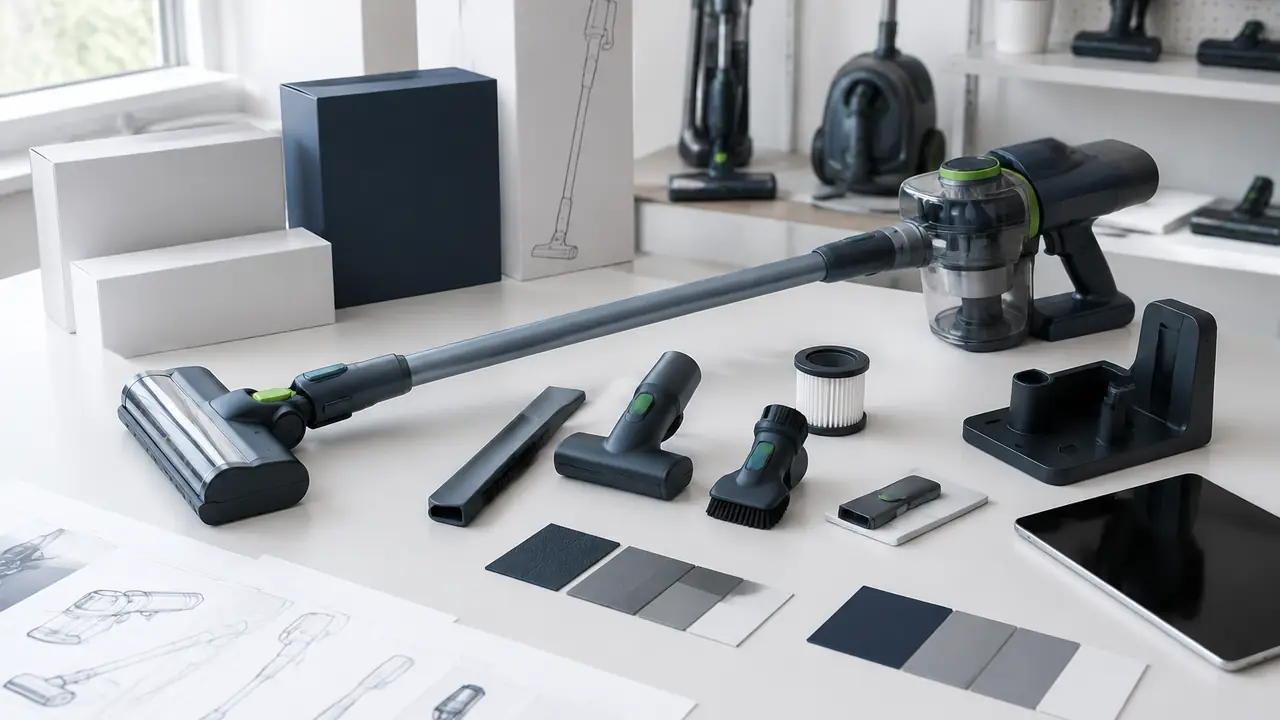
What brand owners are really buying
A brand owner is not buying a vacuum; it is buying a repeatable product that carries a name. The first sample is easy. The hard parts come later: the same suction and runtime in batch five as in batch one, a manual and an app that match the machine, a spare-parts plan and certificates that cover the exact model on the shelf. Vaculent coordinates partner plants in the Suzhou cluster and in Shenzhen, where cordless and robot platforms are concentrated, and the desk shortlists by motor platform, battery supplier and test-lab record rather than catalogue size. The first decision is how much of the product is yours.
Choosing between stock, OEM and ODM
| Route | What you change | Typical MOQ | Typical first batch |
|---|---|---|---|
| Stock model | Almost nothing; sticker or box only | 200-500 units per model | 30-45 days |
| OEM / private label | Logo, colour, box, manual, accessory set | About 500-1,000 per model | 35-50 days |
| ODM | Housing, brush head, dock or app, on a proven motor platform | About 1,000-3,000 plus tooling | 60-120 days including certification |
Most brands begin with private label to learn the market and move to ODM once one model sells. The step is smaller than it looks, because ODM on a proven motor and battery platform reuses the electrical core and changes the visible parts. The detail is in OEM vs ODM for vacuum cleaners.
Differentiation that customers can see
Differences in headline suction rarely hold up, because every plant can print a large number. Visible differences hold up better: brush head design, a quiet-mode profile, a washable filter, a bin that empties cleanly, a dock that fits a living room, tool storage on the wand. For robots, navigation and dock features carry the story; for sticks, battery format and brush design do. Pick two or three and put them in the specification sheet as measurable items, with test method and tolerance. Performance figures are described as typical ranges across the category and confirmed from the model's own datasheet.
A short brief that saves weeks
Before the first quote, write a one-page brief: target market and channel, line, power type, the two or three visible features, the accessory set, the colour reference and the quantity you expect in the first year. Plants quote against what is written, and a vague brief produces a quote that changes later. Add the markets you may enter in the next two years, because adding UL or a radio approval after launch costs time that a plan made on day one would have saved. The quote form follows the same order, so the answers can be pasted straight in.
Tooling and mould ownership
Moulds are the asset. In an ODM program the housing, bin and brush head moulds are paid for as a tooling fee, and the agreement should say in writing who owns them, where they are stored, how many shots they are rated for and what happens if you move to another plant. Ask for mould drawings, a maintenance schedule and a rule that your moulds are not used for another customer. Ownership terms are agreed per program; the desk helps set out the questions but does not give legal advice.
App, manual and packaging assets
- App and firmware. Robots and some sticks use an app. Agree who owns the app, who hosts the cloud, what data is collected and how updates are handled.
- Manual and labels. Languages, safety warnings, WEEE and battery marks and the model number must match the approved certificates.
- Artwork. Logo files, colour references and box dielines come from you; plants return a proof before print. See packaging and retail boxes.
- Spare parts. Filters, brushes and batteries sold as separate SKUs need their own labels and cartons.
Batch consistency and certification planning
Consistency comes from a golden sample that is signed and kept, a written inspection plan, and a rule that any change to a motor, cell supplier or filter needs your approval first. The desk uses sampled checks of suction, runtime, noise and carton contents against the retained sample; see quality control. Certification should start before tooling is final: IEC/EN 60335-2-2 with CE for Europe, UL 1017 or ETL for North America, UN 38.3 and IEC 62133-2 for cordless packs, and CE RED and FCC for robots with wireless modules. Typical timing is CE with third-party reports in about 2-4 weeks, UL or ETL in 4-8 weeks and UN 38.3 in about 2-3 weeks. Vaculent holds no certificates; partner reports are verified per project. See compliance and certifications.