
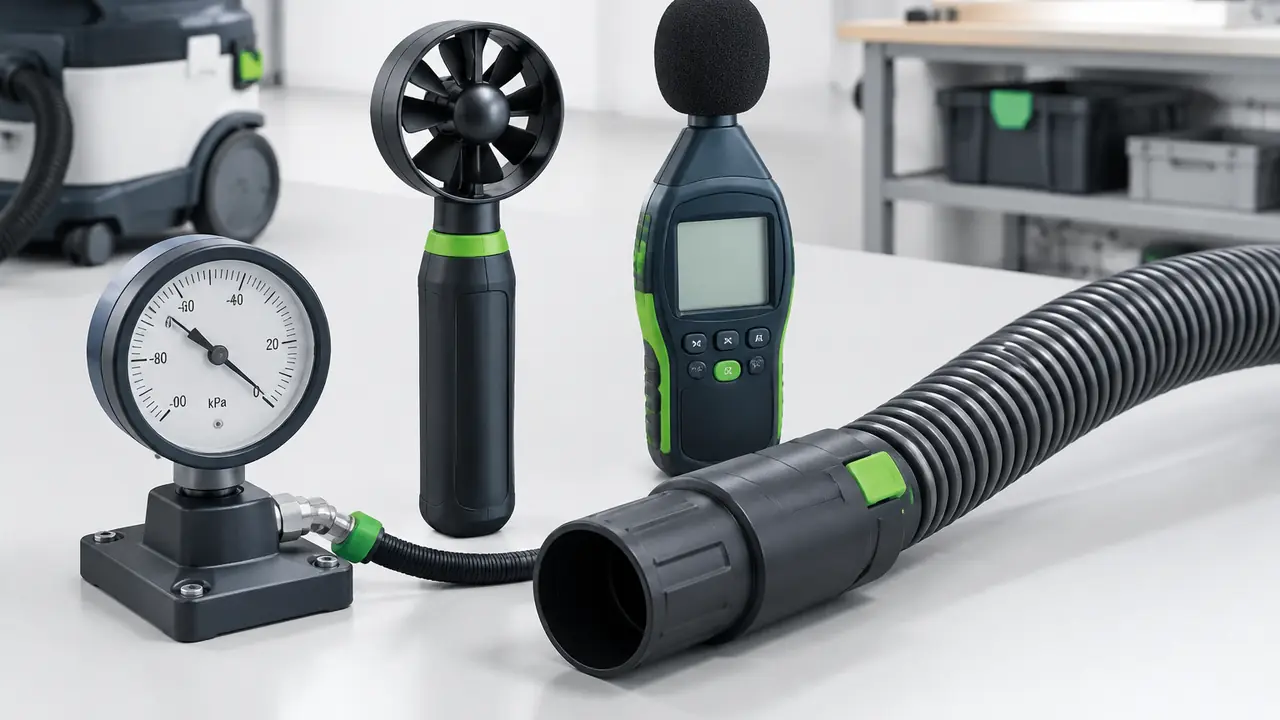
Two quantities from one fan
A vacuum motor spins an impeller that moves air. The harder the machine has to work against a restriction, the less air it moves, and the more the pressure difference across the impeller rises. At one extreme the opening is sealed shut: no air moves, and the pressure difference is at its maximum. At the other the opening is free: air moves at its maximum rate, and the pressure difference collapses to almost nothing. Everything in between is the working range. Plotted on a graph, the relationship is the fan curve, and a datasheet that gives only one end of it describes only part of the machine.
Suction, in the sense of a datasheet, is the sealed end: static pressure in pascals or kilopascals, sometimes in inches of water lift. Airflow is the free end: volume per time, in litres per second, cubic metres per hour or cubic feet per minute. The two are linked but never interchangeable, and no conversion formula turns one into the other without the fan curve itself.
What each number does on the floor
| Task | Leans on | Why |
|---|---|---|
| Lifting loose dust from a hard floor | Airflow | Moving air at the nozzle carries fine particles along; little resistance to overcome |
| Pulling grit out of carpet pile | Airflow through the head, brush action, pressure | Air has to pass through the pile; pressure helps overcome the restriction |
| Crevice and upholstery tools | Pressure | The small opening restricts flow, so the sealed-end behaviour dominates |
| Long hose or wand | Airflow retained after losses | Friction in the pipe eats into both numbers |
| Filter nearly full | Both fall | Added restriction moves the working point toward the sealed end |
The point of the table is not a rule but a prompt: before a spec is chosen, decide which tasks the end customer cares about, and ask for the number that governs them.
Typical ranges across the category
Across the category, the sealed suction of cordless stick vacuums is commonly 15-30 kPa, with entry units at 10-20 kPa; handheld units are typically 5-15 kPa; robot vacuums are usually quoted at 2,000-6,000 Pa, with high-end models above that. Airflow figures vary much more widely with design and test method, so they are best taken per model datasheet. These ranges are for orientation only. Different plants measure at different power modes, with or without a nozzle fitted, and with clean or loaded filters, which is why the sheet must state its condition.
How the numbers are measured
Household performance methods are collected in the IEC 62885 series. In outline, the machine is connected to a measuring chamber or orifice plate; the free-flow airflow is read with a series of defined openings, and the sealed pressure is read with the opening closed. Another set of tests measures real cleaning, for example dust removal from a standard carpet or crevice. A lab report that contains both airflow and pressure readings, and at least one cleaning test, tells a buyer far more than a single number on a box. The test standards note outlines the series, and the testing and inspection page lists the checks that are agreed per order.
One detail that catches buyers: air power, in watts, is the product of airflow and pressure and is sometimes quoted as a single combined figure. It is a useful summary, but it still depends on the point on the curve at which it was calculated. If a sheet gives air watts, ask at what airflow and pressure.
A worked comparison
Imagine two cordless sticks on the desk. Sheet A states 25 kPa and nothing else. Sheet B states 18 kPa sealed and gives an airflow reading at the same power mode, with the test method named. On the face of it A is stronger. But suppose A has a narrow cyclone inlet and a dense pre-filter: its air path is restrictive, so the working point on the curve sits close to the sealed end, where little air moves. B has a wide path and a less restrictive filter, so at the working point it moves more air and cleans carpet better. Nothing in sheet A allows the buyer to see this. Only when the same two measurements are available for both can the comparison be made, and only when a cleaning test is added can it be confirmed on a floor.
The lesson is not that low kPa is good. It is that a buyer who asks for one number gets the number that flatters the machine, and a buyer who asks for the pair, the mode and the method gets a document that can be audited. The same discipline applies to samples: when the pre-production unit arrives, the buyer or an inspector can repeat the sealed and free readings and compare them with the datasheet.
Where the numbers get inflated
- Peak versus steady. A reading taken in the first seconds of a high mode, with a new battery, can exceed what the machine holds for minutes.
- Motor-level versus nozzle-level. A reading taken at the motor inlet, before the filters and hose, is higher than what reaches the floor.
- Clean-filter only. Performance with a loaded bin or dirty filter is what the customer lives with. Ask for a loaded reading if the product is bagless.
- Different units. Pa, kPa, inches of water lift and mmH2O are all pressures but need conversion. Check the unit before comparing.
What to put in a specification
- Sealed suction in kPa at each power mode, with a battery state for cordless units.
- Free airflow in L/s or CFM at the same modes.
- The test method and which nozzle or orifice was used.
- At least one cleaning test relevant to the target floor, such as carpet or hard floor.
- Acceptance tolerance for the batch, written into the order and confirmed in writing.
With those five lines, a sample can be checked against its own datasheet, and a batch can be checked against the sample. The desk shortlists partner plants that can supply this level of documentation. To see how the figures combine with watts, read vacuum watts vs suction; for the full spec checklist, see how to read vacuum specs. To start a project with a defined performance target, use the quote form, and for timing consult MOQ and lead time.