
Filters in series, not one filter
The air path of a modern vacuum goes through a sequence of stages, each removing a different size fraction. A coarse stage, often the cyclone or the bag itself, drops the heavy debris. A pre-filter protects the motor and later stages from medium dust. A fine stage, often a pleated HEPA-class cartridge, captures the smallest particles. Some machines add a final post-motor filter, which catches carbon dust from motor brushes in corded designs and any fine particles that passed. Each stage trades filtration efficiency against airflow resistance, so more filtration is not automatically better: a dense filter in a small machine can choke airflow and raise motor temperature.
The term filter in a specification can therefore mean different things. A foam disc, a paper pleat pack and a glass-fibre HEPA cartridge belong to different positions in the air path, are replaced at different intervals and are sourced from different suppliers. The general background is in the filtration grades guide.
Material by material
| Material | Typical position | Strength | Limit |
|---|---|---|---|
| Open-cell foam | Pre-motor protection, pre-filter | Washable, low airflow resistance, cheap | Coarse capture only; degrades with age and oils |
| Filter paper (cellulose) | Pleated cartridges, dust bags in canisters | Good fine capture for the cost | Not washable; fails when wet |
| Non-woven synthetic (polyester or PP) | Dust bags, cartridges, exhaust filters | Consistent pore structure, lighter, can be washable in some grades | Efficiency depends on grade and charge treatment |
| PTFE membrane laminate | Industrial cartridges, wet dry filters | Surface filtration, releases dust well, hydrophobic | Higher cost; membrane damage ruins performance |
| Glass-fibre HEPA media | Post-cyclone or exhaust filters | Rated to EN 1822 grades H11-H14 | Fragile when pleated, not washable, needs good seals |
| Activated carbon layer | Odour layer in a sandwich | Adsorbs odour compounds | Does not capture dust and saturates over time |
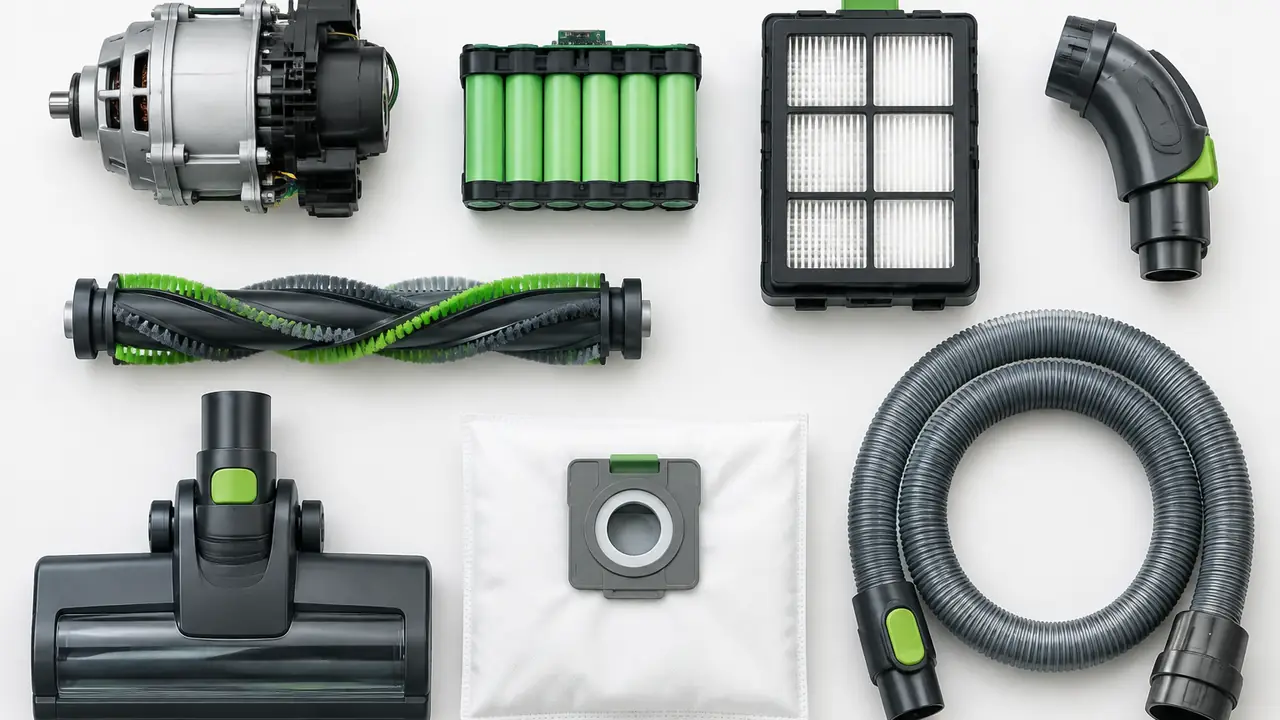
Combinations are the norm. A cartridge may stack a non-woven prefilter layer on pleated HEPA media inside a plastic frame, with a carbon sheet on the clean side. The bill of materials card on the filter line page numbers six items: the pre-filter, the pleated media, the frame, the carbon layer, the end cap and the seal.
Reading the efficiency claim
EN 1822, and its counterpart ISO 29463, grade a filter by its efficiency at the most penetrating particle size. H13 captures at least 99.95% of particles at that size and H14 at least 99.995%. These are results on the filter element tested on a rig. A machine's exhaust cleanliness depends on seals, the frame and any leakage around the filter, which is why some product pages say sealed system. Several practical rules follow for buyers.
- Write the grade by name, for example H13, and ask for the test report of the media or element, not a generic statement.
- Ask whether the claim is for the element, the sealed filter assembly or the whole machine, and keep the claim in listings aligned with the test.
- Do not use medical or similar wording; a grade name describes the media and nothing more.
- Washable filters are usually not HEPA media. Washing changes the pore structure and a wet filter that is refitted can damage the motor.
Grades are discussed in more detail in HEPA filter grades explained.
Airflow resistance and filter area
A finer medium has a higher pressure drop at a given face velocity, so the way to keep resistance down is to increase area: more pleats, a deeper cartridge, a larger frame. Pleat spacing matters because pleats that are packed too tightly lose effective area, and those spaced too widely waste volume. Resistance rises as dust loads, so the clean-filter figure on a datasheet is a starting point. In a cordless machine the pressure drop eats into a limited power budget, which is why many cordless designs use a moderate-resistance filter and rely on the cyclone for most separation. In a wet dry machine, a PTFE-coated cartridge or a foam sleeve is used because fine dust can blind paper quickly.
Frames, seals and the often-missed details
A filter is a frame plus a medium plus a seal. The frame is usually ABS, PP or PET, or a cardboard or metal frame in industrial cartridges. Seals are foam gaskets, thermoplastic elastomer or polyurethane potting that lets the medium meet the frame without leakage. Failures in the field usually trace to the seal: a gasket that has shrunk, a pleat pack that has slipped, an end cap that has lifted. When comparing filter samples, push on the gasket, check that the glue line is continuous and that the dimensions fit within the stated tolerance. A supplier who proposes a look-alike filter for an existing model should always provide dimensional drawings and a fit check.
Replacement filters as a product line
For many importers the filter is the highest repeat-purchase item in the range. That makes it worth treating as a product with its own part number, its own packaging and its own listing, rather than an afterthought. Three points help. First, keep the fit data visible: model compatibility lists reduce returns more than any other change. Second, decide the pack size early, whether single filters or sets with a pre-filter, since this changes the carton and the retail box. Third, make sure the filter material in the replacement is the same as in the original grade; a cheaper substitute that lowers capture or raises resistance will show up as complaints about suction. The planning side is covered in building a spare parts line.
Specification checklist
- Name the position: pre-motor, post-motor, exhaust or wet-use.
- State the dimensions, frame material and sealing method, with drawings.
- State the media type and the EN 1822 grade if a HEPA grade is expected, with the report reference.
- Define washable or non-washable, and the replacement interval the product manual will state.
- State materials compliance: RoHS and REACH declarations for the plastics, adhesives and cartridges.
- Agree the test: airflow resistance at a stated flow, incoming inspection and sampling plan.
Sourcing filters
Filters are sold in thousands, often alongside machines as a replacement line. Many are made by specialist media converters in the same clusters as the machine plants, and the desk coordinates with them. Sample and batch timings are given on MOQ and lead time and are confirmed in writing for each program. The practical advice on keeping filters in service is in filter clogging and cleaning. To start a filter request, use the quote form, and browse the rest of the components category.